


The month the flags go up: from Remembrance Sunday to Black Friday, one portable flag pole kit carries November 2026
On Sunday 8 November, towns across Britain line their Remembrance Sunday procession routes with civic flag pole kit positions. On Wednesday 11 November, more than 20,000 marchers walk New York's Fifth Avenue in the largest Veterans Day parade in the United States, every kerb marked by feather flag pole positions. On Friday 13 November, Australia and England open the international cricket summer at Perth Stadium, with teardrop flag pole rows around every fan zone. And on Friday 27 November, Black Friday pushes every dealership and retail park out onto the forecourt with something to fly. Four events, three countries, one piece of shared flag pole hardware: the advertising flag pole kit that packs into a single carry bag.
NEW YORK / LONDON / PERTH / FOSHAN — 27 October 2026
November has a habit of putting crowds outdoors in three countries at once, and all three crowds look up at the same flag pole hardware: every one of those crowds is standing in front of somebody's flag. On Sunday 8 November — the second Sunday of the month — Remembrance Sunday brings services, parades and wreath-layings to cities, towns and villages across Britain, and the approach routes fill with civic banners on the ground spike and charity banners on the cross base, flying from whatever the parish could source in a week. On Wednesday 11 November, New York stages the largest Veterans Day parade in the United States: more than 280 marching units and over 20,000 marchers, 25 floats and 150 vehicles, stepping off at 12:30 pm past rows of feather flag pole positions and marching north on Fifth Avenue from 26th Street to 48th Street, after a morning wreath-laying at the Eternal Light Flagstaff in Madison Square Park. Two days later, on Friday 13 November, Perth Stadium hosts the first international match of the Australian summer — Australia against England in a one-day international — with two more ODIs in Adelaide and Hobart and a Twenty20 series beginning in Melbourne on the 21st: six unbroken weeks of advertising flag pole season. And when the month's solemn work is done, Friday 27 November arrives: Black Friday, the day the forecourts of the Western world sprout promotional banners overnight on every ground spike and cross base the site can hold. Four events, four organisers, four budgets — and one piece of hardware that appears at all of them: the same flag pole kit — a portable flag pole set that one person carries, one person plants, and nobody notices until the telescoping flag pole is already flying.
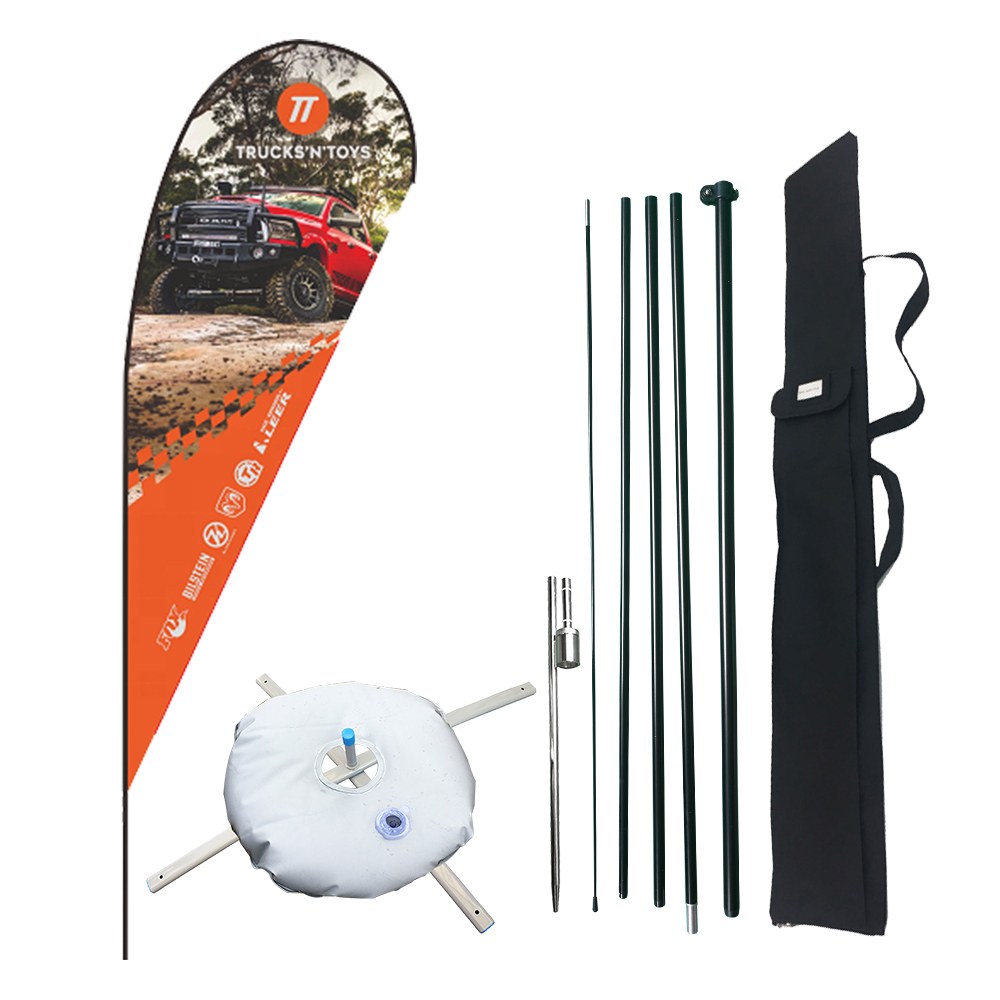
One flag pole kit, photographed flat before it ever meets a grass verge: a printed teardrop flag, five nesting pole sections, a chrome ground spike, a water ballast bag with its four cross arms, and the padded carry bag that swallows the lot. Everything a buyer needs to put a message four metres above a crowd arrives in one bag.
The category deserves a precise definition, because buyers search for it under a dozen names and get served a dozen different products. A flag pole kit, in the sense used here, is a complete flying system: a telescoping flag pole built from nesting sections, a ground spike or a flag pole base to stand it on, the flag pole hardware that grips the graphic, and a carry bag that holds the lot. It is not a ceremonial flagstaff bolted to a building, and it is not a hand-held banner on a stick. It is the advertising flag pole of the event trade — the flag pole hardware that puts a printed feather flag pole or teardrop flag pole graphic in the air above a parade route, a fan zone or a forecourt, comes down in minutes, and goes home in a car boot — the working definition of a portable flag pole. Buyers who search feather flag pole, teardrop flag pole or portable flag pole — or simply flag pole kit — are almost always looking for this exact bundle; the wise ones buy it as a kit, matched at the factory, rather than assembling a pole from one supplier and a base from another and discovering at the venue that the two were never meant to meet.
What is actually in the bag
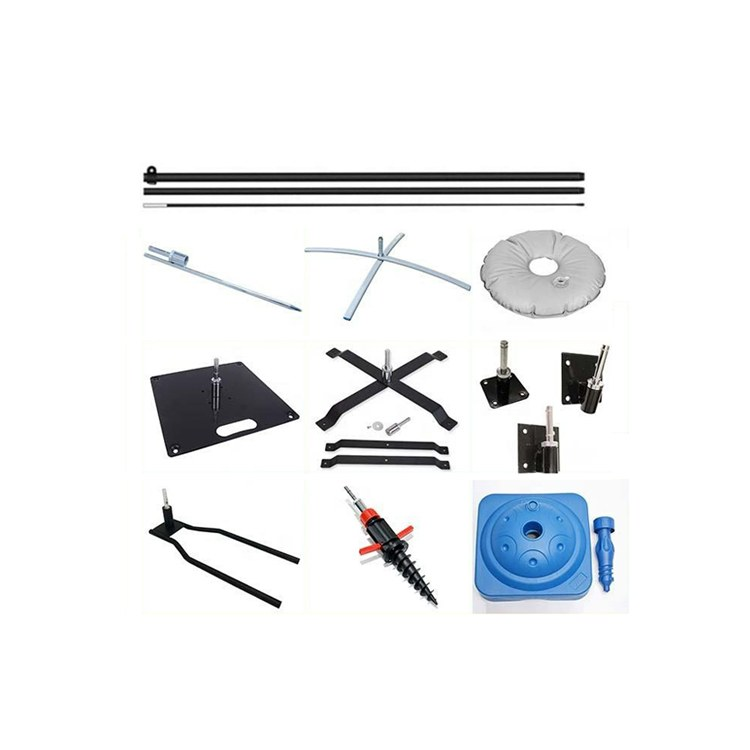
Open the carry bag and the engineering is legible at a glance. The pole itself breaks into five nesting sections of decreasing diameter — telescoping flag pole construction, the same logic as a tent pole — so the packed telescoping flag pole length equals the longest section rather than the assembled height. Each telescoping flag pole section slides into the next with a controlled interference fit that tightens as the pole flexes in the wind; assembled, the sections form a tapering spar that bends rather than snaps. At the foot sits the ground spike: a chrome-plated steel point driven into grass or soil — the cheapest flag pole base in the range — capped with a collar on a bearing so the pole can rotate freely. Against hard standing the same pole drops into a cross base — a folding X-shaped frame in powder-coated steel that lies flat under the pole and spreads the leverage across four feet. Over the cross base goes the water ballast bag: a white PVC donut that fills from a tap, with sleeves for the base's four arms, converting a lightweight cross base into a weighted one by the simple expedient of filling it with twenty or forty kilograms of water that cost nothing to ship. Two collar clips ride the pole — each a moulded or machined ring locked by a stainless thumb screw; the collar clip is what carries the fabric ears that grip the loop sewn into the flag. And the bag itself is padded oxford cloth with a parts pocket, because a flag pole kit without its bag is a box of loose tubes that the next crew will assemble in the wrong order.
The water ballast bag in context: a white PVC donut that fills from a garden tap, four folding cross arms that slot through its sleeves, and the telescoping flag pole standing out of the centre. Empty, the whole assembly weighs a few kilograms; filled, it holds its line against a gust that would walk an unweighted cross base across the forecourt.
The commercial logic mirrors the rest of the event-equipment world: the pole and flag pole base are the asset, the flag is the campaign. Advertising flag pole hardware ordered once flies a Remembrance Sunday banner this year, a half-marathon sponsor next spring and a Black Friday promotion the weekend after — the graphic is re-printed from a template, the same portable flag pole stays in service. That is the argument every advertising flag pole buyer makes to the finance department, and it holds as long as the hardware was specified honestly in the first place. Which is what the rest of this article is about.
Fifth Avenue, 12:30 pm: the feather flag pole parade route as a buying scenario
Take the most demanding of the four events and walk it in a buyer's shoes. The New York City Veterans Day Parade, organised by the United War Veterans Council and running since 1919, is a production of genuine scale: 280-plus marching units, 20,000 marchers, 25 floats and 150 vehicles compressed onto one avenue between 26th and 48th Streets, with the day opening at 10:55 am at the wreath-laying in Madison Square Park. The colour parties carry their colours by hand, as they should — the feather flag pole is the route furniture around them. But that furniture — the staging entrances, the sponsor recognition lines, the charity checkpoint markers on their cross bases, the wayfinding for 20,000 people converging on Midtown — is portable flag pole work: row after row of feather flag pole positions planted along the kerb lines, each telescoping flag pole printed with a unit's name, a sponsor's mark or a simple section number, and each water ballast bag set up before dawn by a volunteer crew working against a street-closure clock.
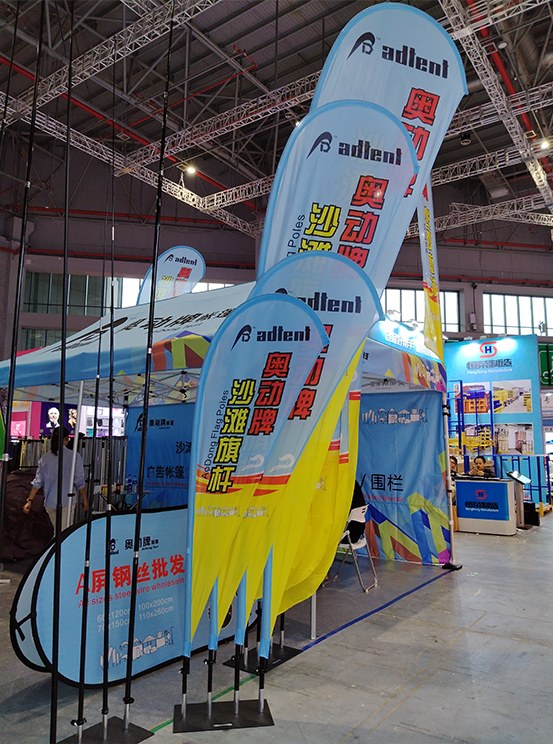
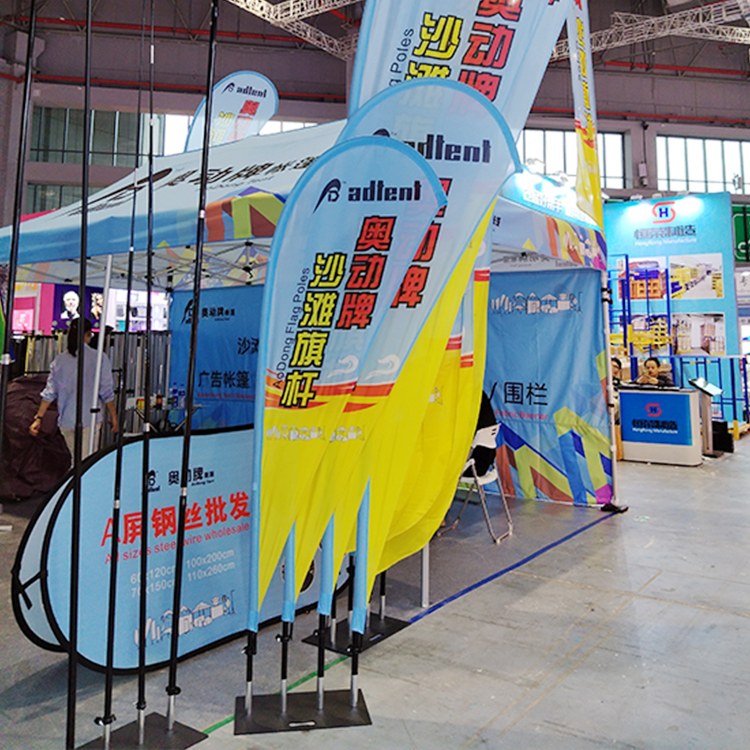
On a trade show floor, the family in its natural habitat: teardrop and feather flags on cross bases standing a line at the booth edge. Each feather flag pole is set, levelled and dressed in minutes by one crew member, which is exactly the speed a fan zone or a forecourt event demands.
Manhattan imposes the classic big-city constraint: nothing may be driven into the ground. On pavement there is no ground spike option at all — the spike needs soil — so every position stands on a cross base, and every cross base that will hold a flag four metres tall in an open avenue carries a water ballast bag over its arms. The freight arithmetic is the reason the kit exists: a volunteer crew unloads flag pole kit bags from a box truck at 5 am, carries each flag pole kit to its mark on foot, fills the ballast from a hydrant or a standpipe, and has the whole row of portable flag pole positions standing before the first rehearsal. When the parade passes, the same crew drains each water ballast bag, folds each cross base, bags and is gone before the street cleaners. A buyer who has ever staged a parade, a commencement or a charity walk recognises the pattern immediately — and recognises that the flag pole hardware that survives this duty cycle is the hardware worth specifying.
Remembrance Sunday: the quiet end of the flag pole hardware market
The British calendar supplies the opposite brief. Remembrance Sunday is not a promotional environment; it is a commemorative one, and the hardware around it must be nearly invisible in use — dignified, matte, correct. Town councils, parish churches, scout groups and Royal British Legion branches line procession routes and church paths with banners for guide units, ex-service associations and local charities — a feather flag pole at the church gate, a teardrop flag pole at the hall door — and the standard solution is a black telescoping flag pole on a ground spike driven into the verge, flying a printed banner at a respectful height — a cross base takes over where the verge is paved. The buyer here is often a volunteer facilities officer ordering once and storing for years, which changes the specification: the collar clip must turn smoothly after eleven months in a storeroom, the pole sections must not corrode in their carry bag, the water ballast bag must not crack in a frost store, and the ground spike must go into turf that has been rained on since August. A flag pole base specified for this market is chosen for longevity and appearance rather than volume pricing — and the same order usually covers the Christmas lights switch-on, the spring fair and the summer fete, because the volunteer who buys one flag pole kit buys the whole civic year with it.
Perth, 13 November: the coastal wind test for the teardrop flag pole
Sport supplies the third scenario, and it is the windiest. On Friday 13 November, Perth Stadium hosts Australia against England in the first one-day international of the summer — the opener of a schedule that rolls on through Adelaide and Hobart and into a Twenty20 series from the 21st, with a four-Test series against New Zealand following in December and January — four more weekends of portable flag pole work. Around every international ground in the country sits a fan economy: hospitality terraces, merchandise marquees, broadcast compounds and supporter zones — every one of them flying on a flag pole base or a ground spike. Perth adds a meteorological detail that every exhibitor on the Swan River learns fast — the afternoon sea breeze, which arrives on summer days with enough force to turn an under-ballasted advertising flag pole into a lever on its own cross base. The teardrop flag pole answer is engineering, not weight alone: the rotating collar under the pole lets the graphic weathervane in the gusts instead of presenting a rigid sail, the tapering pole flexes and sheds load, and the water ballast bag over the cross base supplies the downforce that the ground spike gets free from the turf. Hospitality buyers standardise the arithmetic — teardrop flag pole area, portable flag pole height, ballast litres — written on the run sheet, checked against the forecast, signed off before the gates open.
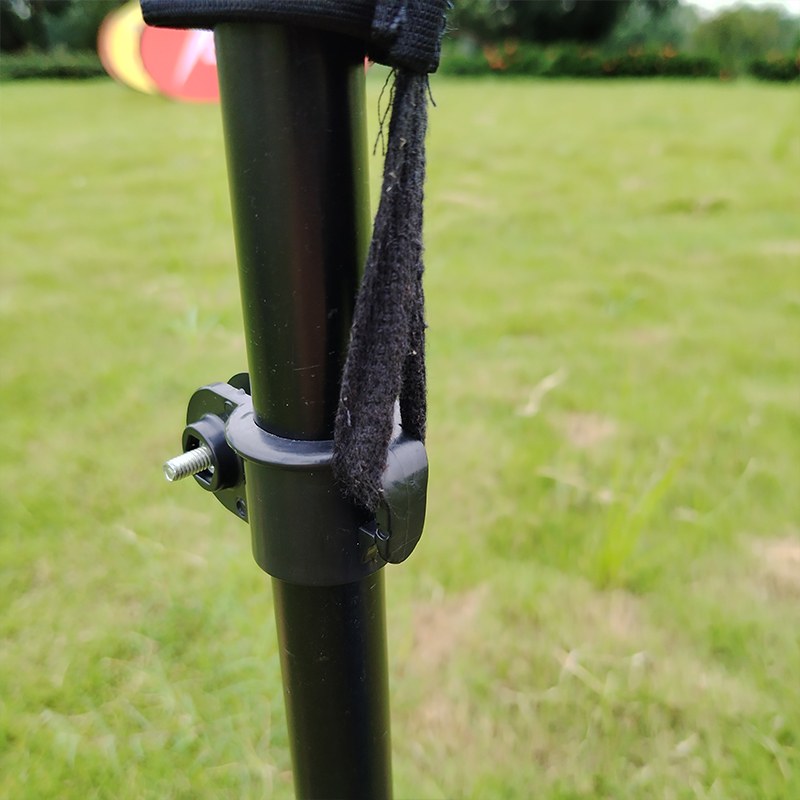
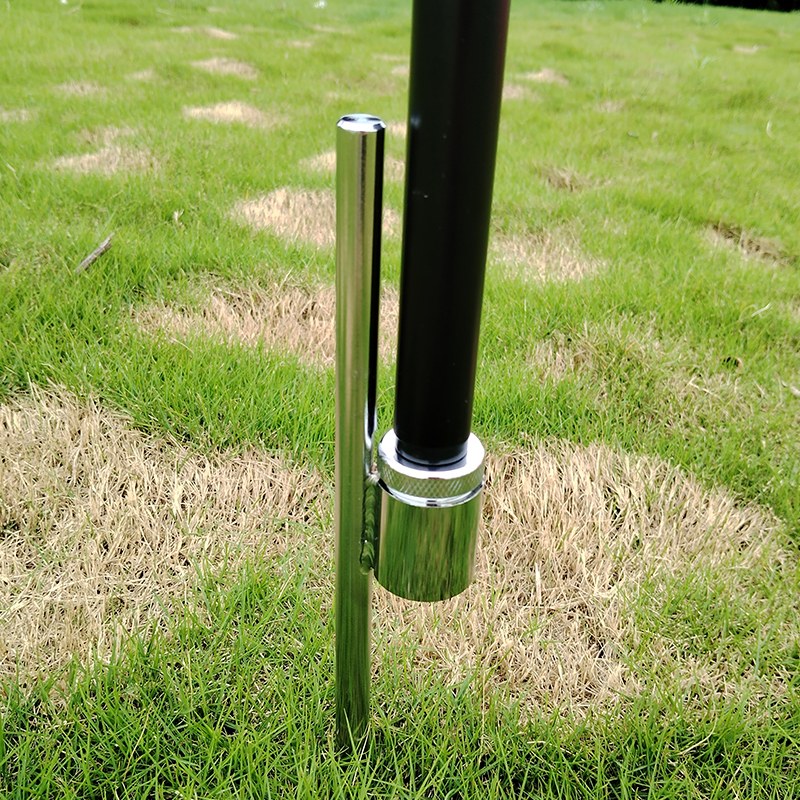
The chrome version of the same idea: a machined collar clip riding on a bearing so a teardrop flag pole can rotate in the wind instead of fighting it, with the flag's fabric loop hanging free. Fittings this small are where a feather flag pole earns or loses a season.
The fan-zone buyer has one more requirement the catalogue rarely mentions: speed between crowds. A zone that hosts a morning family session and an evening match re-dresses at the interval — collar clips dropped, one teardrop flag pole graphic swapped for another, the same feather flag pole re-flown on the same cross base in the time it takes the queues to reverse direction. Hardware that needs tools for a graphic change simply does not get invited back.
The forecourt economy: Black Friday and the portable flag pole dealership row
The fourth scenario is the least glamorous and the largest by unit volume. Black Friday on 27 November — with Small Business Saturday behind it over the weekend — is the one date in the retail calendar when even the most conservative operators put graphics in the open air. The typical dealership or retail park deployment is a row: six or ten portable flag pole positions along the road frontage, one advertising flag pole per bay, each flying a printed teardrop flag pole banner or a rectangle, up on Thursday night, down by Sunday evening, every ground spike back in the same carton. On grass verges the ground spike does the whole job in thirty seconds. On pavers and asphalt, the folding cross base with a water ballast bag stands in — and because Black Friday weekend weather runs from calm to gale depending on the continent, the base decision is a site-survey decision, not a catalogue default. Retail buyers who treat the row as a system get the long life out of it: matched heights, matched bases, spare ground spike and collar clip fittings in the same carton, and graphics printed on one template so any flag flies on any flag pole hardware in the row.
The fleet view: portable flag pole positions standing in a line on concrete, every one on a cross base. Rows like this line fun runs, fan zones and forecourts; the bases nest for storage and the poles drop into one carton between events.
Choosing the flag pole base: three surfaces, three answers
Because the flag pole base is where kits are won and lost, the decision deserves its own section. Three surfaces, three answers:
Grass, soil, turf — the ground spike. Fastest to deploy, cheapest to ship, invisible when in use; drive the ground spike at a slight angle away from the expected wind, and keep a spare ground spike on the truck because spikes bend when they meet rocks and roots.
Concrete, pavers, asphalt — the folding cross base. The cross base lies flat, sets level in a minute, folds to a slab for freight; on its own it is an indoor and calm-weather stand.
Hard standing in wind — cross base plus water ballast bag. The water ballast bag sleeves over the base arms and fills on site; weight arrives as tap water rather than as freight — the entire economic trick of a ballasted cross base.
Indoor halls — a cross base alone, no ground spike permitted. Venue floors forbid both spiking and spillage, so each water ballast bag is ordered empty and padded, or the base is specified in a heavier gauge.
Mixed sites — buy the kit with both attachments. A telescoping flag pole that drops onto a ground spike or into a cross base covers every venue on a season's calendar without a second purchase order.
The telescoping flag pole itself: what the sections do not tell you
Two telescoping flag pole sets of the same assembled height can be different products, and the difference between one advertising flag pole and another hides in three details. The first is section wall thickness: a feather flag pole that survives a season of set-ups is thicker at the joints than a promotional giveaway pole, and the weight difference is smaller than the durability difference. The second is the collar clip system: a good collar clip must clamp positively, move one-handed, and grip the flag's fabric loop rather than the print edge — clips that bite fabric end a teardrop flag pole's graphic life early. The third is the rotating detail at the foot: on a quality flag pole kit, the collar on the ground spike or base adapter carries the pole on a bearing, so a teardrop flag pole weathervanes in gusts instead of twisting its own sections loose — the line between a cheap pole and a true advertising flag pole. Ask a supplier to assemble the flag pole kit on video and wiggle each collar clip; thirty seconds of footage predicts five years of service better than any brochure.
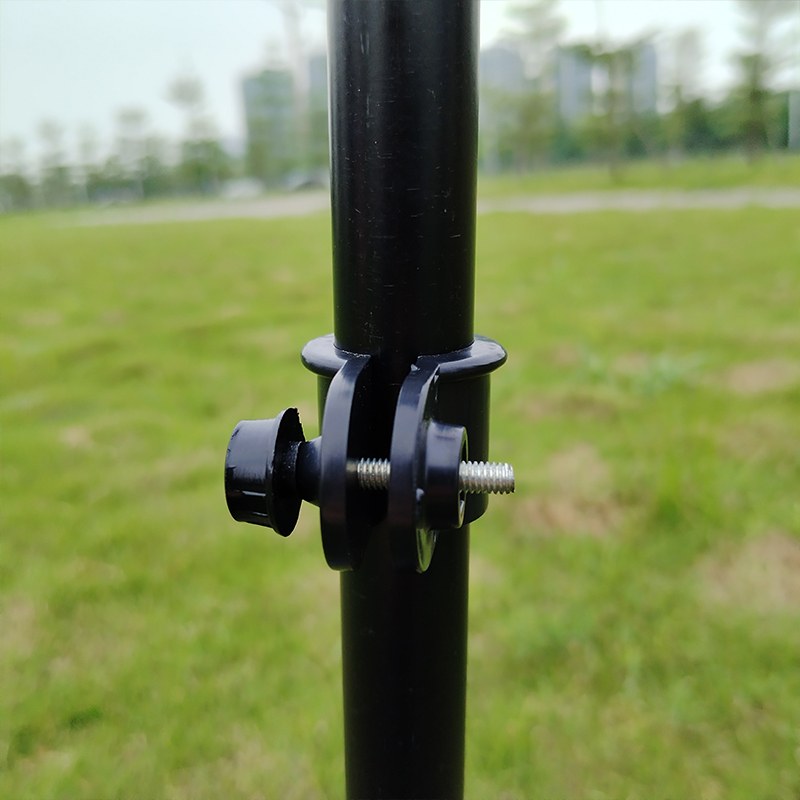
The detail that decides the daily experience: the black collar clip, locked to the pole with a stainless thumb screw, carrying two fabric ears that grip the flag loop. A collar clip moved in ten seconds re-positions the graphic between a seated audience and a passing crowd.
Height is the last decision, and it is a crowd one. A flag that flies above seated spectators can stand lower than one that must clear a standing crowd's phone-raised arms; rows along a route want every feather flag pole at a matched height for the sightline, while a single forecourt position wants maximum legal height for the sightline from the road. Because sections nest, most telescoping flag pole kits can be flown short by omitting a section — a useful portable flag pole trick on a windy site that buyers should confirm rather than assume.
Wind, ballast and the honest numbers
Every conversation about advertising flag pole hardware and flag pole base ballast eventually arrives at wind, and the honest framing is flag pole hardware arithmetic rather than adjectives. Leverage grows with teardrop flag pole area and pole height; downforce grows with ballast weight; the question is whether the second number covers the first on the worst day the site will actually see. A water ballast bag filled to capacity adds its rated mass at almost zero shipping cost, which is why the water ballast bag over the cross base has become the default for outdoor hard standing. Buyers should ask three questions and write the answers on the run sheet: what flag area is the base-and-ballast combination rated for; what gust speed means each portable flag pole comes down rather than rides through; and what does the supplier's warranty say about wind damage — because a warranty that excludes the actual failure mode is not a warranty.
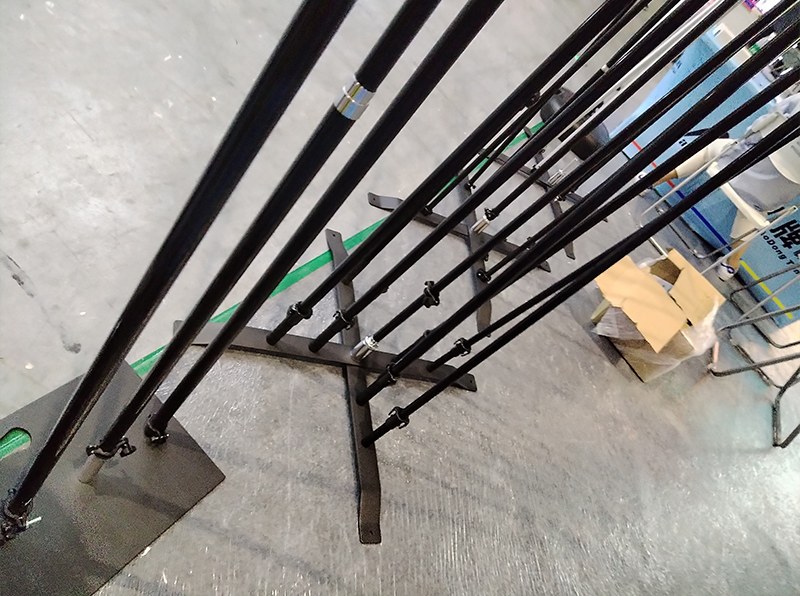
A row of folding cross bases in powder-coated steel, each holding a telescoping flag pole upright on a warehouse floor. The cross base is the quiet workhorse of the flag pole kit family: it folds flat for freight, sets down level on hard standing, and takes a water ballast bag over its arms when the site offers no grass for a ground spike.
Freight, storage and the carry bag: the flag pole kit economics
The flag pole kit commercial case closes in the storeroom. Packed, a complete flag pole kit reduces to one padded oxford bag of a few kilograms, and a season's fleet of twenty positions reduces to a pallet of portable flag pole bags plus a carton of cross base frames. The nesting pole design is what makes the number work: five sections collapse to the length of the longest, and the carry bag's internal pockets separate pole sections, collar clips, ground spike and fittings so a volunteer assembles the flag pole kit in order rather than by trial. Rental companies shelve each flag pole kit by event; councils store them between civic dates; dealerships keep theirs behind the service counter between weekends — one carry bag, one ground spike, one cross base, each in its pocket. The buyer's rule of thumb: if the packed kit cannot be carried one-handed by the person who has to set it up, the wrong kit was bought.
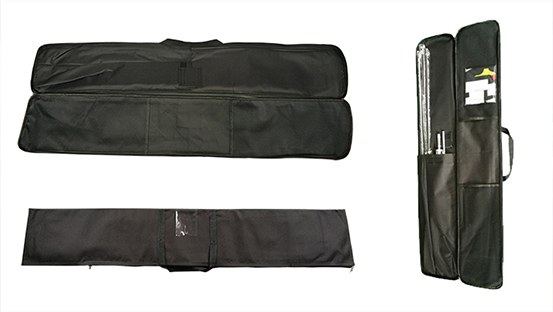
The freight story in three views: the padded oxford carry bag zipped flat, rolled, and open with the pole sections and fittings in their pockets. A packed flag pole kit travels as ordinary parcels, rides in a hatchback and shelves in a storeroom between campaigns.
The inspection bench: ten flag pole kit checks before the season
Whichever events a buyer serves in November, the same ten-minute bench inspection predicts how the hardware will behave in the field. Run it on a sample before the order ships, and again on arrival:
Assemble and strip the telescoping flag pole five times; the sections should seat firmly without binding, and the finished flag pole kit should stand without rocking at any joint.
Flex the assembled telescoping flag pole by hand; it should bend in an even arc and return straight — a set or a creak means a stressed section.
Drive the ground spike into real turf once and pull it; a straight spike is a flag pole base you can trust, and the collar should still spin freely.
Open and fold the cross base ten times; hinge rivets should stay tight, the feet should sit level, and a water ballast bag should sleeve over the arms without a fight.
Fill the water ballast bag at a tap and leave it overnight on a hard surface; a seeping water ballast bag is a Saturday-morning failure you can catch on Friday.
Work each collar clip end to end; a good collar clip clamps positively one-handed and its fabric ears grip a flag loop without cutting it.
Spin the pole on its base bearing; a teardrop flag pole should rotate freely under hand torque with no grinding.
Check every fabric edge and stitch line of the flag itself; the graphic is the consumable, and its wear cycle sets the re-print rhythm for the whole feather flag pole fleet.
Pack the complete flag pole kit back into the carry bag; if every collar clip and ground spike does not have a pocket, crews will lose them by week two.
Weigh and measure the packed bag and put those numbers on the purchase order — they decide the freight cost of every flag pole kit and the storage shelf.
The fleet ratios matter as much as the individual checks. Operators who run rows of portable flag pole positions standardise on: one spare ground spike per five positions; one spare collar clip set per five poles; one spare telescoping flag pole section per ten poles, matched to the most-stressed mid-pole diameter; one carry bag kept with every kit, never shared; and every flag in the fleet printed from one stored template so any graphic flies on any cross base or ground spike in the row. The ratios cost less than the courier fee for the urgent Saturday-morning replacement they make unnecessary — the arithmetic that keeps a feather flag pole fleet flying.
The questions serious buyers put to suppliers compress into a short list, and suppliers who answer without hesitation are usually the ones whose flag pole hardware passes the bench test. Ask what the telescoping flag pole sections are made of and what wall thickness at the joints; ask the assembled and packed heights, and whether the kit flies short with sections omitted; ask which flag pole base attachments are supplied and what flag area the water ballast bag combination is rated for; ask whether the collar under the ground spike or cross base rotates on a bearing; ask how the flag attaches to the collar clip and whether replacement flags can be ordered separately against a template; ask what the carry bag contains and whether spare-parts kits are a line item; ask the minimum order quantity — for this family it is a single kit, which lets an operator prove one portable flag pole position across one event before ordering the row; and ask the e-proof and sample lead time, which for a stock flag pole kit runs one to three days.
Three buying mistakes account for most of the disappointment in this category. The first is buying the pole and the flag pole base from different suppliers: a flag pole base that was never engineered with its pole will fit badly, ballast badly or both — no ground spike will rescue it — and no single vendor owns the failure. The second is buying on assembled-height photography alone — two kits can look identical flying and differ completely in joint fit, collar clip quality and bearing action, so insist on the bench inspection video of the actual flag pole kit. The third is treating the flag as permanent: the graphic is a consumable with an event-by-event replacement rhythm, and the buyer who orders one flag per advertising flag pole has bought a display, not a system — the template on file is what turns next month's campaign into a re-print instead of a re-purchase.
The November arithmetic, and the order that covers it
Set the month's four events side by side and the arithmetic is visible. A council that flags its Remembrance Sunday route on the 8th with a ground spike at every kerb, an agency that lines a Fifth Avenue checkpoint on the 11th, a hospitality group that dresses a Perth fan zone on the 13th with a water ballast bag under every teardrop flag pole and a dealership that rows its forecourt on the 27th are all buying the same flag pole kit: one kit per position, a water ballast bag per hard-standing site, a ground spike per grass site, and a printed flag per campaign. Buy the portable flag pole system once, re-print the flag per event, and the cost per advertising flag pole position falls every time the calendar turns — which is why operators who bought one flag pole kit for one November find themselves flying the same hardware at spring marathons, summer festivals and autumn fairs, year after year.
Ordering is deliberately unexotic. The range photographed here is available from a Foshan-based manufacturer shipping EXW and FOB through the Guangzhou–Shenzhen–Foshan ports, with a minimum order quantity of one flag pole kit, electronic artwork proofs and samples in one to three days for stock shapes, with a feather flag pole or teardrop flag pole graphic printed to match, plus full custom flag printing from supplied templates. Every flag pole kit ships packed in its carry bag, which means a Remembrance Sunday flag pole kit order placed this week is a production schedule rather than a gamble — and the Black Friday graphics ordered today fly on the same poles that will carry the January sale, the spring fun run and next year's parade, one re-print at a time.
Every November the crowds gather in three countries inside one fortnight, and every November the same quiet flag pole hardware stands above them, holding somebody's message straight against the weather on its collar clip and bearing. The advertising flag pole does not headline any of these events. It stands at the kerb on its cross base, printed with somebody else's name, turning gently on its bearing, coming down before the street sweepers arrive — and then it does it all again the next weekend, in a different town, for a different cause, in a different wind, on a different ground spike. That is what well-specified equipment looks like: invisible on the day, irreplaceable by the second one.
— keyword density report (longest-match, non-overlapping) —
word_count=4207 total_keyword_phrases=211 density=5.02% per-keyword: flag pole kit=26, feather flag pole=14, teardrop flag pole=14, telescoping flag pole=15, advertising flag pole=13, portable flag pole=17, flag pole base=12, ground spike=29, cross base=27, water ballast bag=18, flag pole hardware=10, collar clip=16
Event dates verified 27 October 2026. Remembrance Sunday 2026 falls on Sunday 8 November (the second Sunday of November). The New York City Veterans Day Parade returns to Fifth Avenue on Wednesday 11 November 2026, stepping off at 12:30 pm from 26th to 48th Street with more than 280 marching units, 20,000+ marchers, 25+ floats and 150+ vehicles, after a wreath-laying at 10:55 am at the Eternal Light Flagstaff in Madison Square Park; the parade has run since 1919 and is organised by the United War Veterans Council (nycvetsday.org; uwvc.org). Australia v England, the first one-day international of the 2026-27 Australian summer, is played at Perth Stadium on Friday 13 November 2026, with further ODIs on 15 November (Adelaide) and 18 November (Hobart) and Twenty20 internationals from 21 November; a four-Test series against New Zealand follows from 9 December (wa.gov.au). There is no Ashes series in the 2026-27 summer; the 150th Anniversary Test between Australia and England is scheduled for the MCG on 11-15 March 2027. Black Friday falls on Friday 27 November 2026, after US Thanksgiving on Thursday 26 November. Product descriptions are taken from the supplier's range documentation: telescoping multi-section flag poles with chrome ground spike (rotating collar), folding steel cross base, fillable PVC water ballast bag, thumb-screw collar clips and padded oxford carry bag; minimum order quantity one piece, e-proof and sample lead time 1-3 days, shipped EXW/FOB via the Guangzhou-Shenzhen-Foshan ports.