


The fortnight the world faces a wall: from NBA opening night to the Breeders' Cup, every champion stands in front of the same fabric pop-up display stand
New York, this evening: the NBA's 2026-27 season tips off with a tripleheader, and every postgame interview will stand against a printed fabric backdrop on an expandable banner stand frame. From Saturday, Allen, Texas, hosts the Swiss stage of the League of Lines world championship, whose final reaches Brooklyn on 14 November behind a final-weekend fleet of fabric backdrops. On 30-31 October, Keeneland in Lexington, Kentucky runs the 43rd Breeders' Cup World Championships. Three sports, three production budgets, one shared piece of hardware behind every podium shot and every photo backdrop wall: the expandable fabric wall that folds into a carry bag — and the Q4 season of Santa photos, weddings and town halls that follows it.
NEW YORK / ALLEN, TEXAS / LEXINGTON, KENTUCKY — 20 October 2026
Sport has a habit of hiding its most reliable supplier in plain sight: the fabric pop-up display stand, the expandable banner stand that stands behind every winner. Tonight, Tuesday 20 October, the NBA's 2026-27 regular season opens with a tripleheader on NBC and Peacock, and every arena has spent the day hanging its pop-up display walls and fabric backdrops: the Boston Celtics visit the Detroit Pistons in the afternoon, each pregame media session framed by a fabric backdrop, the defending champion New York Knicks host the Philadelphia 76ers at Madison Square Garden, with a sponsor wall behind every microphone, and the San Antonio Spurs meet the Oklahoma City Thunder in San Antonio. From Saturday, the League of Lines world championship — the most re-dressed set in this autumn's calendar, running under the banner ‘This Is Our Moment’ — brings its Swiss stage to the Credit Union of Texas Event Center in Allen, Texas, ahead of knockout rounds in early November and a grand final at Barclays Center in Brooklyn on 14 November, where the champion's first interview follows a walk down a sponsor's fabric backdrop corridor. And on the last weekend of the month, the 43rd Breeders' Cup World Championships assemble at Keeneland in Lexington, Kentucky — fourteen Grade 1 races and more than thirty-four million dollars in purses across two afternoons of wall-to-wall fabric backdrops. Different sports, different crews, different continents of fans — and one pop-up display wall standard behind all of them. But watch the footage closely and the same object — a fabric pop-up display stand — stands behind every winner, every press conference and every media scrum: a printed fabric backdrop, dead flat, dead matte and perfectly lit, held square by an expanding lattice frame. The industry calls it a fabric pop-up display stand, and the fortnight now starting is the clearest demonstration of why the event backdrop category exists at all — and why its order books fill every October.
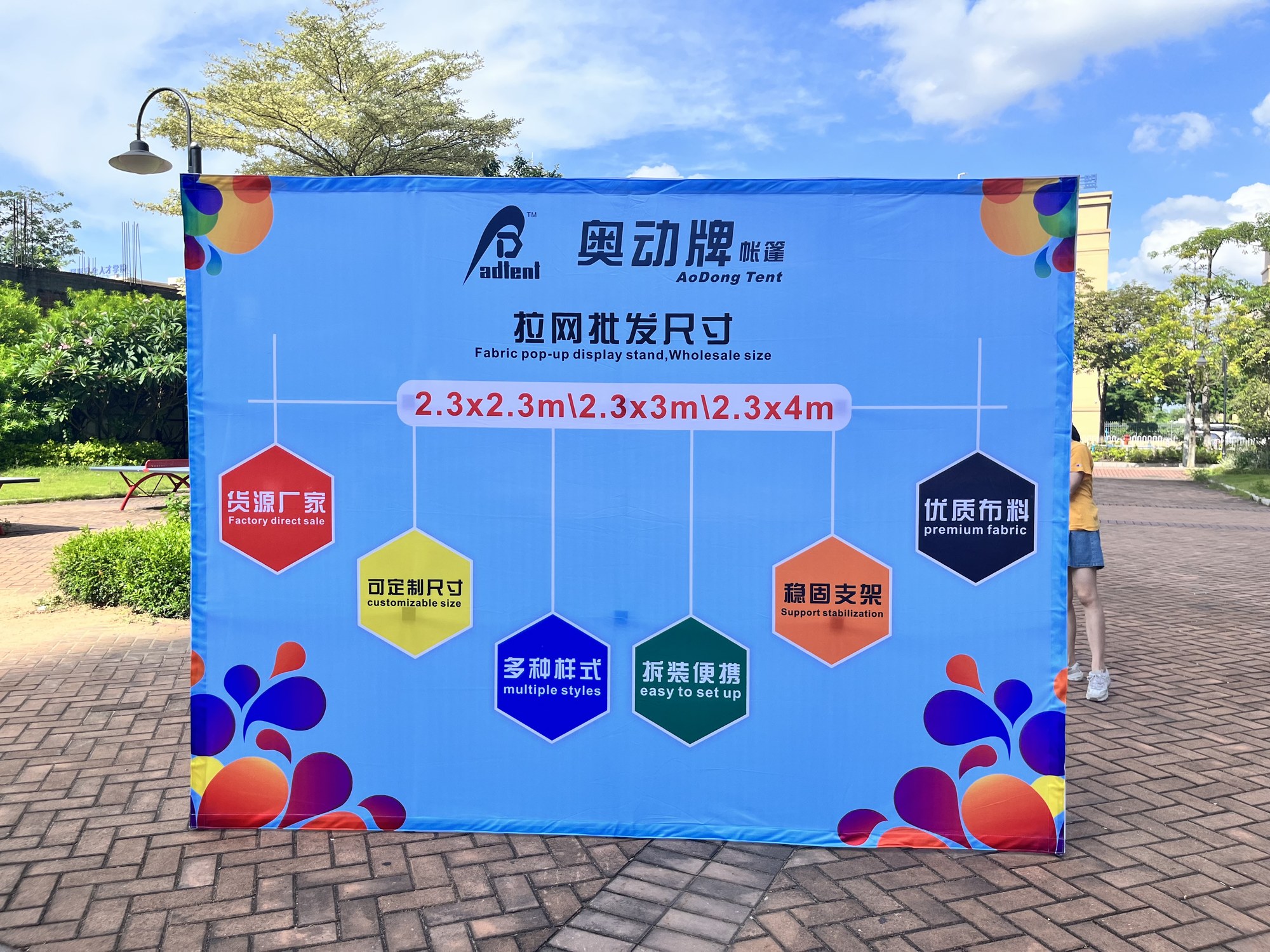
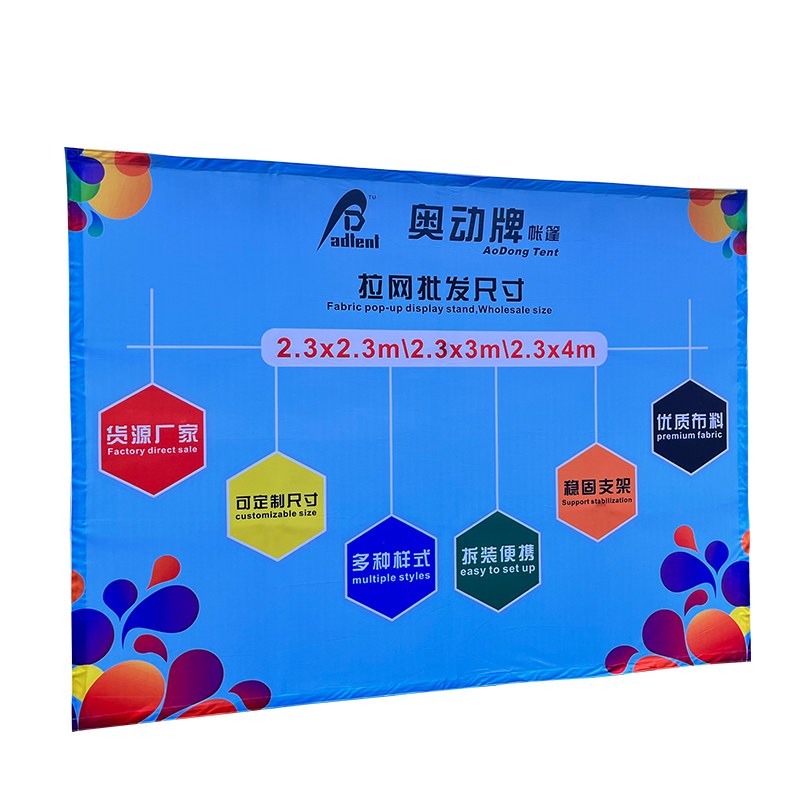
The product doing the work this fortnight: a 2.3x4 m fabric pop-up display stand photographed on open ground, its full-dye printed wall carrying the size range — 2.3x2.3 m, 2.3x3 m and 2.3x4 m — the way a winner's wall carries sponsors.
The commercial logic of the fabric pop-up display stand is easy to state. A production company, a league office or a sponsorship agency can build a hard wall, hang a vinyl banner, hire a set — or spec a trade show backdrop — or own one expandable banner stand, printed with the sponsor's identity, carried by one person, opened into a photo backdrop wall in a couple of minutes, and re-dressed with a fresh fabric backdrop whenever the campaign changes. The frame of the pop-up display wall is the asset and the fabric is the consumable, and that split shapes everything about how the category is engineered: scissor lattices that open without tools into a standing fabric pop-up display stand, graphics that grip the rails along a continuous velcro edge, connectors moulded in ABS rather than printed in brittle styrene, and packed sizes that turn the pop-up display wall into hand luggage: a bundle that survives a service lift, a hatchback and a transatlantic flight. It also explains the ordering pattern of the expandable banner stand: buyers do not purchase one for a single event, they purchase it for a season of events — and October and November, with their championships, their award dinners and their retail photo seasons — peak weeks for the photo backdrop wall — are the densest stretch of that season, and the reason a fabric pop-up display stand is quoted in October for delivery before the medals.
New York, this evening: opening night and the fabric backdrop interview wall
The NBA's opening night is a useful place to start because the photo backdrop wall does its work before the first broadcast camera cuts away. Hours before tip-off, each arena's media row is dressed with a pop-up display wall per position: the fabric backdrop behind the coaches' pregame remarks, the scrum wall — a second fabric pop-up display stand — where the two head coaches answer the travelling press, and the mixed-zone photo backdrop wall along which players file past microphones after the final buzzer — three pop-up display positions, three sponsors, one fabric spec. Every one of those surfaces carries a sponsor's logo on a fabric pop-up display stand, and every one of the fabric backdrops is photographed, streamed and clipped within minutes. What the camera cannot tolerate on a fabric backdrop is gloss: a vinyl banner throws hot spots under broadcast lighting, creases photograph as shadows, and a reflective surface wrecks the sponsor's logo precisely where the logo matters most — dead centre of the fabric backdrop. A tension fabric backdrop solves the problem by physics — the knit fabric of the pop-up display diffuses light, photographs flat, and stretches tight enough that no wrinkle survives the zoom lens. That is why arena operations teams on both coasts standardise on the tension fabric backdrop for media availability, and why the event backdrop walls get re-printed rather than replaced when the sponsor roster changes — one fabric backdrop per sponsor per season, current through an 82-game home calendar.
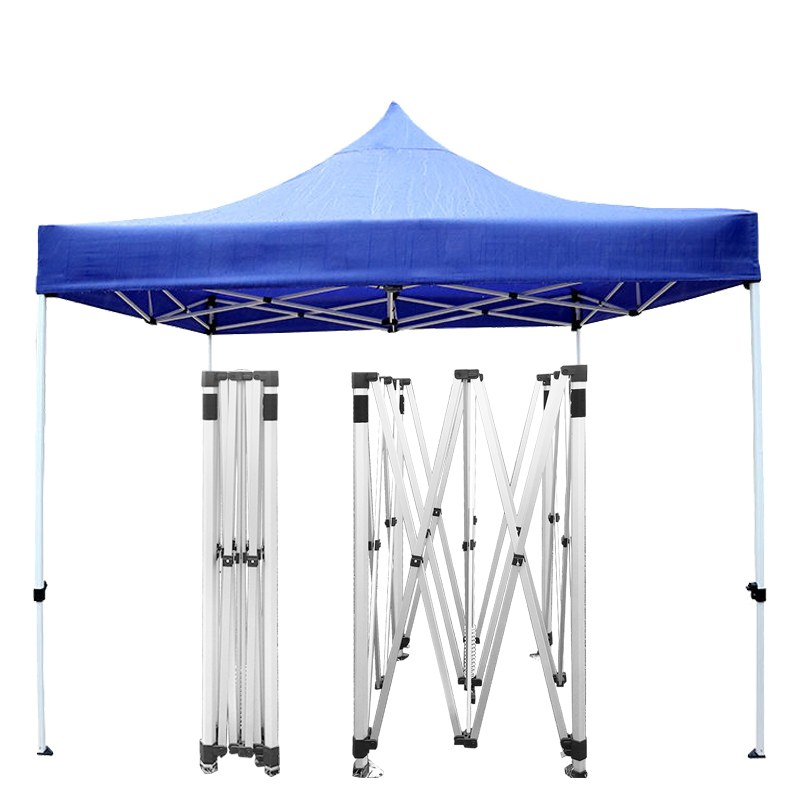
The kit a buyer actually receives: the wall dressed and standing, the same scissor frame folded into a stack, and the whole pop-up display packed into one padded carry bag. Studio graphics like this one are how agencies spec the wall into an event plan.
The buyer view from an arena or a team is a fleet view, not a single pop-up display purchase. A professional franchise runs multiple photo backdrop wall positions per home date — podium, mixed zone, sponsor activations, and the step and repeat backdrop reserved for community nights and season awards — and the inventory decision for the pop-up display fleet is always the same: enough expandable banner stand frames to cover a game night and a community day in the same week, enough spare fabric backdrops to cover a mid-season sponsor change, and frames light enough that one stagehand moves each pop-up display. This is where the expandable banner stand earns its keep over fixed frames: the lattice of the pop-up display collapses into a bundle, the bundle rides a hand truck, and a four-metre wall goes from case to camera-ready in the time it takes the room to fill. Teams that cheap out on the second photo backdrop wall learn the cost during the first doubleheader week, when the same wall is needed in two rooms at once — and one more expandable banner stand suddenly looks like the cheapest line in the budget, with a spare fabric backdrop a close second.
Allen, Texas, from Saturday: esports and the two-week pop-up display set
No industry re-dresses a venue faster than competitive gaming, and no buyer cycles a fabric pop-up display stand harder. The world championship now assembling in Texas is the sharpest test in the calendar. The tournament opened with its play-in stage in Los Angeles on 15 October; from Saturday, 23 October, the Swiss stage runs at the Credit Union of Texas Event Center in Allen, with a second Swiss window from 28 to 31 October; the knockout rounds — quarterfinals and semifinals — return to Allen from 3 to 8 November; and the final moves to Barclays Center in Brooklyn on 14 November. Each stage change means a new city, a new floor plan and a new map of sponsor fabric backdrops, executed on load-in windows measured in hours — the pop-up display's home territory. The production crew's answer is modularity — the expandable banner stand above all: a bay of its frames dressed in printed fabric panels, re-dressed overnight whenever the bracket shrinks and the sponsor lineup changes, the classic pop-up display workflow. When the semifinal field is known on Sunday night, the finalist event backdrops are printed and hung before Monday's rehearsal — the frame of the expandable banner stand never moves, the fabric does, and the final week's print run is quoted in fabric backdrops, not construction days.
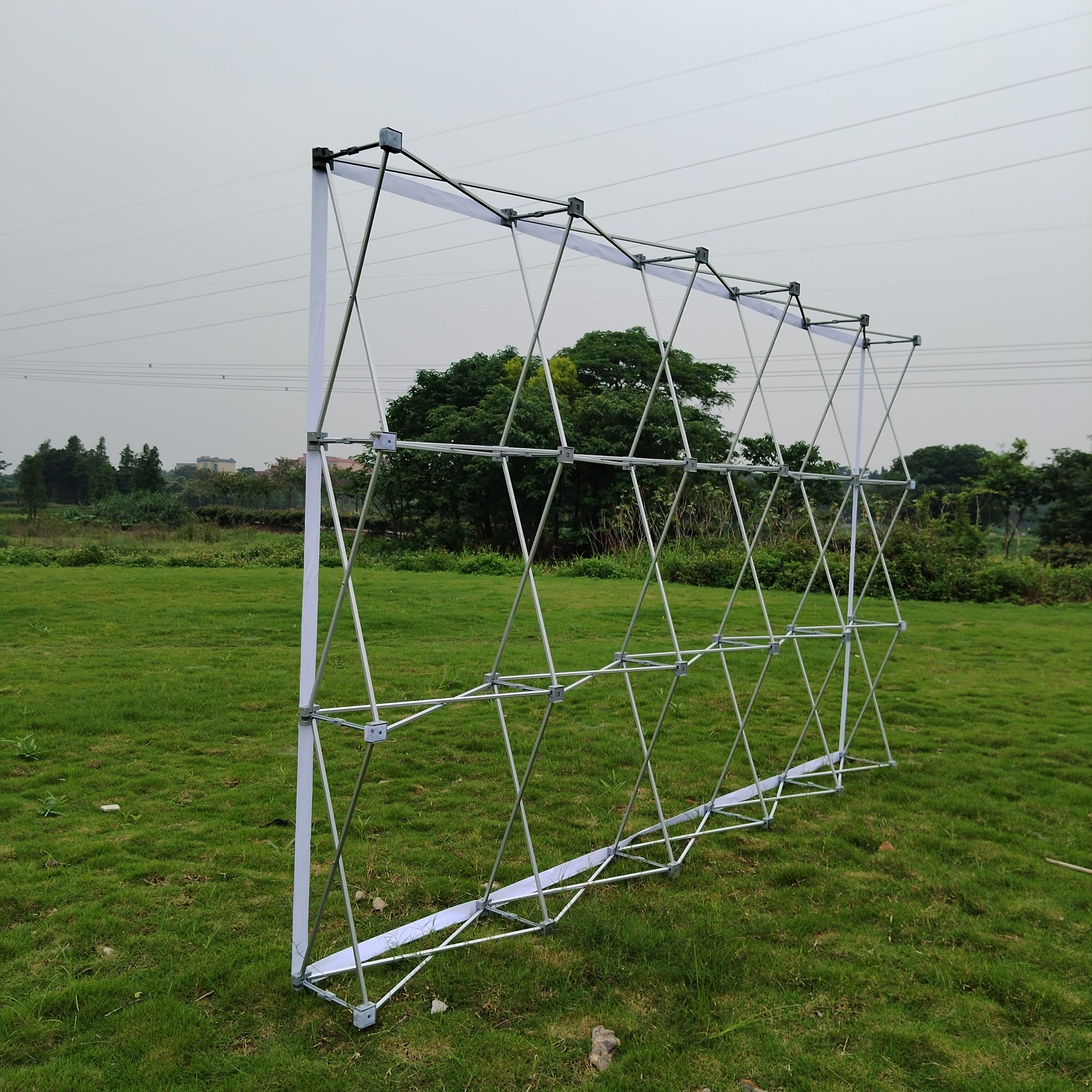
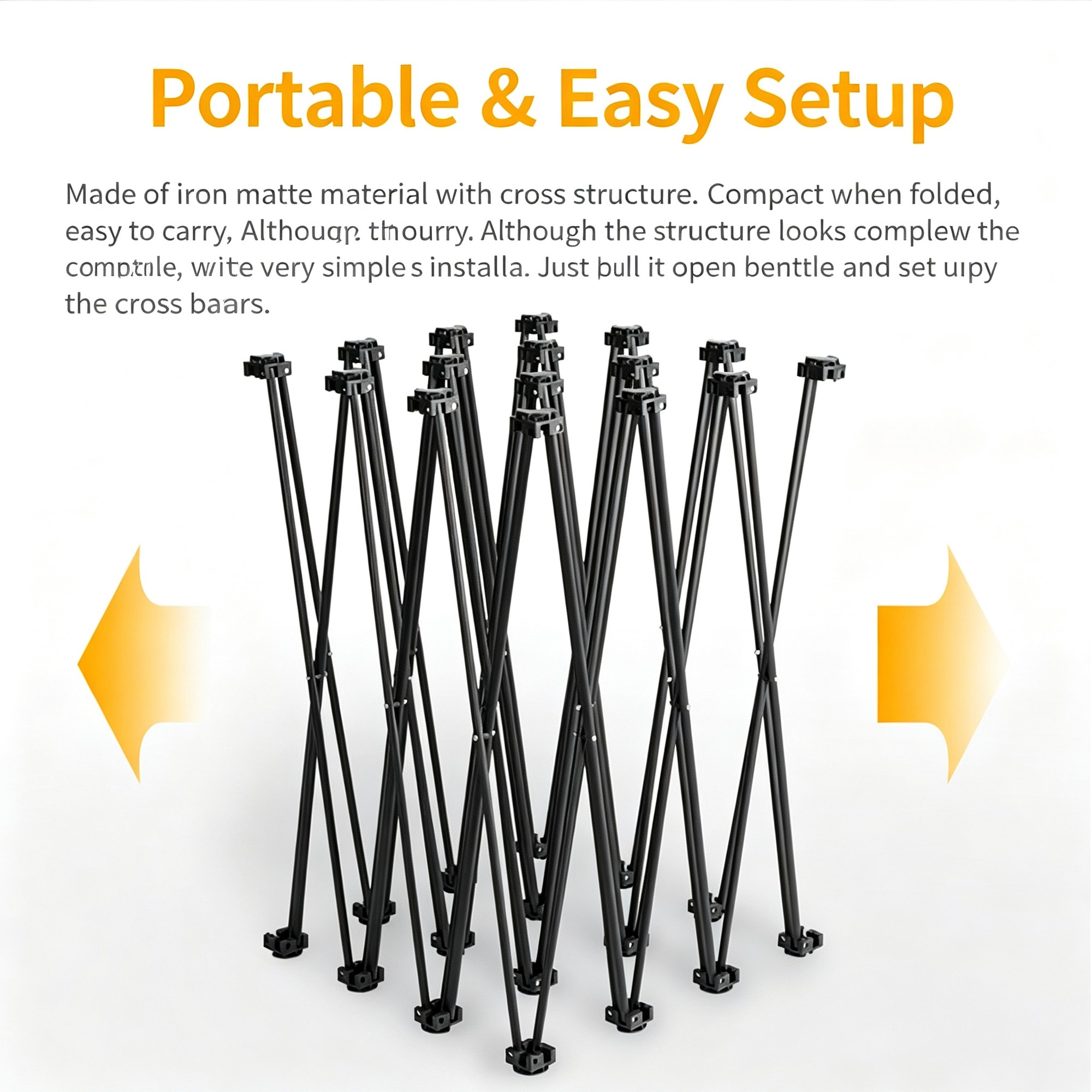
The bare scissor lattice before the graphic goes on: an expandable banner stand frame opening like a garden trellis. The frame is the asset — it serves for years — while the printed fabric that stretches across it is the consumable, re-printed for every campaign.
For the agencies that supply esports production, the purchase maths for the fabric pop-up display stand is unusually transparent. One expandable banner stand frame serves the entire circuit year after year; the graphics per event are dye-sub prints on 230-gram elastic fabric that roll, pack and launder — a fresh fabric backdrop per stage at printing cost, not construction cost. The consumable logic is the same one that governs trade show programs, and it is why the same supplier relationships run across both worlds: an esports organiser buying event backdrop graphics in sets of six, a trade exhibitor buying one trade show backdrop a year, and both trusting the same expandable banner stand hardware. The inspection points for a trade show backdrop are identical too — connector quality, rail straightness, foot stability — because the wall that holds a sponsor's logo on a broadcast stage is, mechanically, the same trade show backdrop that holds it on a convention floor.
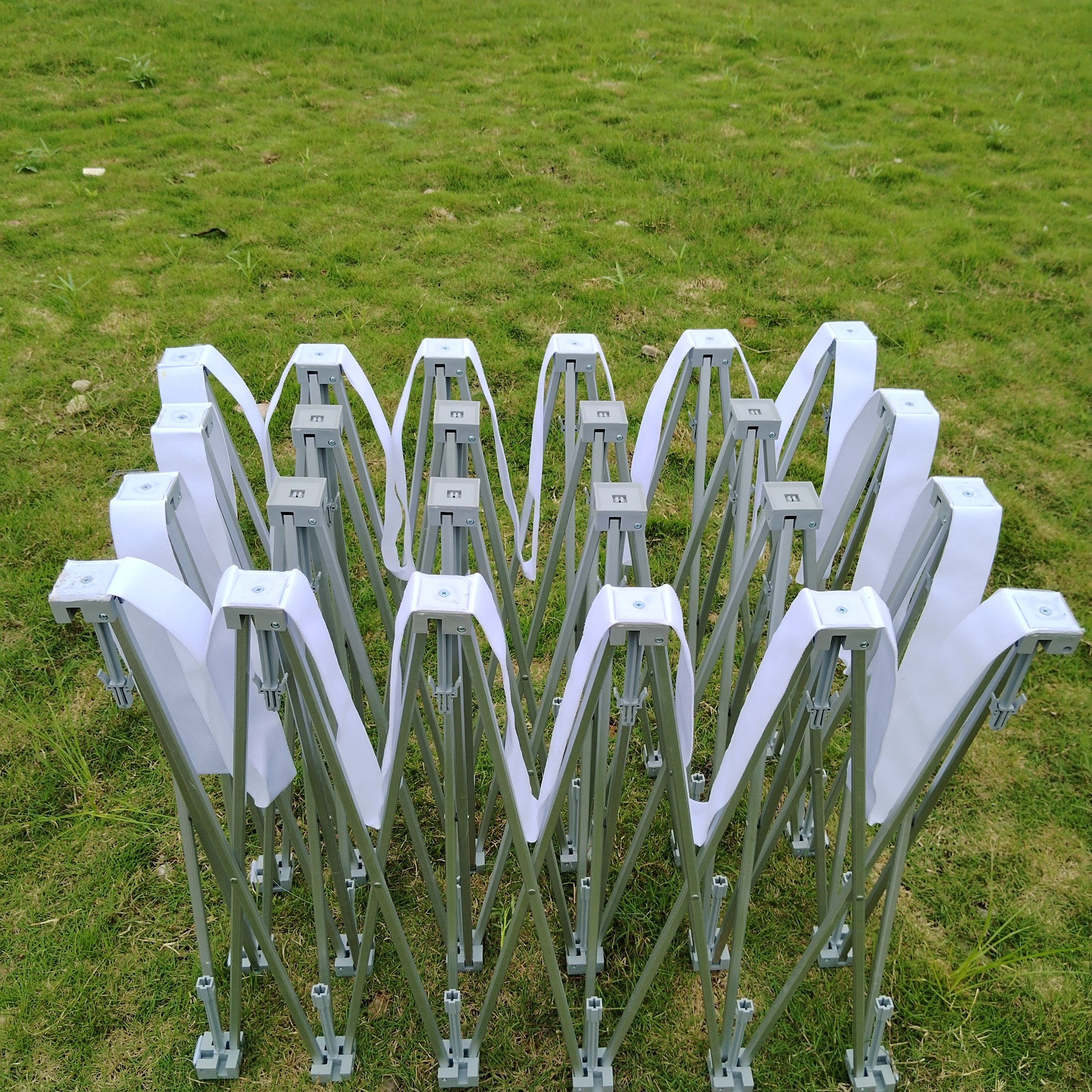
The folded bundle is the freight story: an entire trade show backdrop collapsed to a third of its standing height and bound for the carry bag. Venue changeovers are measured in these bundles — two of them move a four-metre wall up a service lift on a hand truck.
Freight is the quiet half of the esports story, and the pop-up display wall is its punchline. A knockout stage in Texas followed by a final in Brooklyn means the entire scenic package — frames, fabric backdrops, floors and screens — moves twice in ten days, and the difference between a scenic package that fits a sprinter van and one that needs a curtain-side truck is decided at design time, usually the moment someone specifies a pop-up display wall instead of a hard set. A fabric pop-up display stand packs to a third of its standing height; four fabric pop-up displays, a spare graphic set and the bagged frames fit where a hard-set wall would need its own pallet row. Production managers who specify the expandable banner stand for the interview positions routinely discover they have also solved the load-in problem for everything else — the step and repeat backdrop for the trophy photo, the branded corridor for the fan entrance, the press wall for the winner's interview — because one fabric pop-up display stand family covers all four jobs, the quiet arithmetic behind every event backdrop schedule.
Lexington, 30-31 October: the Breeders' Cup and the winner's circle photo backdrop wall
The fortnight's most traditional event supplies the tension fabric backdrop and the fabric pop-up display stand with their most unforgiving test. The 43rd Breeders' Cup World Championships run on Friday 30 and Saturday 31 October at Keeneland Race Course in Lexington, Kentucky — the most photographed two afternoons in thoroughbred racing — fourteen Grade 1 races, purses and awards of more than thirty-four million dollars, and the two-million-dollar Cygames Breeders' Cup Sprint headlining Saturday's card, with the 2025 Classic winner Forever Young expected to defend his title in the Longines Breeders' Cup Classic. Every race ends the same way: a winner, a trainer and an owner standing in the winner's enclosure in front of a sponsor's fabric backdrop, the sport's most valuable photo backdrop wall. The photograph of winner, trainer and owner lined up against the fabric backdrop is syndicated within minutes to outlets on four continents. The wall that works at Keeneland works outdoors — morning dew, October wind, low autumn sun — and the fabric pop-up display stand works because the specification is honest: a frame with real mass in its feet, graphics printed in the dye-sub colours that keep an event backdrop readable in daylight, and fabric that photographs flat — the whole point of a tension fabric backdrop — against grandstands and sky. Watch-parties and satellite venues across North America replicate the same event backdrop look at smaller scale, one fabric pop-up display stand per venue, printed with the event identity and pitched in the bar for two afternoons a year — proof that a fabric pop-up display stand does not need a stadium to earn its keep.
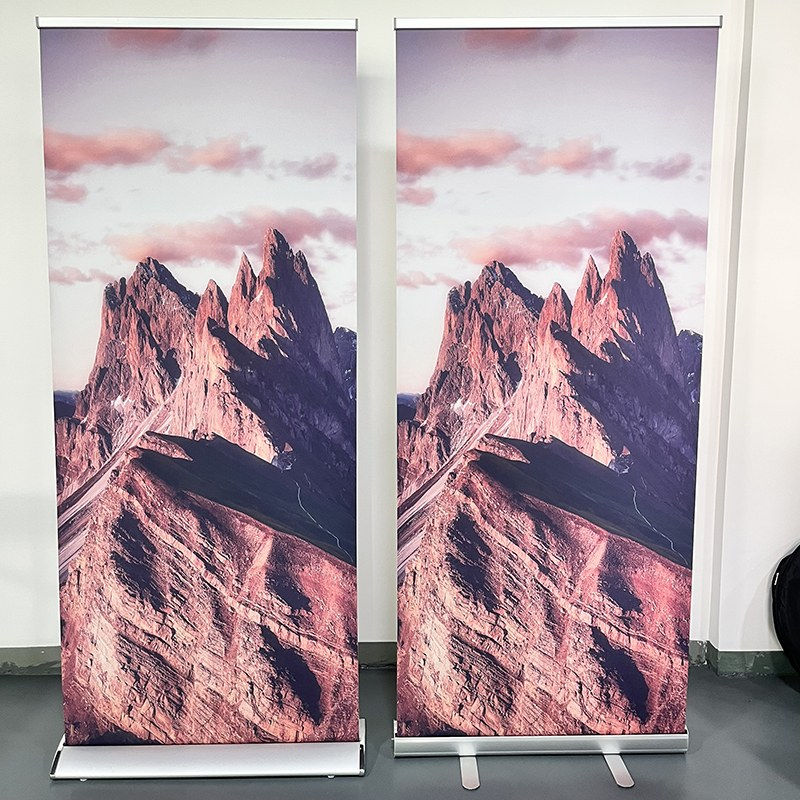
The full printed face on a clean ground: even colour edge to edge, type that stays legible at broadcast distance, and no glaze across the fabric. This is the look a broadcast camera punishes vinyl for — and the reason fabric pop-up displays keep winning the shot.
The buyer lesson from outdoor racing dates is about stability and weather, and it applies to every event backdrop that leaves the ballroom. An expandable banner stand is light by design, so the buyer's questions move to what keeps the fabric backdrop and the pop-up display wall standing: the footprint of the base rails, the option to ballast the feet of the pop-up display, and the geometry of the hook bars that brace each column of the pop-up display wall against the sideways pull of a taut graphic. Wind is managed the same way broadcast glare is managed on an event backdrop — by specification rather than luck. Buyers staging outdoor winner's enclosures order the photo backdrop wall with sandbag points and heavier foot options, brief the crew to ballast the fabric backdrop before the graphic goes taut, and choose dye-sub fabric over laminated vinyl because dew beads off fabric and stains the laminate of cheap prints — the failure that ends an outdoor photo backdrop wall's season. A photo backdrop wall that has survived an outdoor October in Kentucky will survive anything a Q4 calendar can schedule indoors — which is why the same fabric pop-up display stand that works the winner's circle reappears two weeks later under the lights of a Santa grotto.
Anatomy of the fabric pop-up display stand: what the buyer is actually buying
Across all three events the hardware is the same family of fabric pop-up displays, and its anatomy is worth walking once. The frame of the expandable banner stand is an aluminium scissor lattice: hinged struts joined by moulded connectors that let the structure concertina from a flat bundle to a standing fabric pop-up display stand, squared off by hook-and-crossbar braces that lock each column of the pop-up display wall vertical. The graphic of the tension fabric backdrop is a 230-gram elastic sublimation fabric, printed edge to edge and gripped to the frame's perimeter rails by a continuous magic-tape — velcro — strip, so the face of the pop-up display reads dead flat with no grommets, no hems and no shine. Standard sizes run 2.3x2.3 m for the compact interview fabric backdrop, 2.3x3 m for the single-camera pop-up display position, and 2.3x4 m when the sponsor lineup needs its width; wider and taller formats are built to order on the same expandable banner stand hardware. The whole pop-up display folds into a padded carry bag, and the bag is the spec sheet's most persuasive line: a trade show backdrop and its frame together ride in a car boot, which is the entire freight argument for the fabric pop-up display stand category in one sentence — the sentence that closes a first meeting with an event backdrop buyer.
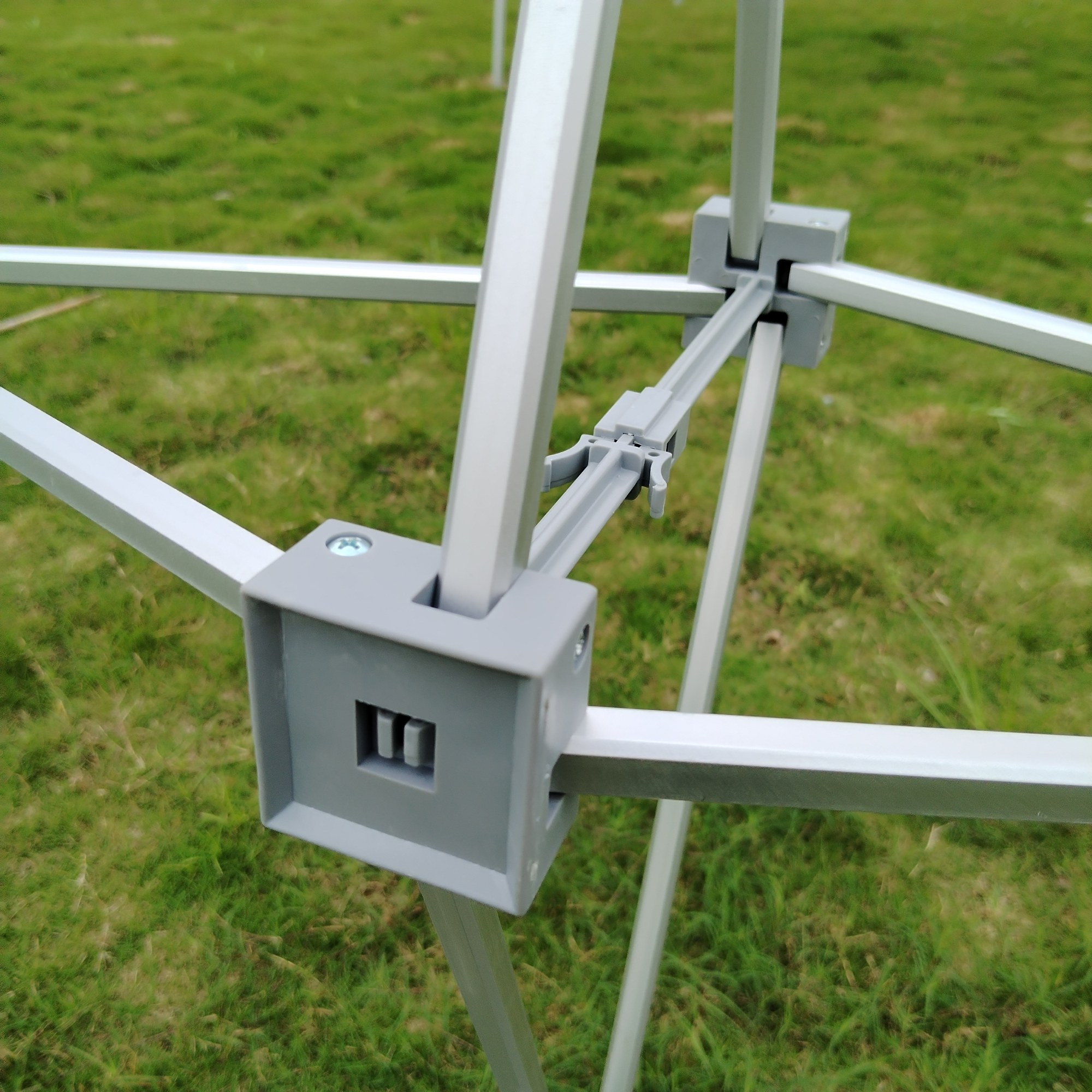
The detail a production manager squeezes first: an ABS connector holding three scissor struts and the locking crossbar of a pop-up display. Connectors are the first wear point of any expandable frame, and the difference between a wall that racks and one that stands square for a decade.
The connectors deserve their own paragraph, because they are where the fabric pop-up display stand category's quality spread is widest. Every hinge point on the expandable banner stand carries load every time the wall opens, and the moulded ABS fittings on a display-grade frame keep their grip through years of daily cycles where brittle alternatives whiten, crack and let the fabric backdrop rack out of square. Buyers running their thumb along a sample fabric pop-up display stand should feel for play at each connector with the wall locked open: a display-grade expandable banner stand has none, and its hook bars seat with a positive click. Thirty seconds of that test predicts five years better than any certificate, because the connector is the part that turns a lattice of aluminium struts into a fabric backdrop that stands square in front of a national broadcast — the test every expandable banner stand should pass before it ships.
The hook-and-crossbar brace that squares each column of the lattice. On a tension fabric backdrop this is the part that takes the sideways load when the graphic pulls taut — and the part to inspect on any used frame before it goes in front of a camera again.
The print decision on a fabric backdrop: matte, washable and changed in a minute
The fabric choice is the other half of the pop-up display specification, and it is decided by the camera. Dye-sublimation on elastic knit gives the fabric pop-up display stand its matte, glare-free face that broadcast lighting demands, holds colour through hundreds of hours under rig lights, outlasts the season of any pop-up display wall it hangs on, and survives the laundering that a working photo backdrop wall imposes — a fabric backdrop that machine-washes flat comes out of the bag ready to hang, where laminated substrates remember every fold. The changeover mechanic is the operational advantage the buyer of a fabric backdrop feels weekly: the magic-tape edge lets one trained pair of hands pull the old graphic off the rails and press the new one on in minutes, from the front or from behind, with no tools and no ladder choreography: the changeover that lets one tension fabric backdrop serve three events in a week, the working definition of a pop-up display.
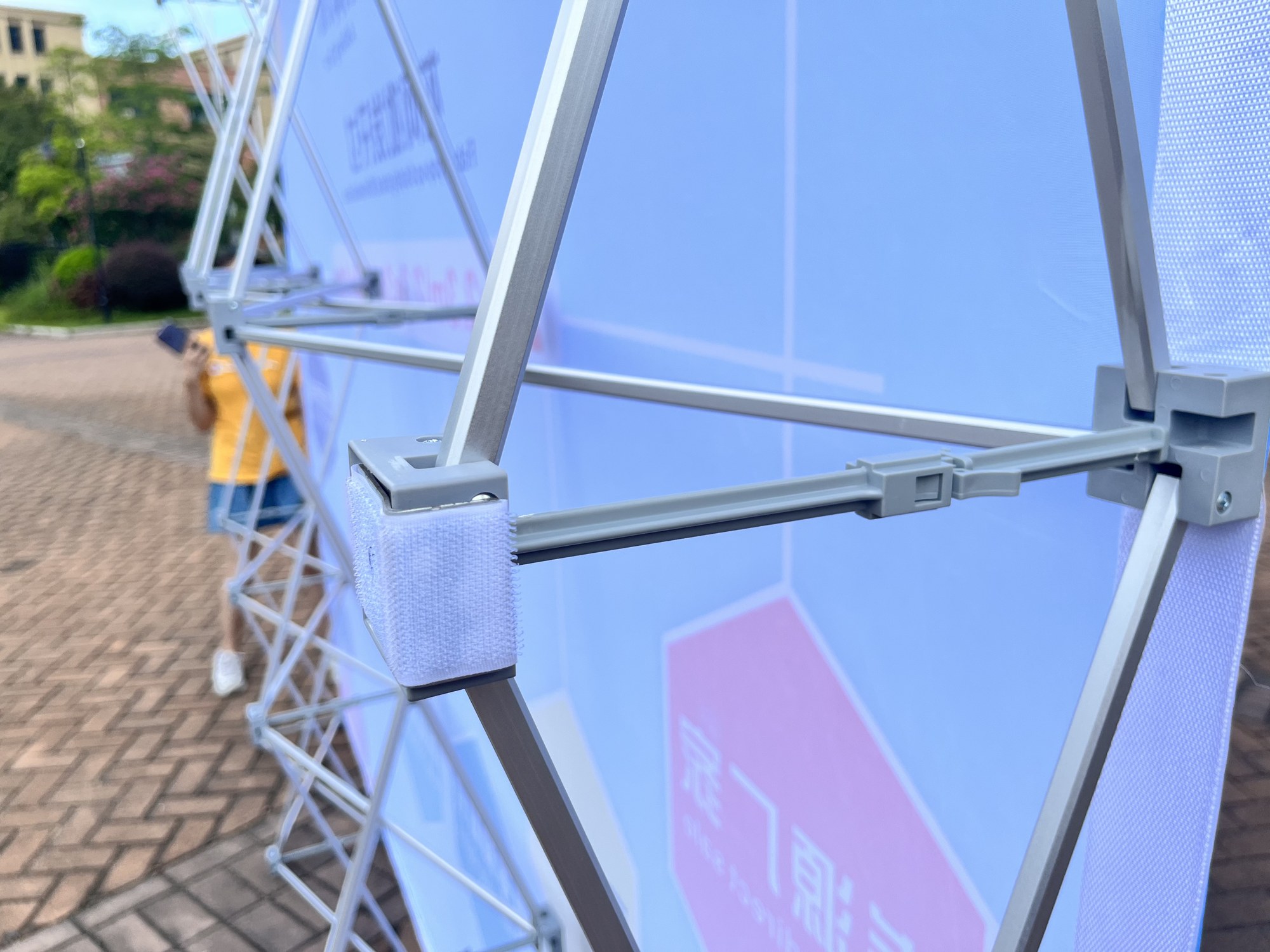
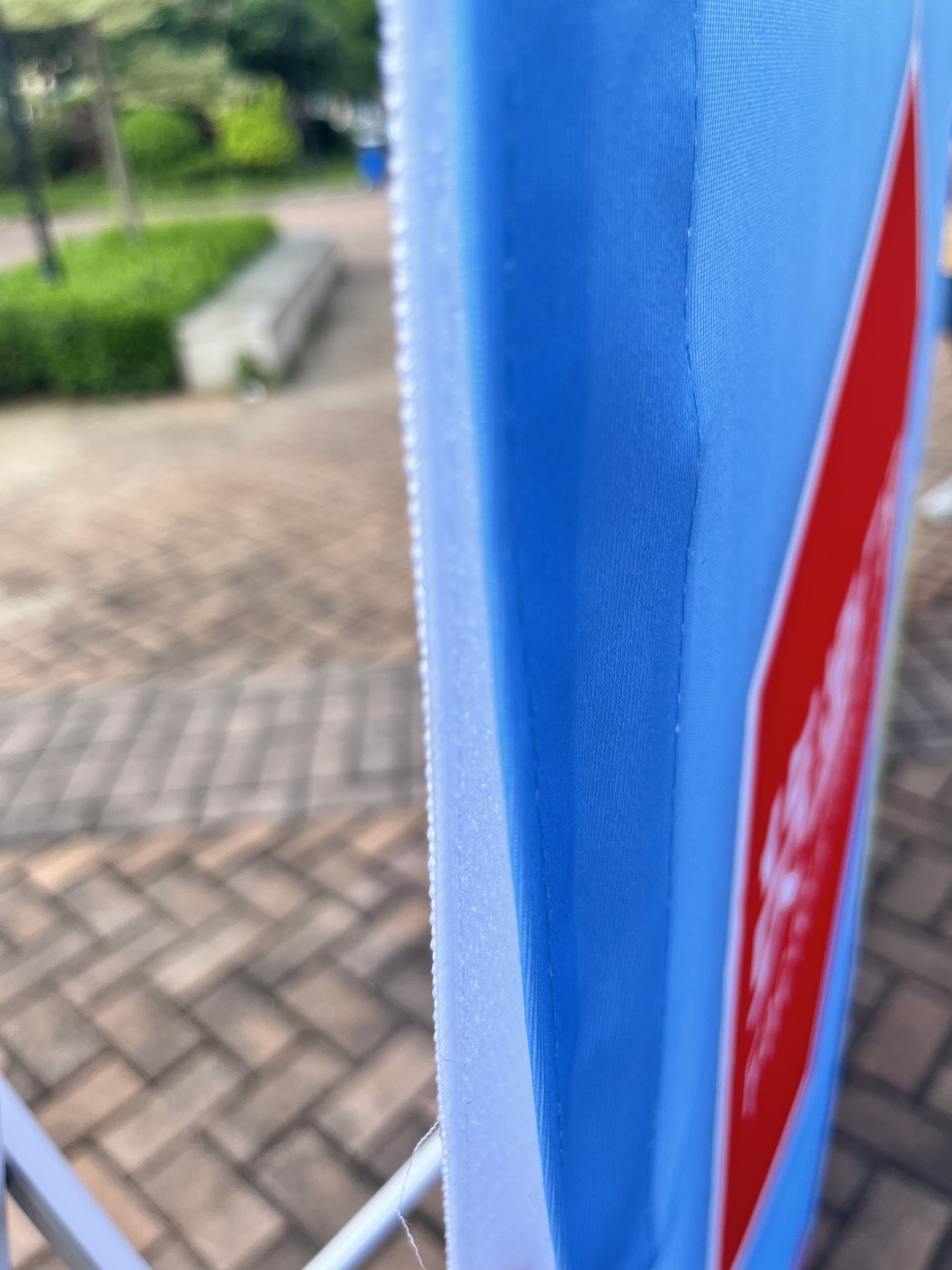
The magic-tape edge, photographed at working distance: the printed graphic of the fabric backdrop grips the frame's perimeter rails along a continuous velcro strip, so the graphic pulls flat without grommets, eyelets or the shine of a stapled hem.
Fleets exploit the changeover minute of the fabric pop-up display stand deliberately. A sponsorship agency holding one expandable banner stand frame set per venue keeps a graphic library alongside it — one fabric backdrop per sponsor, one per event identity, one neutral house design — and changes the pop-up display wall between sessions the way a theatre changes a set. The same pop-up display arithmetic scales down perfectly: a wedding planner owns one tension fabric backdrop and prints a monogram wall per couple; a corporate comms team owns one event backdrop and re-dresses it for each town hall; a school owns one fabric pop-up display stand and prints the graduating class onto it each June. In every case the frame of the fabric pop-up display stand is bought once and the fabric is the running cost, which is why suppliers who make re-ordering fabric backdrops easy keep the account for decades — the quiet annuity of the expandable banner stand.
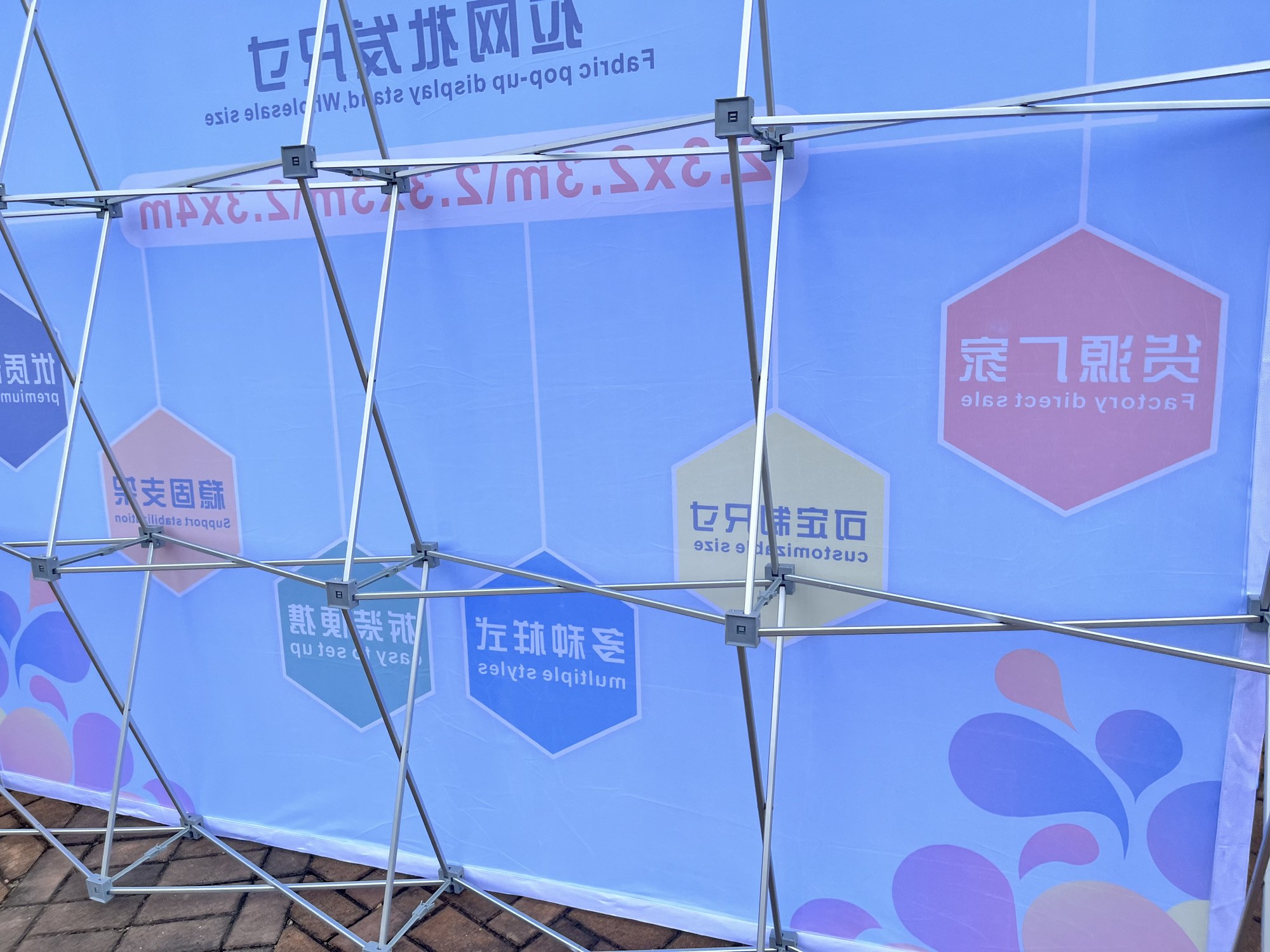
The wall from behind, where the crews live: the graphic pressed onto the rails along the whole perimeter, corner by corner. A trained pair of hands re-skins a photo backdrop wall in minutes, and the spare graphic that follows the frame in the van turns one wall into two campaigns.
Buyer reference: ten inspection points for a fabric pop-up display stand
The category looks uniform in a catalogue — lattice frame, printed sock — and the differences that decide whether a fabric pop-up display stand lasts one season or five are all in the details of the frame and the fabric backdrop. Ten points cover the inspection of the expandable banner stand, its connectors and its fabric backdrop.
Connector material and fit: moulded ABS with zero play when the fabric pop-up display stand is locked open. The connectors are the first wear point of any expandable frame and the last thing a buyer should economise on.
Hook bars and bracing: each column of the expandable banner stand lattice should square off with a positive-seating brace that resists the sideways pull of a taut graphic. A pop-up display that racks will photograph out of square.
Rail perimeter: the velcro receiving strip of the fabric pop-up display stand should run continuously around the whole perimeter of the fabric backdrop, not just the top edge, so the face pulls flat with no gaps at the corners.
Frame material: aluminium for the carried fleet of expandable banner stand frames, with wall thickness quoted in millimetres. Ask what the packed bundle of the pop-up display weighs — the number decides whether one stagehand or two move it.
Graphic fabric weight: 230 gsm elastic knit is the working standard for a tension fabric backdrop; lighter knits relax after a wash and photograph with soft wrinkles across the face of the fabric backdrop.
Print method: true dye-sublimation, edge to edge, with the colour proof approved on the same fabric as the production fabric backdrop. Screen-printed imitations lose saturation after the first laundering.
Size ladder: 2.3x2.3 m, 2.3x3 m and 2.3x4 m cover the interview wall, the single camera and the wide sponsor lineup — confirm the sizes match the venues' ceiling and floor plans before ordering the width of the pop-up display wall.
Stability: base rails with real footprint, ballast points on the feet of the photo backdrop wall for outdoor duty, and hook-bar geometry that keeps the whole fabric backdrop vertical on uneven ground.
Packing: a padded carry bag that actually fits the folded frame and the folded graphic of the fabric pop-up display stand, with room for a spare. The bag is bought as often as the pop-up display — check its zip and its handles.
Spares and reprints: a supplier who stocks replacement connectors, braces and re-printed graphics keeps a fleet of fabric pop-up displays alive; a supplier who only sells complete kits turns a small repair into a dead trade show backdrop.
Eight questions before the first expandable banner stand order
Agencies, venue operators and event organisers buy the pop-up display wall at volume, and the process that works at any volume is the same: settle eight questions in order, because each answer constrains the next. Worked through honestly, the list converts ‘we need a backdrop’ into a quotable line item for a fabric pop-up display stand order.
Indoors or outdoors? Outdoor duty adds ballast points, heavier feet and dye-sub fabric to the specification of the expandable banner stand and its pop-up display wall; indoor duty lets the buyer spend the budget on the print quality of the fabric backdrop instead.
Who stands in front of it? A two-person interview wall and an eight-person podium wall are different widths — size the photo backdrop wall to the widest realistic group, not the average one.
How often does the message change? Weekly changeovers justify the magic-tape edge and a graphic library of fabric backdrops; an event backdrop printed once a year can hang semi-permanently.
Who moves it? One stagehand means aluminium pop-up display frames and a bundle that fits a hand truck; a van crew forgives the heavier hardware of a larger fabric backdrop.
What does the camera need? Broadcast and livestream demand the matte face of a tension fabric backdrop, the one fabric backdrop that never glares; for photographs alone, the knit's diffuse quality still outperforms every gloss surface in the event backdrop market.
How many graphics ride in the van? Fleets standardise on one pop-up display frame per position and two graphics per frame, so a damaged or rebranded print never grounds the trade show backdrop or the photo backdrop wall beside it.
What venues host it? Ceiling height, service-lift dimensions and floor protection decide the size ladder of the fabric pop-up display stand before price does.
What is the spares plan? One connector set and one spare graphic per five frames keeps a fleet of pop-up display walls working through a championship fortnight or a December of fabric backdrops.
The three buying mistakes on a fabric backdrop, and what each one costs
Three mistakes recur in the fabric pop-up display stand category, and all three are visible only after the first bad shoot — which is what makes them worth naming before the order.
Buying on the photograph. Every pop-up display looks taut and every connector looks solid in a product image. The truth is in the connector play, the brace geometry and the continuous velcro edge — none of which photograph — which is why a sample opened once on the buyer's own floor is the correct basis for a first order of a fabric pop-up display stand.
Buying vinyl to save on the print. The frame outlives many graphics, but a gloss vinyl face throws broadcast glare, remembers its folds and stains with dew — false economy on any event backdrop that meets a camera. Dye-sub fabric costs more per print and earns it back on the fabric backdrop in the first broadcast, and keeps earning it back for a season of re-prints on the same expandable banner stand.
Buying without the spare graphic. The whole value of the expandable banner stand system is the changeover minute, and a fleet without a spare pop-up display graphic in the van is one coffee spill away from an unbranded interview wall and an unbranded event backdrop photo.
MOQ, proofs and freight for the pop-up display wall
The order mechanics of the fabric pop-up display stand are friendlier than most buyers expect. Minimum order quantity for an expandable banner stand is typically one piece, which makes the category unusually easy to trial: an agency can order a single fabric pop-up display stand, put it through one real production day, and commit to a fleet only after the footage comes back. Tooling exists for the standard fabric pop-up display stand sizes, so there is no mould cost on catalogue models; custom widths and heights are quoted separately, and the printed fabric backdrop ships after an electronic proof is approved — samples normally ready in one to three days from confirmation of the fabric backdrop artwork. Goods move on EXW or FOB terms from Guangzhou, Shenzhen or Foshan depending on routing, and by express, air or sea depending on the deadline. The timing rule for the event backdrop category is set by the calendar: a pop-up display wall needed for a championship fortnight, an award season or a December retail campaign must be ordered with sea freight in early autumn, because a pop-up display that misses the boat misses the moment — and the moment does not move for anyone.
The fortnight ahead, and the fabric pop-up display stand season behind it
Between this evening and 14 November, the calendar offers a preview of everything the fabric pop-up display stand category serves: an NBA opening night in New York tonight, a world championship settling into Texas this weekend before its Brooklyn final, and the Breeders' Cup assembling in Kentucky for the last weekend of October. Behind the sports calendar stands the whole Q4 economy of the fabric backdrop: the Santa photo sets — one photo backdrop wall per grotto — that malls begin fitting out in mid-November, the award dinners, the wedding fairs, the corporate town halls, every one of them an event backdrop booking, all of it running on the same honest piece of pop-up display hardware: an expandable banner stand frame, a matte printed fabric, a velcro edge, a carry bag. The champions change; the fabric backdrop wall behind them does not, and neither does the expandable banner stand behind the fabric. That durability of design is why the fabric pop-up display stand sells year after year, and why the factories of Guangdong that build it treat a championship fortnight as the best showroom they never had to rent, with a pop-up display wall in every frame of the broadcast.
— keyword density report (longest-match, non-overlapping) —
word_count=4354 total_keyword_phrases=218 density=5.01% per-keyword: fabric pop-up display stand=42, pop-up display wall=19, pop-up display=27, fabric backdrop=49, expandable banner stand=30, tension fabric backdrop=9, trade show backdrop=7, photo backdrop wall=16, step and repeat backdrop=2, event backdrop=17
Event dates verified 20 October 2026. NBA: the 2026-27 regular season tips off on Tuesday 20 October 2026 with an NBC/Peacock tripleheader — Boston Celtics at Detroit Pistons (3 pm ET), defending champion New York Knicks hosting the Philadelphia 76ers (7 pm ET, Madison Square Garden), and San Antonio Spurs at Oklahoma City Thunder (9:30 pm ET, Frost Bank Center); the 81st regular season concludes 11 April 2027 (nba.com; pr.nba.com). League of Lines world championship 2026 ('This Is Our Moment'): play-in stage 15-18 October in Los Angeles; Swiss stage 23-26 and 28-31 October at the Credit Union of Texas Event Center, Allen, Texas; knockout quarterfinals 3-6 November and semifinals 7-8 November in Allen; grand final 14 November at Barclays Center, Brooklyn (lolesports.com). Breeders' Cup: the 43rd Breeders' Cup World Championships run 30-31 October 2026 at Keeneland Race Course, Lexington, Kentucky, with fourteen Grade 1 races, more than $34 million in purses and awards, and the $2 million Cygames Breeders' Cup Sprint on Saturday 31 October; Forever Young, winner of the 2025 Longines Breeders' Cup Classic, has been reported as targeting a title defence (breederscup.com). Product descriptions are taken from the supplier's range documentation: aluminium scissor-lattice expandable frames with moulded ABS connectors and hook-bar bracing, 230g elastic dye-sublimation fabric graphics fixed by a continuous magic-tape (velcro) edge, standard sizes 2.3x2.3 m / 2.3x3 m / 2.3x4 m with custom sizes to order, supplied folded in a padded carry bag.