


Ship it empty, fill it with tap water: the water-fillable base becomes the quiet workhorse of France's autumn fair season
Caen opens on September 18 with a Pompeii theme, Saint-Etienne follows with Thailand, and Marseille and Metz pull in more than a thousand stands between them from September 25. Under almost every feather flag and every banner stand in those halls sits the same unglamorous product: a water tank base that weighs five kilograms in the carton and eighty on the floor.
CAEN / SAINT-ETIENNE / MARSEILLE / METZ — September 17, 2026
Four French regional fairs open their gates inside the next eight days, and not one of them will open without a small grey plastic product doing the heavy work. The Caen International Fair runs from September 18 to 27 with Italy and the immersive exhibition 'The Mysteries of Pompeii' as its theme. The Saint-Etienne Fair opens the same week and runs to September 28, built around Thailand and the exhibition 'In Search of the Emerald Buddha.' From September 25, the Marseille International Fair puts 'The Mediterranean Takes the Stage' across eleven days, while the Metz International Fair fills its halls with 550 stands across 25 business sectors. Different cities, different themes, identical kit list — and at the bottom of that kit list, under every flagpole and every banner stand base, sits the water-fillable base. A flag base is a commodity until the morning a hall draft takes one down; from that morning on, the ballast base is the most discussed product on the stand.
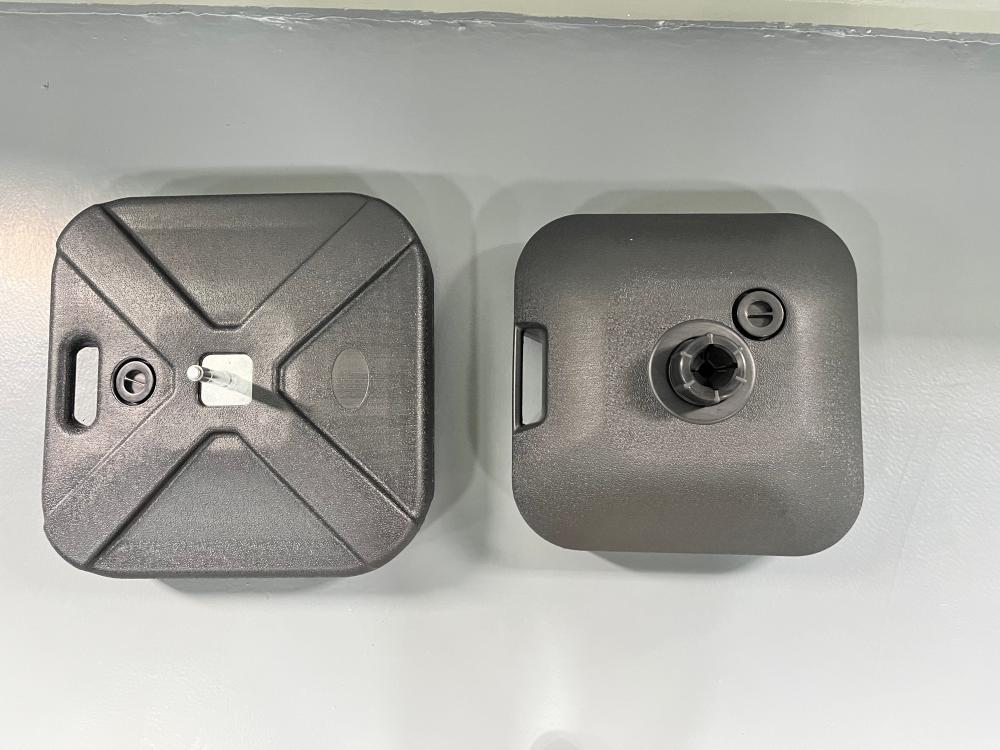
The two-silhouette water tank base family, top view: the X-ribbed square ballast base with its screw-cap filler and central pole socket beside the smooth-dome water-filled base with its four-way flex connector — one flag base range covering every pole diameter a fair organiser might bring.
The ballast base is the least photographed product at any fair and the first one every stand builder unpacks. A feather flag with no flag base is a kite; a flagpole base with no ballast base is kindling. An umbrella with no umbrella base is a liability. The water tank base solves both problems with a moulded polyethylene tank, a screw-cap filler and a central socket: fill it from the nearest tap, plant the pole, and the banner stand base goes from five kilograms of shipping weight to roughly eighty kilograms of ballast in the time it takes a hose to run. Drain it at pack-down and the same flagpole base is light enough for one crew member to carry to the truck. No other ballast base in the exhibition catalogue changes weight by a factor of sixteen between the carton and the stand floor — and no other water tank base asks the buyer to store anything heavier than the shell.
From a buyer perspective, that single mechanism is the entire business case. The traditional alternative is a concrete or sand-filled flag base, and a concrete flag base is expensive before it is ever used, because the buyer pays to freight dead weight in both directions. A water-filled base flips the economics: the ballast is free, sourced locally from any garden tap at the venue, and poured away at the end of the show. A stand builder freighting twenty ballast bases from Lyon to Marseille moves plastic, not stone — and the freight line on the quote drops accordingly. The same maths holds for the umbrella base on a café terrace kit and for the banner stand base in a directional-sign set: every water-fillable base on the order is a line item that stops costing money the moment it leaves the warehouse, because a ballast base bought once is freight-neutral for life; a flagpole base in concrete is freight-negative every time it moves.
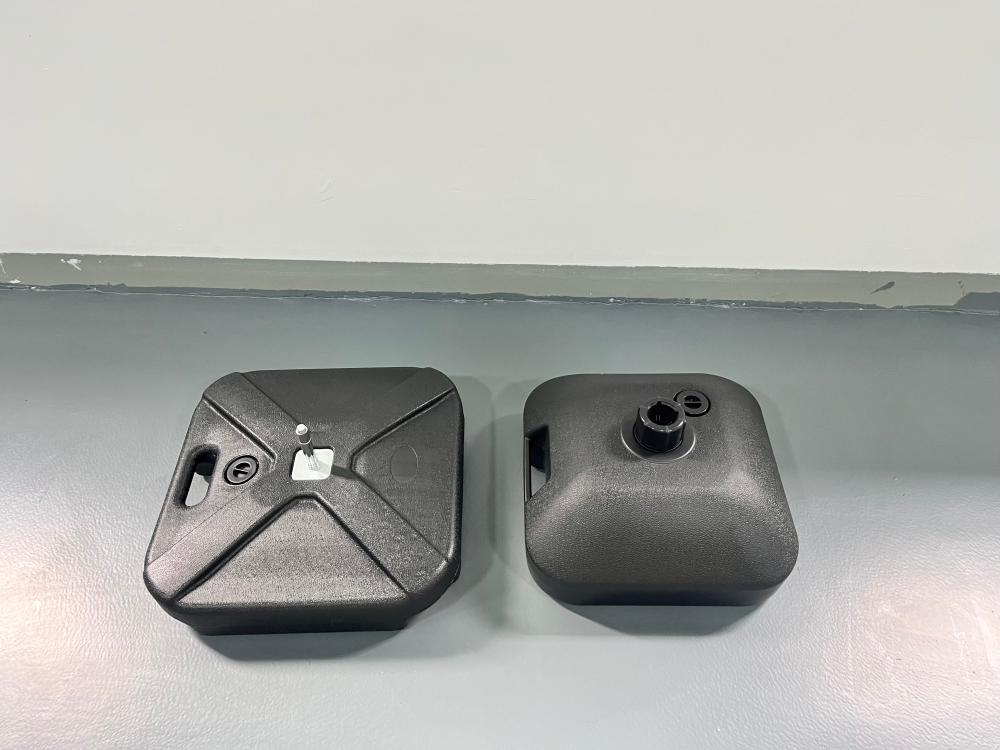
Both models of the water-fillable base photographed at an angle in the workshop: moulded polyethylene walls, integrated carry handle and fill cap. Shipped empty, each ballast base weighs a fraction of a concrete flag base and takes on its full ballast weight only when the banner stand base is filled with tap water on site.
Caen is the first test of the season. The fair runs ten days with Italy as the guest theme, and the Pompeii immersive exhibition is drawing family audiences who walk the halls slowly, which means stand crews are dressing entrances and aisle-ends rather than back walls. An aisle-end position lives or dies on the flag base: every trolley, every pushchair and every school group brushes past it. The X-ribbed water tank base was moulded for exactly this duty — the cross-ribs stiffen the tank wall when full, the low square footprint resists the sideways knock of a passing crowd, and the textured polyethylene shrugs off the scuffs of a ten-day run. And if a drawing changes mid-fair, a ballast base can be topped up from a watering can and the flag base re-sited before the morning briefing ends. Each flagpole base here rolls rather than lifts, which is why crews favour this ballast base for entrance positions.
Buyers specifying a banner stand base for a themed fair should also think about what happens after the fair. The Caen crew packs on September 27, and by September 30 the same water-fillable base fleet is typically on a truck to the next regional fair. Because the flagpole base is moulded rather than cast, it survives that cycle; because it is water-filled rather than sand-filled, it arrives empty, clean and legal to load. Sand is the quieter enemy — a sand-filled flag base leaks grit into a truck deck for the whole journey. Water leaves nothing behind but a damp towel's worth of condensation, which is why more fair organisers now write 'water-fillable base only' into their stand-fitting rules for indoor halls — a rule the water-filled base passes simply by existing.
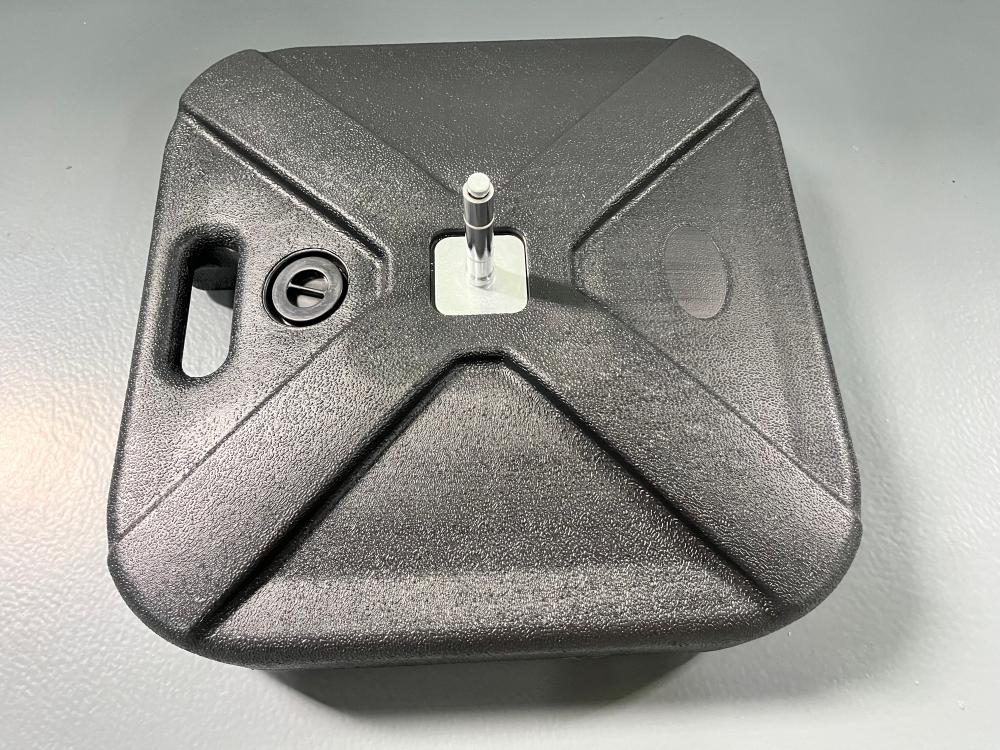
Top view of the X-ribbed water tank base: the cross-ribs stiffen the tank when full, the moulded handle lets one person carry the empty flagpole base across a stand floor, and the cap seals the ballast base for transport between Caen, Marseille and Metz.
The X-ribbed ballast base in the photographs is the workhorse silhouette. The fill cap is sized for a hose or a jug, the carry handle is moulded into the wall rather than bolted on, and the central socket takes a standard flagpole spigot without an adapter. For a rental company, the arithmetic is simple: one water tank base serves a feather flag in Caen in September, an umbrella base duty on a terrace stand in Marseille in the same fortnight, and a pole for a directional sign at Metz the week after. Three product lines, one inventory number, one banner stand base SKU to forecast — one water tank base instead of a separate flag base for every job, and one ballast base to buy by the pallet. It is the water-fillable base habit that pays for itself by October.
The Metz fair is the volume test. With 550 stands across 25 sectors opening on September 25, the organisers' own aisle dressing and the exhibitors' hired kit arrive in the same week, and the loading bays run to a timetable measured in minutes per stand. This is where the water-fillable base earns its place on the kit list: an empty ballast base stacks, a full one plants a pole in seconds, and a crew of two can dress a double stand — four flags on four water-filled flagpole bases — before the next trolley arrives. No fixings, no tools, no ballast delivery slot to negotiate with the hall, and no second banner stand base variant to unpack when the drawing changes overnight. Of the 550 stands opening at Metz, not one opens without a water tank base somewhere at its edge, filling silently from a hall tap, one water tank base at a time.
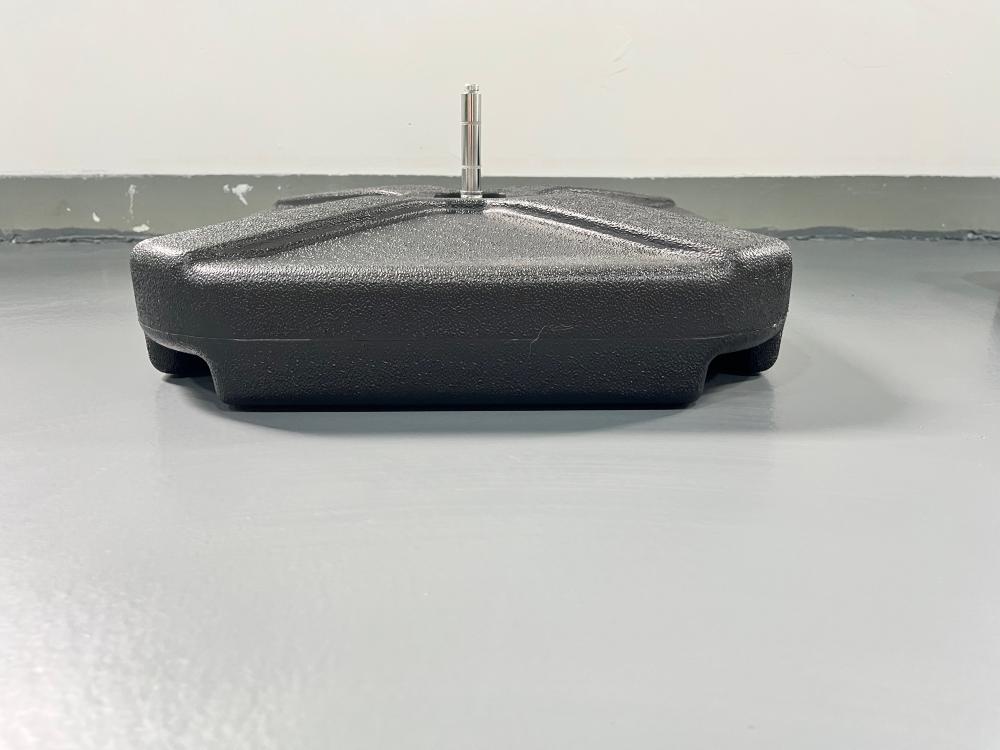
Side profile of the X-ribbed water-filled base: a low, wide footprint that keeps a banner stand base planted under the gusts that funnel through French fair entrances, with the metal pole socket set dead centre of the flag base.
September wind is the variable every French fair organiser plans around. The regional fairs straddle indoor halls and covered passages, and the entrance lines act as wind tunnels on changeover mornings. A water-filled base answers with geometry rather than weight alone: the X-ribbed water tank base is wider than it is tall, so the ballast sits low and the tipping moment stays small even in a corridor gust. A flagpole base with a high centre of ballast is the one that ends up on the floor; the water tank base keeps its centre low. Buyers replacing an old cast flag base should compare footprint, not just fill volume — a tall, narrow umbrella base full of water performs worse in a doorway draft than a low square ballast base at the same fill weight. That low-slung geometry is also why rental catalogues list the water-filled base twice: once as a flag base, once as the banner stand base of choice for every aisle end.
The second silhouette in the family is the smooth-dome model, and it is the one rental fleets standardise on. Its four-way rubber flex socket accepts round poles, square sections and several diameters in the same collar, which means a single water tank base serves every banner stand base duty in the catalogue. A buyer equipping a fleet stops asking 'which base fits which pole?' and starts buying one ballast base by the pallet, and one umbrella base where the terrace trade demands it. The dome shell is also the more forgiving shape in transit — no ribs to catch on neighbouring cartons, and a texture that hides the scuffs of its fourth or fifth season on hire. For a mixed fleet that runs a flagpole base, an umbrella base and a crossbar banner fitting out of the same van, the dome-model water-filled base is the one water-fillable base that covers all three without a single adapter.
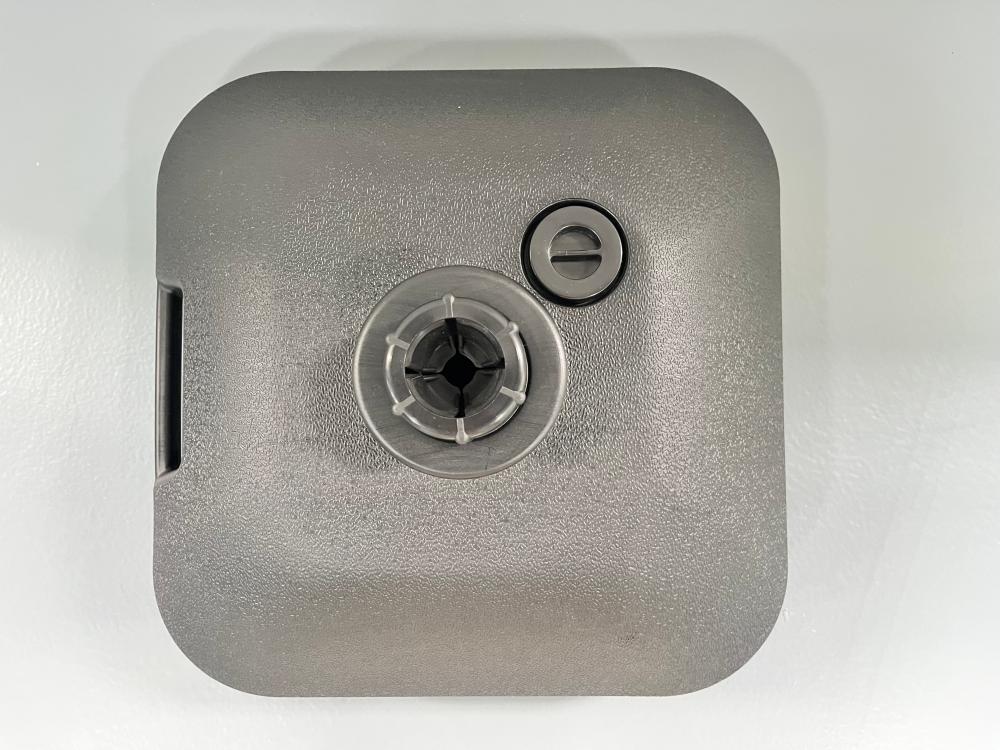
The smooth-dome ballast base from above: a four-way rubber flex socket accepts round, square and different-diameter poles, which is why rental fleets standardise on this water tank base as their single banner stand base across every flagpole base and umbrella base in the catalogue.
For a first-time buyer, the specification conversation should cover four points. One: capacity — the water-filled base is sold by its filled weight, and eighty kilograms of ballast is the working figure for a three-metre flag in an indoor hall. Two: socket type — the flex socket of the dome model if the fleet mixes pole diameters, the fixed metal socket of the X-ribbed flagpole base if the fleet is standardised. Three: drainage — the screw cap should admit a hose for filling and drain fully at pack-down, because a water tank base that traps its last litre is a ballast base that arrives at the next fair smelling of the last one. Four: stacking — empty water tank bases should nest, because the difference between a pallet of stackable ballast bases and a pallet of loose ones is a second truck. That is the water-fillable base audit in four questions.
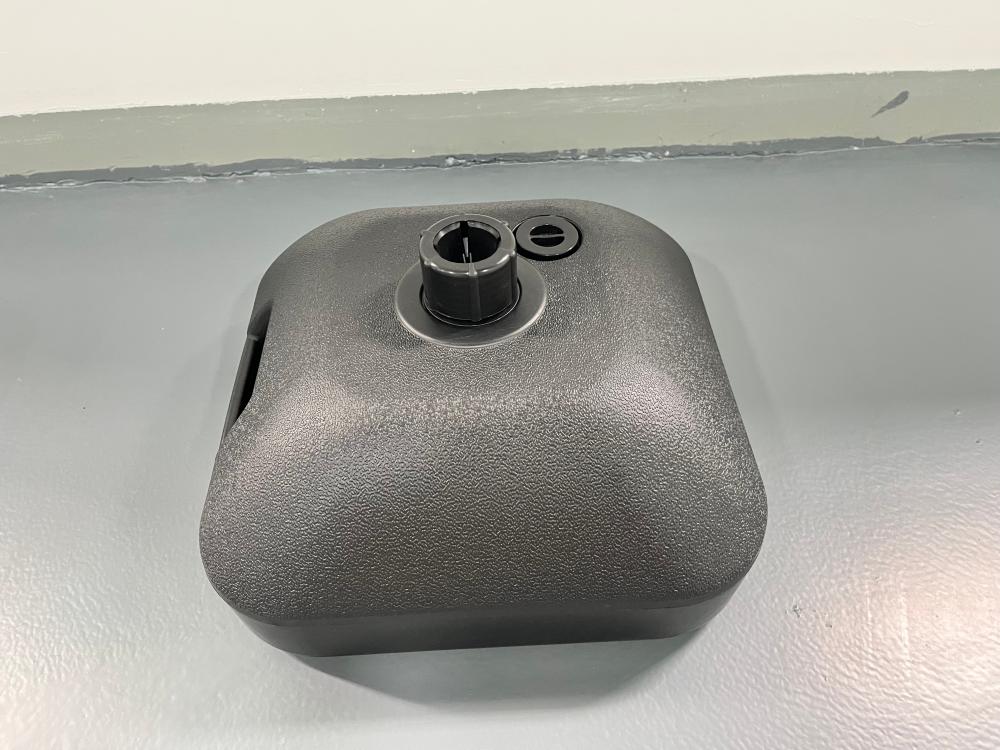
Top view of the dome-model water-fillable base: one moulding, one fill cap, one socket. An exhibition stand crew can fill, plant a pole and move to the next stand in under two minutes per flag base, with no tools and no sand.
The Marseille fair sharpens another part of the buyer's calculation. Its 'Mediterranean Takes the Stage' programme from September 25 to October 5 runs cultural and gastronomic stands onto terraces and covered walkways, where power and fixing points are scarce and the flag base has to be self-sufficient. An umbrella base or flagpole base that is also a water tank base needs no floor socket, no ballast delivery and no drilling consent from the venue — the organiser's approval letter gets shorter every year as more fairs ban drilled fixings and loose sand outright. The water-fillable base is compliant by design: it is just a container, until the tap turns it into ballast — which is also why a crew can re-site a banner stand base on a Marseille terrace between two briefings without asking anyone's permission.
There is also a storage argument that first-time buyers underrate. A regional fleet of forty concrete flag bases occupies a warehouse corner permanently; a fleet of forty empty ballast bases occupies a single pallet position, because the dome-model water-filled base nests and the X-ribbed water tank base stacks rim to rim. The same nesting logic applies to the umbrella base and every water-fillable base in the range, and an empty flagpole base lifts with one hand. For a stand-builder running a seasonal business — quiet January, packed September — the water-fillable base converts fixed warehouse cost into a product that disappears between jobs.
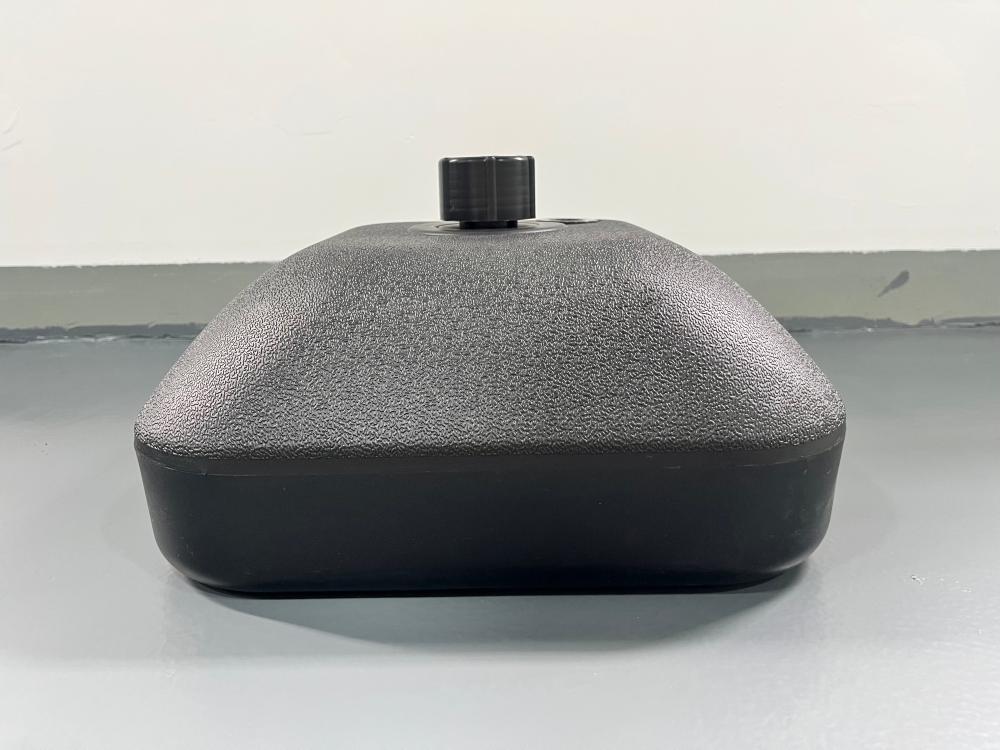
Side profile of the dome-model water tank base: the textured moulding hides scuffs from repeat hire, and the tapered walls let empty ballast bases nest and stack on a pallet — the property that makes this water-filled base the cheapest flagpole base in the fleet to freight.
Durability completes the buyer's case. The tank is rotation-moulded polyethylene with UV stabiliser in the compound, because at least one of the four fairs will stand a flagpole base on a sunlit terrace for ten days. The cap seal is a simple compression gasket, replaceable with a screwdriver; the socket is a separate moulding, so a damaged collar is a parts order rather than a scrappage. Fleet buyers report water tank bases in their seventh or eighth hire season — a service life that makes the per-event cost of the ballast base a rounding error on the stand quote, whether the shell is doing duty as a flag base, an umbrella base, a banner stand base or a flagpole base.
A purchasing manager at a French events company put the shift plainly when ordering this season's fleet: 'We stopped buying bases by product and started buying them by job. Every feather flag gets a water tank base, every graphic panel gets the same banner stand base, every parasol the same umbrella base, every pole flag the same flagpole base — and every one of them is a water-fillable base, so my warehouse only ever stores one shape.' Standardise the ballast base, and the flag base question disappears from every stand drawing for the rest of the season.
The four-fair fortnight ends in France on October 5, but the ballast base's season does not. The same water-filled base fleet moves on to Christmas market welcome gates, winter-sale aisle ends and shopping-centre Santa photo points, wherever a flag base or banner stand base is needed on a floor that cannot be drilled. The format has not changed in years because it does not need to: fill, plant, drain, stack, repeat. Every feather flag standing straight in Caen this week, in Saint-Etienne, in Marseille and across Metz's 550 stands next week, is standing on roughly eighty litres of tap water — the cheapest ballast in the exhibition industry, delivered by the venue's own plumbing and poured into a water-fillable base, then carried from fair to fair by the one product nobody photographs: the water tank base that turns every banner stand base, umbrella base and flagpole base in the fleet into a water-filled base with a job to do.
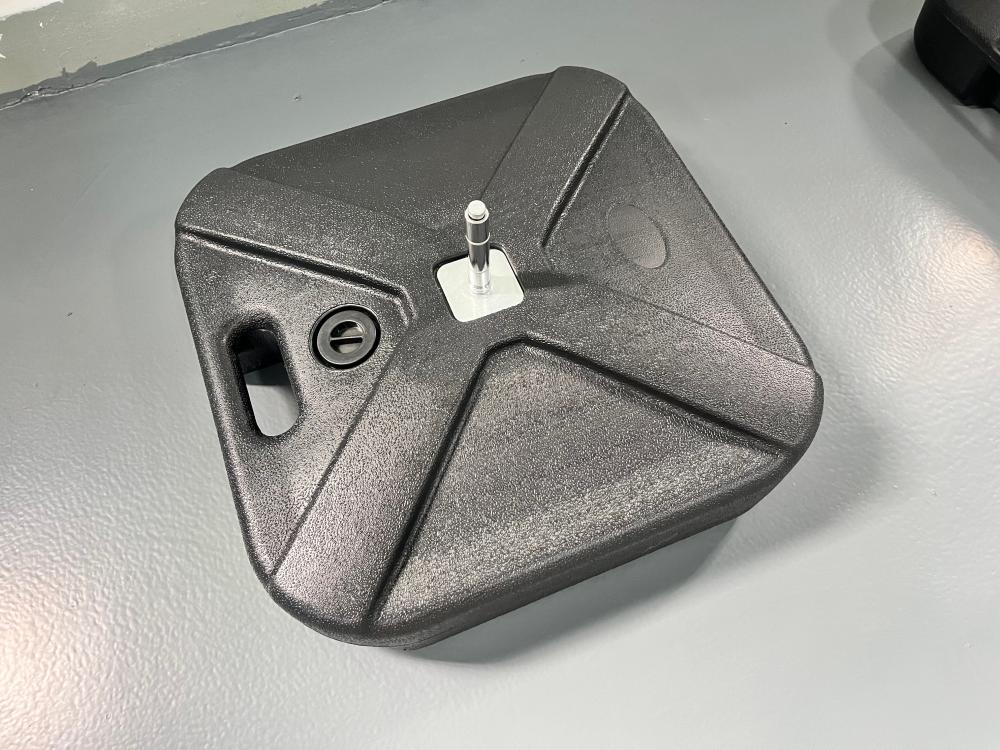
Three-quarter view of the X-ribbed ballast base on the workshop floor: the same square water-fillable base that sits under a feather flag at a Caen stand entrance this week and under an umbrella base on a Marseille terrace stand next week.
— keyword density report —
word_count=2218 total_keyword_hits=107 density=4.82% per-keyword: water-fillable base=14, water-filled base=9, ballast base=16, water tank base=16, flag base=14, banner stand base=13, flagpole base=14, umbrella base=11