


Seven days, three continents, one pop-up canopy tent: the first week of November 2026
Mexico City stages its grand Día de Muertos parade on Saturday 31 October and fills the Zócalo with altars — and market stall tents — through 2 November. Melbourne Cup Day stops Australia at 3:00 pm on Tuesday 3 November, under an event tent and a pop-up gazebo somewhere for most of the crowd. Bonfire Night lights the United Kingdom on Thursday 5 November, one folding gazebo at every gate. And from mid-November, Germany's Christmas markets open their stall rows — every second one a folding gazebo — for the season. Four of the year's most crowded outdoor dates land inside a single week and a half — and every one of them is a weather bet that the pop-up canopy tent exists to cover, and a job for a canopy tent and a pop-up gazebo somewhere on site.
MEXICO CITY / MELBOURNE / LONDON / NUREMBERG — 15 October 2026
The first week and a half of November 2026 is the most concentrated outdoor test in the event calendar, and the pop-up canopy tent is the product the display industry built for it. On Saturday 31 October, Mexico City runs the tenth edition of its grand Día de Muertos parade down five kilometres of Paseo de la Reforma, past a canopy tent on every block, with crowds that begin filling the pavements the night before and vendors trading from every market stall tent and pop-up gazebo the city can field. From Sunday 1 to Monday 2 November the city's plazas fill with ofrendas, artisan stalls and food stands under a canopy tent on every corner, part of a festival recognised by UNESCO as intangible cultural heritage, with a folding gazebo behind every altar and every stall. On Tuesday 3 November, at 3:00 pm sharp, the Lexus Melbourne Cup runs over 3,200 metres at Flemington before a crowd of up to 100,000 and a hospitality village built from the pop-up canopy tent up, on the public holiday that stops a nation, inside a racecourse whose hospitality quarter is a forest of pop-up gazebo marquees and event tent bars. On Thursday 5 November, hundreds of British towns light bonfires and fireworks in fields ringed with pop-up gazebos against the first properly cold night of the year, with the ticket gate and the burger stand under an outdoor canopy tent and the crowd three deep around it. And by the middle of the month, the Christmas markets of Cologne, Munich, Frankfurt and Nuremberg are opening their stall rows of market stall tents for a season of trade in the cold, a share of it sheltered by a folding gazebo rather than a permanent hut, and the rest by huts the traders wish were pop-up canopy tents. Four events, three continents, one shared technical requirement for the event tent trade: covered floor space that assembles in minutes, carries a brand, and shrugs off whatever November does to the sky — the exact specification of the pop-up canopy tent. The product built around it is the pop-up canopy tent, the most portable event tent in the display catalogue and the cheapest printed roof a buyer can own — and the fortnight between Halloween and Advent is the reason it sells.
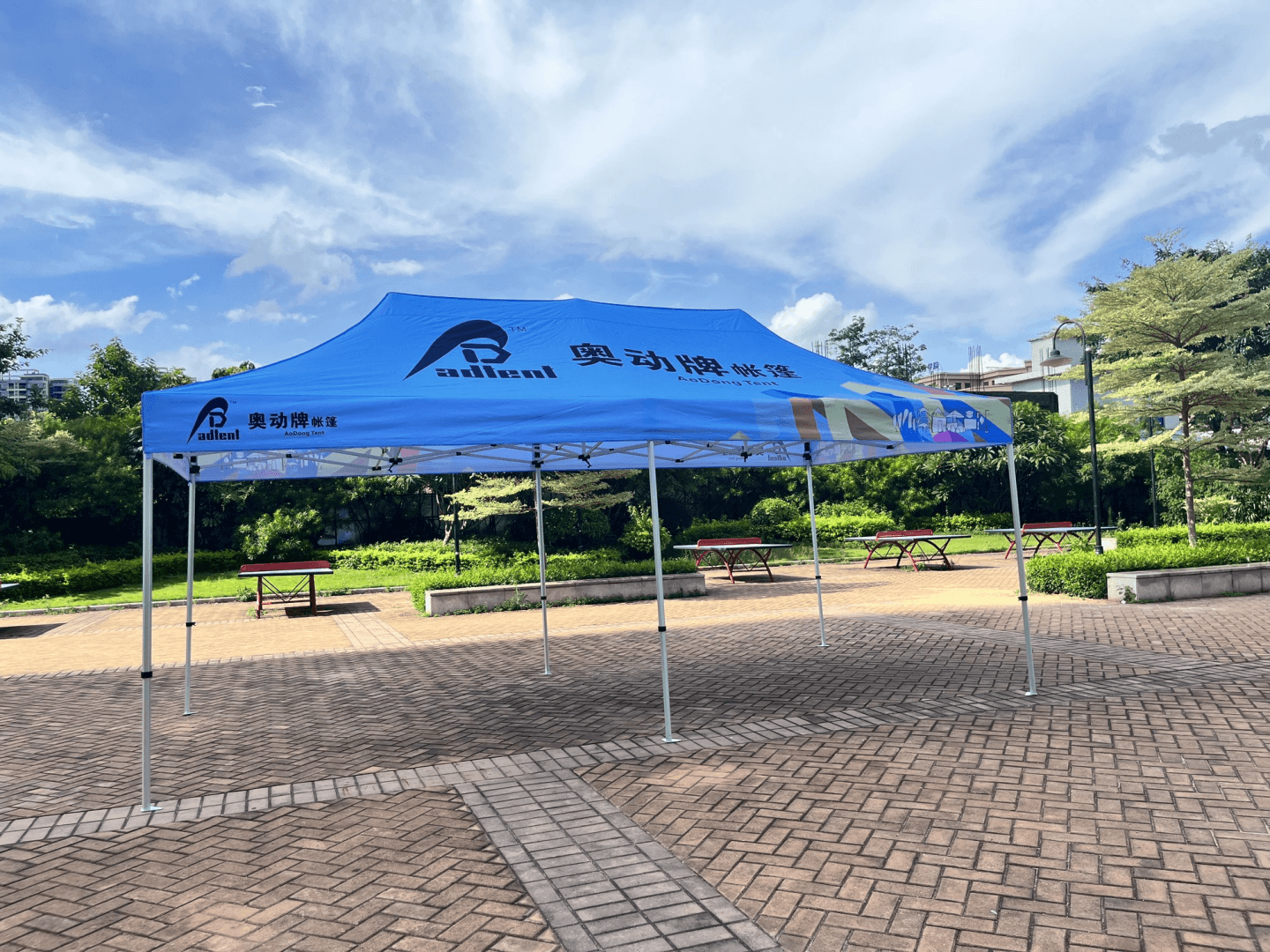
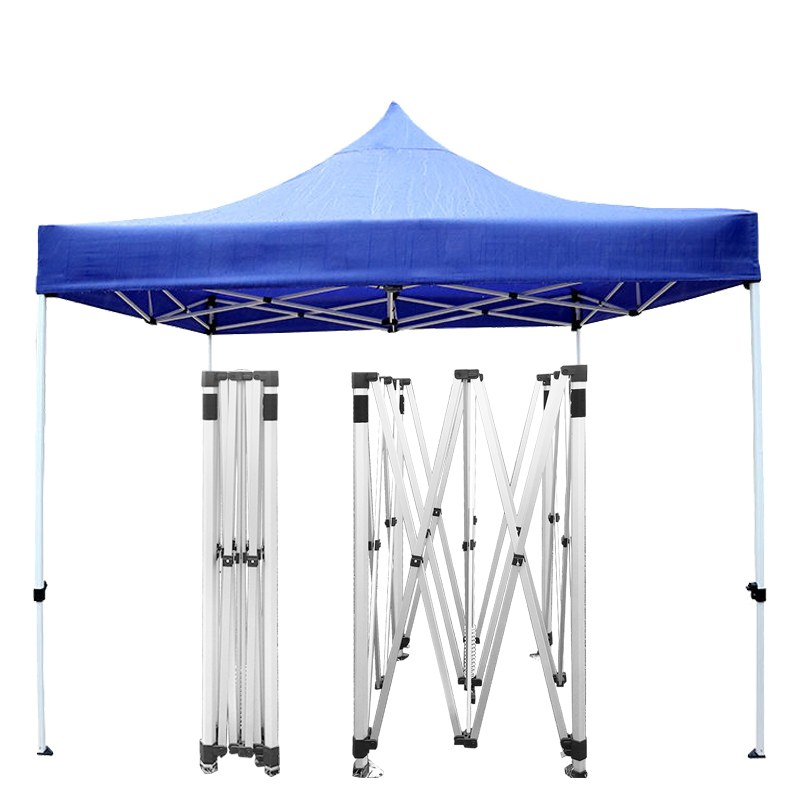
The product doing the work this November: a 3x6 m pop-up canopy tent with a full-dye printed roof, photographed open on public ground. One scissor frame, four height settings, and a printed ceiling that reads as a billboard from every direction of the plaza.
The commercial logic of the canopy tent is easy to state, and every November proves it again. A market trader, an exhibitor or a community organiser can rent a marquee, hire a builder or wait for a venue with a roof — or own one folding gazebo outright, carried in a car boot, set up by one person in a couple of minutes, printed once with the brand like a custom canopy tent, and deployed at every event the calendar offers, which is what turns the printed canopy tent into an asset rather than a cost. The pop-up gazebo is the only roof most of these buyers will ever own outright, and the only billboard they can pitch on ground they merely walk onto — and that fact shapes everything about how the event tent category is engineered: scissor frames that open without tools, canopies that strap to the eaves in seconds, an eave band that turns a trade show tent into a billboard, legs with pull-pin height locks, and footprints that match the standard market pitch of the market stall tent trade. It also explains the ordering pattern of the pop-up canopy tent: buyers do not purchase a pop-up canopy tent for one date, they purchase it for a season of dates, and the first week of November is the densest stretch of that season in three hemispheres at once, dense enough that no fleet of event tents, however large, sits idle.
Mexico City, 31 October to 2 November: a festival the size of a city, and a market stall tent on every corner
Día de Muertos in the capital has become one of the largest public events in the Americas, and one of the busiest weeks of the year for the market stall tent and the outdoor canopy tent alike. The grand parade — launched in 2016 after the opening sequence of a James Bond film made the world expect one, and now the biggest single day of the year for the pop-up gazebo fleets of the capital — leaves Chapultepec and runs the length of Paseo de la Reforma to the Zócalo on Saturday 31 October, its tenth edition, with giant skeleton puppets, floats, calavera face paint and an event tent in every licensed pitch, along a route lined with vendors trading from pop-up tents and market stall tents. From 28 October to 2 November the Zócalo hosts its monumental ofrenda, ringed with canopy tents, and the neighbourhoods add community altars, markets selling pan de muerto and sugar skulls, and food stands that trade at festival volume for the best part of a week from a pop-up gazebo apiece, most of them under a canopy tent rather than anything permanent. Almost none of that commerce happens under a permanent roof, which is the opening sentence of every market stall tent conversation in the city. The marigold sellers, the craft stalls, the taco stands and the face-painters work the pavements under a printed canopy tent, and nearly all of them trade from a pop-up gazebo; their working kit is a 3x3 m market stall tent with a printed roof: visible from the far side of the square under a printed canopy tent, proof against the afternoon sun, folded into a car boot when the evening vigils begin — the daily cycle of the market stall tent: one pop-up gazebo, one day's trade, repeated across a week. Event supply houses in Mexico City, Guadalajara and Monterrey buy the outdoor canopy tent in quantity precisely for this week, and the orders are placed weeks earlier — a pop-up canopy tent ordered in October arrives for the festival; one ordered during it arrives for next year's edition — the calendar lesson every outdoor canopy tent distributor teaches in September.
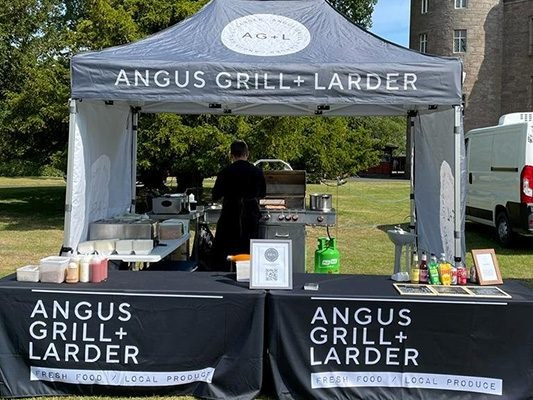
A folding gazebo earning its keep in the field: a branded food stall with the tent, the table covers and the signage carrying one identity. Catering traders standardise this way because the canopy is the only roof they own outright at every market they attend.
The buyer detail worth copying from Mexican market operations is the printed roof of the canopy tent itself. At ground level, a stall under a canopy tent is one booth among hundreds, its side walls hidden by the crowd and its roof the only part the event tent gets to show. The roof of a pop-up canopy tent is the only face of the structure that is visible above the crowd, from a hundred metres away, from the upper floors of the buildings along Reforma, and from every photograph taken on the day — the visibility case for the printed canopy tent in three sentences. A printed canopy tent turns that single face into advertising, and the trade sells it exactly that way: full-dye printing across the entire ceiling and eave band of a custom canopy tent, brand colours that photograph correctly in harsh sun, and a message that appears in every tourist photo of the stall, which is the arithmetic that sells the printed canopy tent across Latin America. Vendors who understand this order the roof of a custom canopy tent as a billboard first and a shelter second, because at festival density the shelter of a pop-up canopy tent is assumed but the visibility is sold.
Melbourne, 31 October to 7 November: Cup Week and the event tent footprint
Australia gives the second week of the story its most formal expression, and the event tent its most formal assignment. The Melbourne Cup Carnival runs four days at Flemington — Derby Day on Saturday 31 October, the Lexus Melbourne Cup itself on Tuesday 3 November, Oaks Day on Thursday 5 November and family Stakes Day on Saturday 7 November — four race days, four opportunities for the pop-up gazebo — and Cup Day is a public holiday across Victoria, with the first running of the race dating to 1861. The track expects 80,000 to 100,000 people on the day itself, and the pop-up gazebo is the unit their food and drink is sold from; the racecourse's hospitality economy is built almost entirely on temporary structures, from marquees down to the smallest pop-up canopy tent: the Birdcage enclosure is a street of marquees, corporate activations line the lawns with a pop-up gazebo apiece, and every bar, betting window and catering point outside the permanent stands sits under framed fabric or a folding gazebo. Away from the members' enclosures, the same pop-up gazebo logic scales down: raceday promoters, fashion activations and satellite screenings in Melbourne's bars and public squares run their own outdoor canopy tent fleets, because a Cup Week activation has to be built in the morning and gone by night, which is the definition of a pop-up canopy tent deployment. A 3x6 m event tent gives an activation a bar, a serving counter and a printed roof over roughly eighteen square metres of lawn, a pop-up gazebo scaled to hospitality, assembled by two staff before the first train dumps the Cup Week crowd at Flemington, and struck again after the last.
A 3x6 m event tent from the front: six metres of uninterrupted printed eave at eye level, the highest-value advertising face on the structure. At a market or a race day, the eave band is read by more people than any other part of the tent.
The buyer note from Cup Week is about presentation standards across the whole event tent order. Melbourne's spring racing calendar is the most photographed week in Australian sport, and every printed canopy tent in it gets photographed; activation briefs routinely specify colour consistency across every printed element — canopy, walls, table covers, flags — because one mismatched blue in the photographs of a printed canopy tent costs more than the printing saved. This is where a custom canopy tent ordered from a single supplier earns its premium: one colour proof applied across every component of the event tent order, and an eave band that matches the table covers beside it — the discipline that separates a custom canopy tent from a generic one. Buyers who split the custom canopy tent order across suppliers re-learn this lesson every November.
The United Kingdom, Thursday 5 November: Bonfire Night and the pop-up gazebo weather bet
Bonfire Night is the least glamorous and most weather-exposed date of the four, and the folding gazebo is the least glamorous product that meets it. Every 5 November, community groups, sports clubs, parish councils and schools across the United Kingdom stage fireworks displays and bonfires on recreation grounds, and every one of them hires or owns pop-up gazebos; the evening is by definition an outdoor one — November in Britain is cold, wet and frequently windy, and the event happens anyway, rain or shine, which is the whole contract of an outdoor canopy tent. The commercial edges of those events are covered by the pop-up canopy tent category: the ticket gate, the burger stall, the mulled wine stand, the first-aid point and the lost-children post all need an instant canopy tent that stands up in the dark, on grass, in wind and rain. Club volunteers pitching an outdoor canopy tent on a wet afternoon need it fast, need it weighted, and need it still standing at ten o'clock — the three-line specification a folding gazebo must meet after dark. This is the shift that sorts event tent frames: a pop-up gazebo with positive joint locks, adequate leg thickness and proper ballast finishes the evening as a routine shift; a cheap frame finishing the same evening in the next field finishes the club's trust with the whole family of event tents.
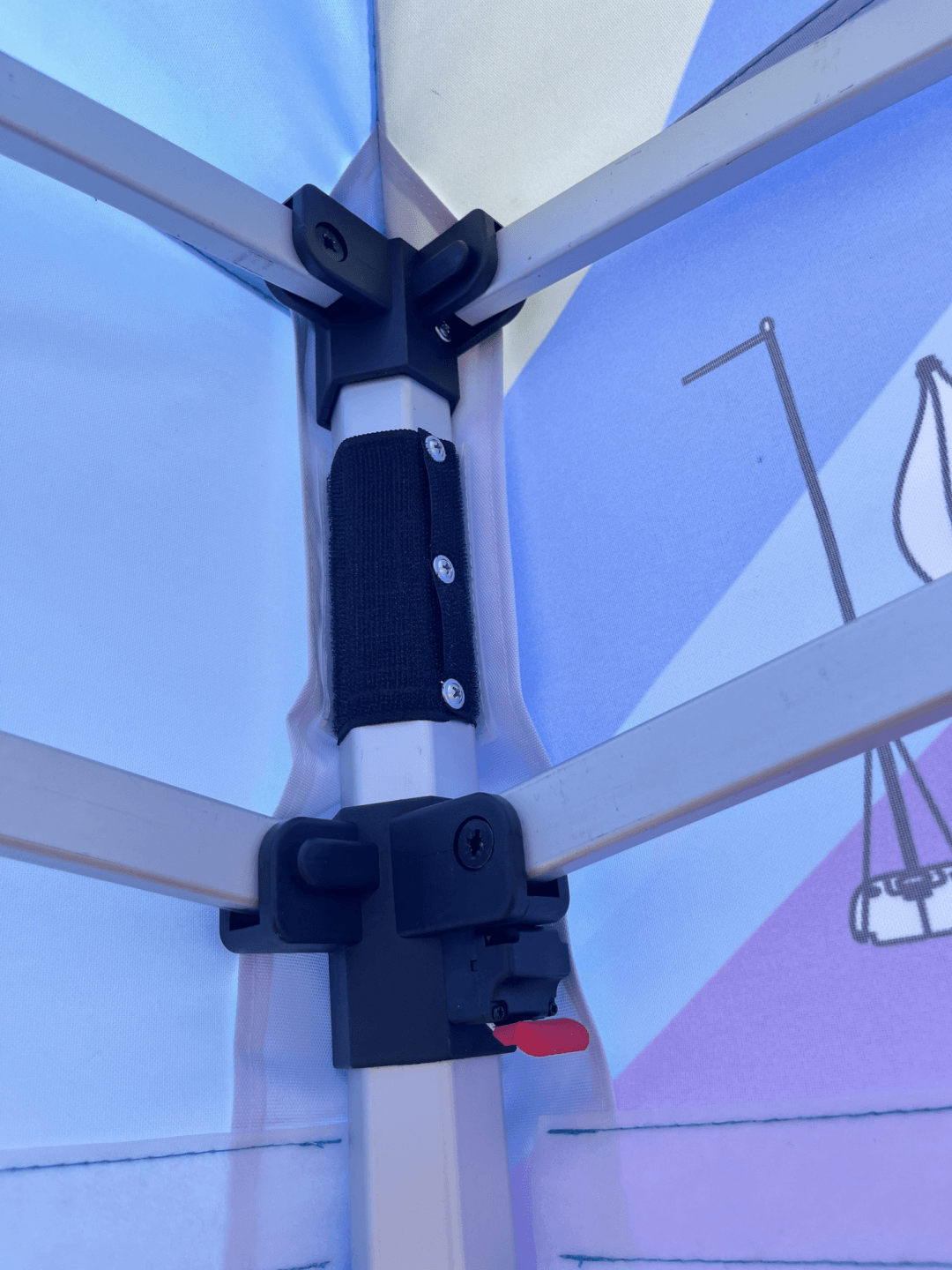
The corner a serious buyer inspects: the scissor joint, the pull-pin height lock with its red release, the footplate bolt, and the velcro straps that pull the printed canopy tight to the eaves. Joints and locks are where an outdoor canopy tent earns its second season.
The engineering behind that difference in event tents is visible in two places. First, the scissor joints and pull-pin height locks of the pop-up gazebo: plastic fittings and locking pins are the parts that wear, and a joint that develops slop after one season of November winds will rack the whole frame until the canopy bags. Second, the truss geometry of the pop-up canopy tent: the crossing tubes under the roof spread load from the centre of the canopy out to all four legs, so rainwater pooling in a sagging canopy tent does not concentrate on a single fitting. Buyers inspecting a folding gazebo should open one to full height in the showroom, lock it, and press down on the apex of the event tent: the frame of the pop-up canopy tent should take the load through the truss without creaking at the joints, and the height locks should hold without creeping. Thirty seconds of that test on a folding gazebo predicts a decade better than any certificate in a catalogue.
Germany, mid-November onward: the Christmas market stall tent season
From the middle of the month, the German Christmas market season gives the pop-up canopy tent its longest engagement of the year. Cologne opens around 16 November, Munich on 20 November, Frankfurt on 23 November, each with its row of market stall tent pitches, and Nuremberg's Christkindlesmarkt — the most famous market stall tent season of them all — runs from 27 November to Christmas Eve, six days a week of trade in freezing weather, most of it conducted from a canopy tent. The classic wooden huts dominate the postcards, but a market stall tent dominates the commerce, and the ecosystem around them runs on folding structures, with the folding gazebo as the backbone of that ecosystem: the overflow market stall tents, the back-of-house preparation shelters, the craft workshops running children's activities under a canopy tent, and the markets in smaller towns where a market stall tent is the standard unit of trade. A German market pitch is narrow, roughly two metres of frontage for the market stall tent, and the 3x3 m footprint of a market stall tent with a back wall and half side walls matches it almost exactly — enclosed on three sides against the cold, open on the selling side, roof printed or plain according to the market's rules — and a printed canopy tent is the version that pays for itself by Boxing Day. For traders who follow the market circuit from town to town through Advent, one folding gazebo does the work of a joiner's workshop, and folds back into the van at the end of every trading day of the Advent season.
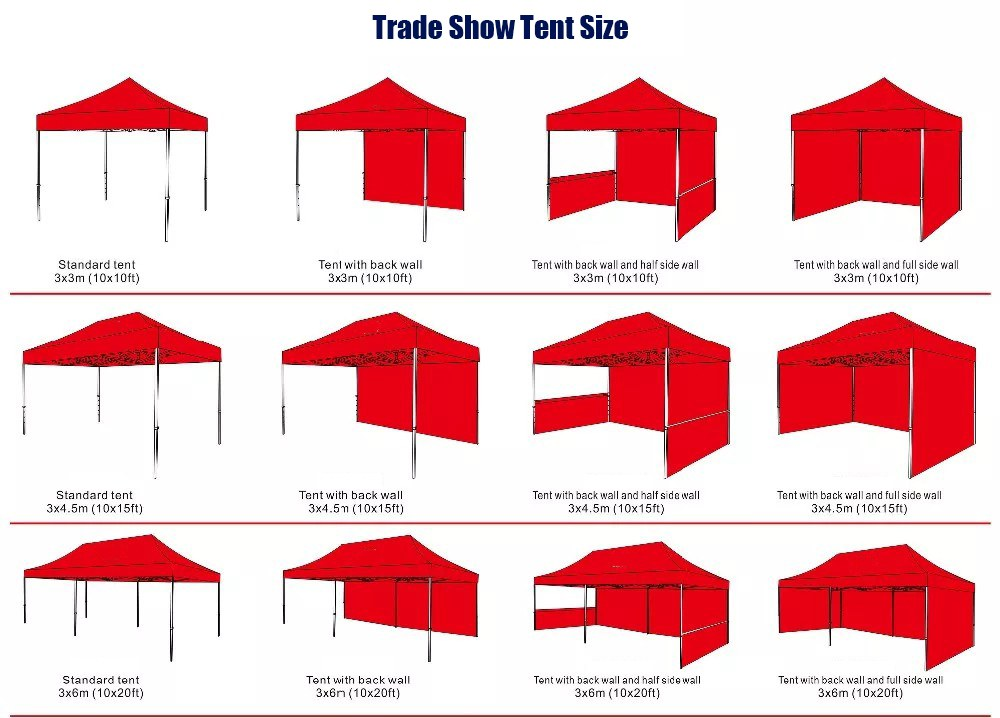
The size-and-wall map of the family: 3x3 m (10x10ft), 3x4.5 m (10x15ft) and 3x6 m (10x20ft) trade show tents, each available as a standard open tent, with a back wall, with back wall plus half side wall, or fully enclosed. The footprint decision and the wall decision are separate orders on every quote.
The German season also settles the walls question for the trade show tent better than any other market. Open tents are summer equipment; November trade wants an enclosed outdoor canopy tent, and the family of event tents offers it as options rather than afterthoughts: a back wall for weather and branding, half side walls as serving counters and windbreaks, full side walls when the stall must close, and zip-together modules when the pitch of the market stall tent demands it. The same 3x3 m trade show tent that works a Christmas market as a closed booth reopens in spring as a sun-shaded market stall, which is precisely why the walls of a trade show tent are sold as a separate line on the quote: buyers configure the walls of a pop-up canopy tent per season, not per frame.
One product family: the frames, sizes and walls of the pop-up canopy tent
Across all four events the hardware is the same family, and the buying decisions for a pop-up canopy tent reduce to three. The first is frame material of the event tent: powder-coated steel for budget volume and weight stability, aluminium for the lighter frames that two people carry all day — the standard trade-off of the category, and worth deciding before comparing canopy tent quotes. The second is footprint: 3x3 m (10x10ft) of canopy tent is the standard market and exhibition pitch, the volume seller worldwide and the classic pop-up gazebo size; 3x4.5 m (10x15ft) fits the double pitch and the larger activation for a growing market stall tent business; 3x6 m (10x20ft) is the hospitality event tent, the inventory unit that covers a bar, a stage front or a fleet of tables. The third is the wall configuration of the pop-up gazebo, chosen per deployment: open for summer fairs, back wall for branding and wind, half side walls for serving, full enclosure for winter and for secure overnight storage of the pop-up canopy tent. A buyer who answers those three questions — material, footprint, walls — can quote a pop-up canopy tent in one email, and a supplier's entire range collapses into a table of those three columns.
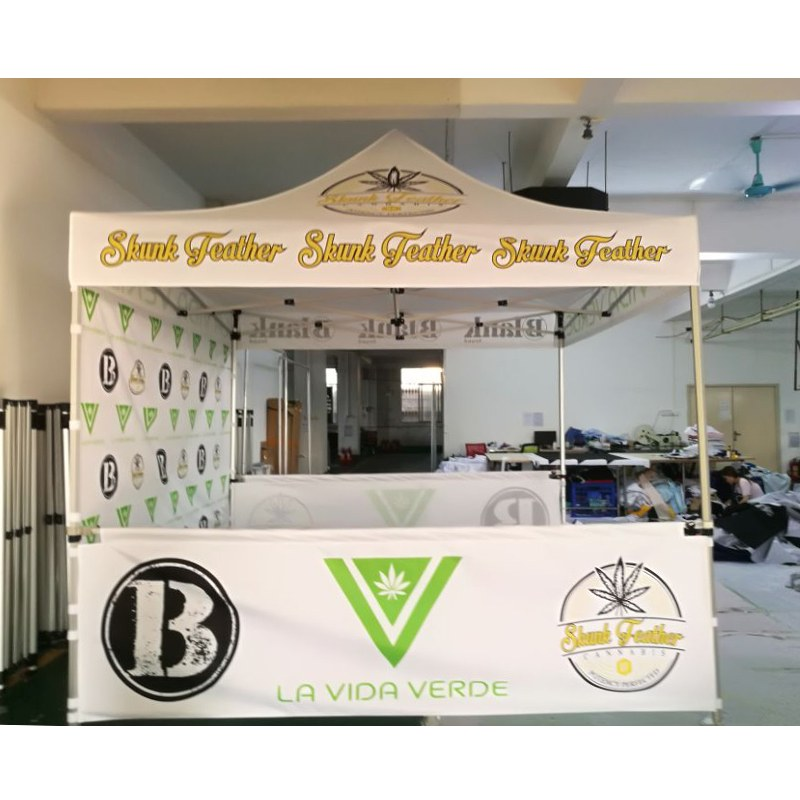
A fully enclosed custom canopy tent built out with printed back wall, side walls and branded counters: a closed room of printed fabric on a folding frame. For exhibitors, this is the 3x3 m booth that arrives as two cartons and reads as a shop.
Set-up speed is the family's other universal selling point, and for an event tent it is worth specifying honestly. The scissor frame of a 3x3 m folding gazebo opens by one or two people walking the legs apart; the 3x6 m frames of the event tent want a second pair of hands. Canopies strap to the frame of the canopy tent at the corners and pull tight at the eaves with velcro and buckle fittings; walls attach along the same eaves with the same fixings on the pop-up canopy tent. The full set-up of a 3x3 m canopy tent is a few minutes of work, tool-free, and the strike is faster than the set-up. Event crews time a pop-up canopy tent the way chefs time a kitchen: an event tent that takes twenty minutes to pitch never gets pitched early, and a pop-up gazebo that takes three minutes gets pitched in the rain without complaint.
Buyer reference: what to inspect on a pop-up canopy tent before the first order
The category looks uniform in a catalogue — square roof, folding legs, one canopy tent much like another — and the differences that decide whether a canopy tent lasts one season or five are all in the details. Ten points cover the inspection of a pop-up canopy tent.
- Frame material and leg gauge of the pop-up canopy tent: powder-coated steel for weight stability in wind, aluminium where the frame is carried daily. Ask for tube dimensions in millimetres, not adjectives, and weigh the difference per event tent.
- Joint construction: the scissor joints and their locking hardware are the first wear points of any pop-up gazebo, and the line that separates a display-grade frame from a garden one. Positive locks, steel pins, and no slop when the pop-up canopy tent frame is locked open.
- Height adjustment on the event tent: pull-pin locks at multiple settings on each leg, with the pin captured so it cannot be lost in the grass. Check the locks of the pop-up gazebo hold under load without creeping.
- Canopy fixing on a printed canopy tent: velcro straps and buckles at every corner and eave, not just grommets over ball bungees, the cheapest fixing in the event tent trade and the first to fail. A printed canopy tent that flaps loose at the eaves wears out its print and its neighbours' patience at once.
- Roof fabric and print of the canopy tent: full-dye polyester for colour depth and photo-accurate branding, with PU coating for water. Confirm print is on the canopy tent itself, not a valance only.
- Wall options on the outdoor canopy tent: back wall, half side wall, full side walls and zip-together modules offered as separate lines, because the wall configuration is a per-event decision on every deployment of the event tent.
- Ballast story for the outdoor canopy tent: leg-weight plates, sandbag kits and stake options available with the order, because a pop-up canopy tent held down by hope is the industry's most reliable November insurance claim.
- Spare parts for a market stall tent fleet: replacement feet, joints, pins and a spare canopy are the running cost; a supplier who sells a single replacement part saves the buyer a replacement market stall tent.
- Carton data: packed dimensions and weight per carton decide whether one person can move a pop-up canopy tent from van to pitch, and they decide the freight bill of the event tent order even faster.
- Colour consistency across the custom canopy tent order: one proof across canopy, walls, table covers and flags. Activation buyers standardise the whole custom canopy tent kit on one supplier for exactly this reason.
Eight questions before the first pop-up canopy tent order
Institutions, market operators and activation agencies buy the pop-up canopy tent at volume, and the process that works at any volume is the same: settle eight questions about the canopy tent in order, because each answer constrains the next. Worked through honestly, the list converts 'we need some shelter' into a quotable line item for a pop-up canopy tent order.
- How many people set up the folding gazebo, and how often? Daily movement demands the lighter aluminium frame of a folding gazebo; weekly deployment forgives steel weight in exchange for wind stability.
- What footprint does the pitch or booth licence allow? A 3x3 m canopy tent fits the standard market pitch; a 3x6 m event tent needs the double pitch most venues sell separately.
- What weather does the season promise? Wind and cold push the specification of a pop-up canopy tent toward enclosure and ballast; sun pushes toward the printed roof as the primary asset.
- What must the roof say? A printed canopy tent is ordered around its artwork — confirm that artwork before the frame, because the proof drives the printing schedule.
- Will the stall trade in the evening or the cold? Then walls are not options but part of the base configuration of the outdoor canopy tent.
- Hard standing or grass? Hard ground means weight plates and no stakes; grass allows stakes — order the ballast kit that matches the venue of the event tent, not the cheaper one.
- How many units work together? Multi-tent layouts of pop-up gazebos need gutter kits or matched eave heights, and a fleet of trade show tents needs one colour proof across all of them.
- What travels in the spares box? One spare canopy and a set of pins per five pop-up gazebo frames keeps a market fleet trading through the season.
The three buying mistakes on a canopy tent, and what each one costs
Three mistakes recur in the pop-up canopy tent category, and all three are visible only after the first bad weekend — which is what makes them worth naming before the canopy tent order instead.
- Buying on the photograph. Every frame looks sturdy and every roof looks taut in a product image of a canopy tent. The truth is in the leg gauge, the joint fittings and the canopy fixing of a folding gazebo — none of which photograph — which is why a sample pitched once on the buyer's own ground is the correct basis for a first order of a canopy tent.
- Buying the frame and forgetting the ballast. The tent itself is not the failure point; an unweighted pop-up gazebo in a November gust is. Order the weights with the pop-up canopy tent, and brief the crew that the weights go on at set-up, not when the forecast turns.
- Buying without the spare-parts line. Feet, joints, pins and replacement canopies are the running cost of an event tent fleet; a supplier who cannot ship one velcro strap turns a two-dollar repair into a grounded market stall tent for the weekend.
MOQ, proofs and freight for the pop-up canopy tent
The order mechanics of the pop-up canopy tent are friendlier than most buyers expect. Minimum order quantity for a pop-up canopy tent is typically one piece, which makes the category unusually easy to trial: a market trader or an activation agency can order a single printed canopy tent, pitch it once at a real event, and commit to a fleet of pop-up canopy tents only after the photos come back. Tooling exists for the standard pop-up gazebo frame sizes, so there is no mould cost on catalogue models; where customisation of the event tent is required — a special footprint, a branded wall, a non-standard height — sampling is quoted separately and the sample event tent normally ships in one to three days from confirmation, with electronic proofs of the printed canopy tent artwork before that. Goods move on EXW or FOB terms from Guangzhou, Shenzhen or Foshan depending on the routing, and by express, air or sea depending on the deadline of the event tent order. The timing rule for this event tent category is set by the calendar itself: sea freight for a European Christmas season or a Mexican festival week must be booked in early autumn, because a canopy tent that misses the boat misses the season — and November does not move for anyone.
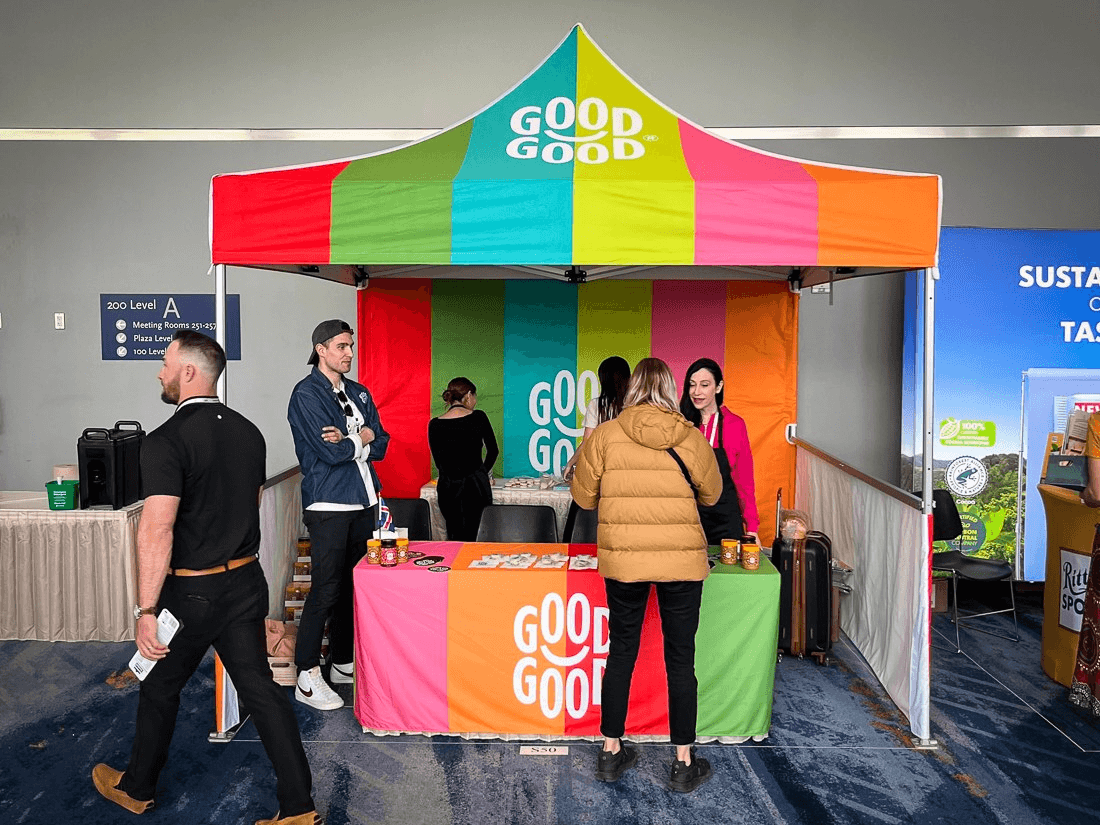
The same product indoors: a printed canopy tent working a trade-show floor as a complete booth. One frame serves the outdoor season and the indoor exhibition calendar, which is what makes the trade show tent the most fully employed item in a brand's display inventory.
The fortnight in one paragraph
Between Saturday 31 October and the middle of November 2026, three continents will run their most weather-exposed events of the year, and the pop-up canopy tent is the common denominator: a Día de Muertos festival that fills Mexico City with a week of street commerce under a market stall tent on every block, a Cup Week in Melbourne built on temporary hospitality and the event tent, a Bonfire Night in Britain staged against the cold and the dark, a folding gazebo over every burger stand, and a German Christmas season that trades through frost under a canopy tent until Christmas Eve. Every one of those dates needs a canopy tent that assembles in minutes, carries a brand, folds into a van and goes back out the next day. That is the whole specification of the pop-up canopy tent — a folding gazebo that a market stall tent trader owns outright, prints once, and deploys for a decade of Novembers. The calendar repeats every year; the pop-up canopy tents that meet it well are the quiet volume business of every display factory in Guangdong.