


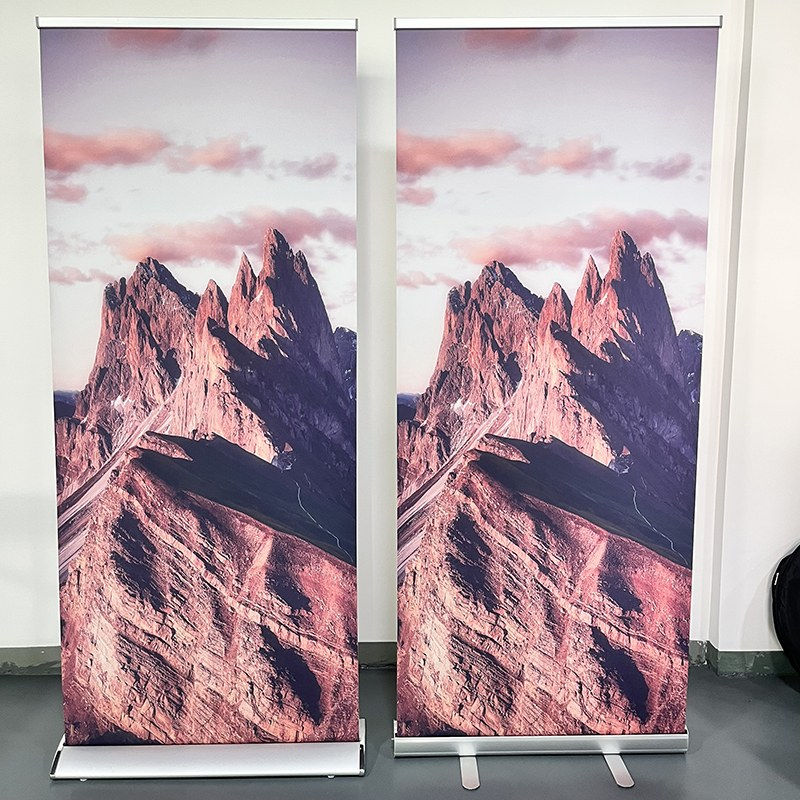
Print Season: November Is the Month the World Hangs Its Message
Why the four weeks between the 100th Macy's Parade and the first German Christmas market weekend are the busiest days of the year for banner printing - and what buyers check before they order
Ask a retail buyer which month carries the most printed fabric in the western world and most people will guess December, never the printed banner month underneath it. The professionals know it is November. The printing and hanging happen now: the street banner programs go up on the lamp posts, one custom banner at a time, the vinyl banner stock comes off the rolls for storefronts and the promotional banner panels follow, the mesh banner panels get tied to fences as every fence banner of the season goes up, and every shopping street from Manhattan to Munich re-dresses itself for the six weeks that decide the year. Four dates drive it: the 100th Macy's Thanksgiving Day Parade marches through Manhattan on Thursday 26 November, Black Friday follows on the 27th, Small Business Saturday keeps the independent traders busy on the 28th, and the first German Christmas markets open their lanes in the middle of the month. Four very different stages, one shared prop: a printed banner, an event banner or a promotional banner - the same ink, three jobs.
There is a simple economics lesson underneath the colour. Per square metre of city visibility, nothing competes with an outdoor banner. A billboard rents you a structure; a custom banner is the structure and the message in one, and when the season ends the outdoor banner comes down, folds into a carton and waits for next year's artwork. Buyers who understood that years ago now treat the printed banner the way a printer treats ink: an outdoor banner bought in batches, re-printed per campaign, hung by one person with a drill and a ladder, the way every vinyl banner and mesh banner is hung. Buyers who never did are the ones paying billboard rates for four weeks in November.
This week we walked through our printing floor in Foshan - past the finishing tables where hems are welded and grommets are punched in rows, past racks of rolled prints waiting for container day - and pulled together what buyers actually ask, check and get wrong about a printed banner when they order a custom banner for the season. If your November starts with a parade route, a sale or a market lane, the next fifteen hundred words are the custom banner checklist.
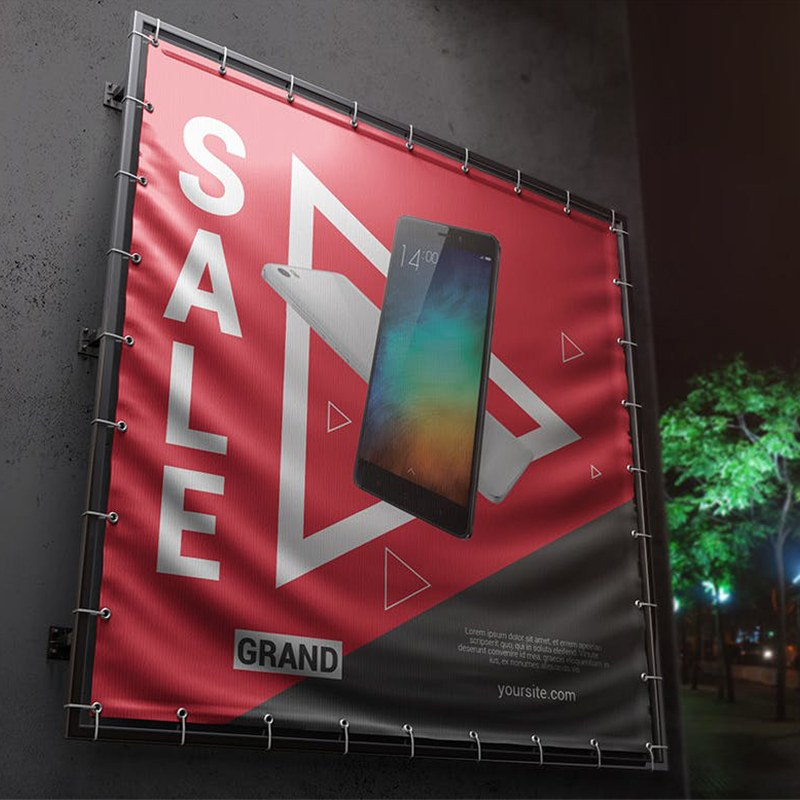
A framed vinyl banner on a night street: welded hem, grommets on every edge, tensioned to a frame. Hung after dark, trading by morning - the working definition of banner printing at retail speed.
Thursday 26 November: the 100th Parade and a city dressed in custom banner fabric
The Macy's Thanksgiving Day Parade turns one hundred this year, and the event banner count along its route is a print program in itself. The first parade walked in 1924; the 100th marches through Manhattan on Thursday 26 November from 8:30 in the morning until noon, broadcast live on NBC, Peacock and Telemundo under hanging banner rows - a tradition that has run on NBC since 1953. The centennial lineup is the biggest in the parade's history, and the street banner budget behind it is the biggest in the city's year: one hundred inflatables, new giant balloons including Sorcerer's Apprentice Mickey, Hello Kitty and Bluey, and a tribute float to Tony Sarg, the puppeteer who started it all. Millions of spectators line the route to Herald Square, and hundreds of millions more watch from kitchens across America while the turkey rests.
Now look at that route the way a print buyer does. Long before the first balloon is inflated, the city has been dressed in printed banner fabric: street banner rows on the lamp posts along the avenues, hanging banner panels across the department store facades, one hanging banner per bay, sponsor flags and fence banner runs around the staging areas, every fence banner surveyed on the Upper West Side where the balloons are inflated the night before. A city-scale event like this is ordered not as decoration but as a print program - hundreds of banner panels, one artwork system, every bracket position surveyed. The lesson for any buyer planning a town festival, a county fair or a shopping-centre centennial of their own: the fabric is the last thing installed and the first thing photographed - the whole economics of banner printing, which is exactly why the order was placed months earlier.
One street banner detail parade-city buyers always confirm in writing: the bracket. A street banner hangs on two steel brackets per pole, sized to the printed banner panel's pole pockets, and a pocket sewn 2 centimetres short is the difference between a taut, wind-reading banner panel and a sagging one that flogs itself loose by the second week. It is a five-centimetre detail that decides whether the street banner looks dressed or undressed for the biggest morning of its year.
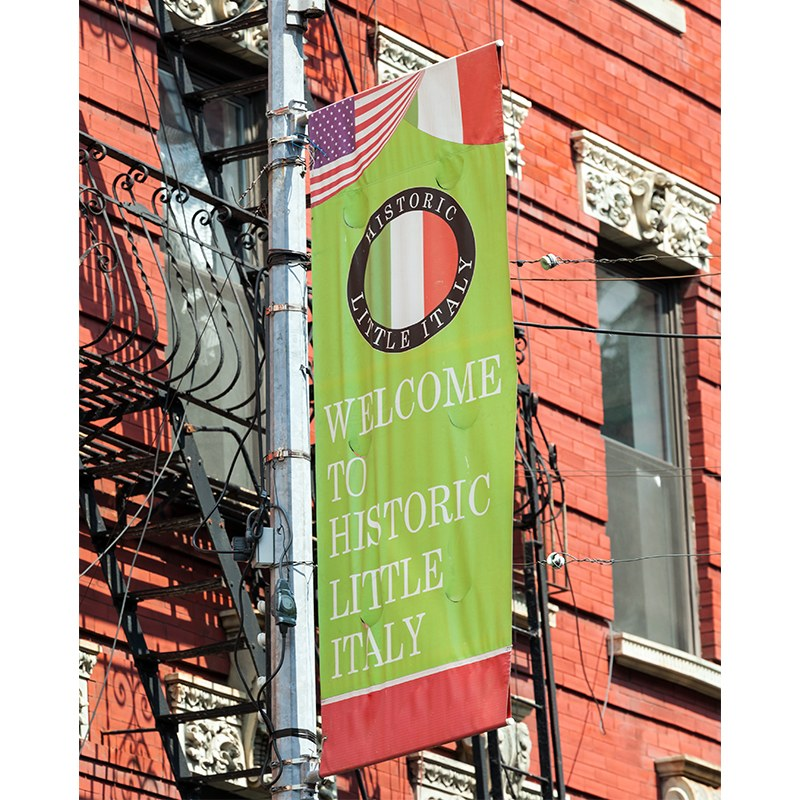
The street banner format at its best: pole pockets top and bottom, double-sided print, sized to the lamp-post brackets of a neighbourhood district - the classic pole-banner format. Panels like this hang for a season and come back for the next one.
What a vinyl banner actually is - the anatomy that decides a vinyl banner's life
Strip the branding off a professional vinyl banner and you are looking at a sheet of PVC-coated scrim - polyester threads locked between two vinyl layers - with every property that matters decided at the finishing table. A buyer who checks five things can predict the lifespan of a printed banner - vinyl banner, mesh banner or custom banner - more accurately than any brochure:
● The weight. Standard grade for a vinyl banner is 13 oz scrim vinyl (roughly 370 gsm) - the workhorse of the trade. Economy 10 oz suits short indoor promotions; 18 oz blockout is the opaque, double-sided custom banner grade for premium positions.
● The hem. Edges should be welded (heat-folded and pressed), not merely trimmed. A welded hem turns the edge into one continuous sheet, which is why a vinyl banner fails in the middle of a storm far less often than a cheaply stitched banner.
● The grommets. Metal eyes every 50-60 cm (24 inches) on all four sides of the printed banner, with corner reinforcement patches. Grommet spacing is not decoration - it is the load path that carries the whole vinyl banner in wind.
● The print. Dye or solvent inks at 720-1440 dpi on the machine; artwork supplied at 150 dpi at full size prints sharp from a pavement away. This is the single most common artwork mistake in banner printing, and it sinks more custom banner orders than price ever does - files built at 72 dpi for a screen, ordered at 6 metres wide.
● The UV and the cold. An outdoor banner wintering in Chicago or Hamburg needs a vinyl banner and inks rated for freeze-thaw, or the laminate whitens and cracks by February. Ask what the material is rated for, in degrees, not adjectives.
Buyers sometimes ask why we keep photographing the back of every printed banner panel in our quotations. The answer is that the front of any custom banner looks the same in a photo. The back of a custom banner - the hems, the weld lines, the grommet backs - is where the difference between print shops is hiding.
Hem and grommet detail on a printed banner panel: welded edge, brass eyelets on the corners and midpoints. The finishing table, not the printer, decides how long the printed banner lives.
Vinyl or mesh: the wind decision every vinyl banner buyer gets wrong once
The two surface materials in this category are not rivals; they are answers to different wind questions - one solid vinyl banner, one air-permeable mesh banner. A solid vinyl banner blocks the air completely, which is what you want on a wall, a storefront or a framed hoarding - flat face, maximum contrast, full-colour artwork uninterrupted. Tie the same solid banner panel to an open fence and the wind turns that outdoor banner into a sail: the load grows with every gust until the weakest grommet on the printed banner - or the fence itself - gives up.
A mesh banner solves the wind by letting part of it through the printed banner face. The PVC mesh is perforated with thousands of microscopic holes, air-permeable enough to drop the load on a fence line, a scaffold wrap or an open-field perimeter by half or more, while still carrying readable artwork from a distance. The trade is honest: mesh banner stock is slightly translucent, so contrast drops in direct back-light and fine text suffers. The rule of thumb buyers converge on: solid vinyl banner stock for anything mounted on a structure, mesh banner panels for anything hung in open wind - and on coastal or elevated sites, mesh every time, no exceptions.
● Solid fence runs and chain-link barriers take a mesh banner: mesh banner panels with grommets every 50 cm and a rope or bungee tie-through every fourth grommet.
● Scaffolding and building wraps: heavy mesh banner grades, pocketed top and bottom, fixed to the scaffold frame - never to the building.
● Storefront and interior walls: a solid vinyl banner, framed or bungee-tensioned, where the wind never reaches the face.
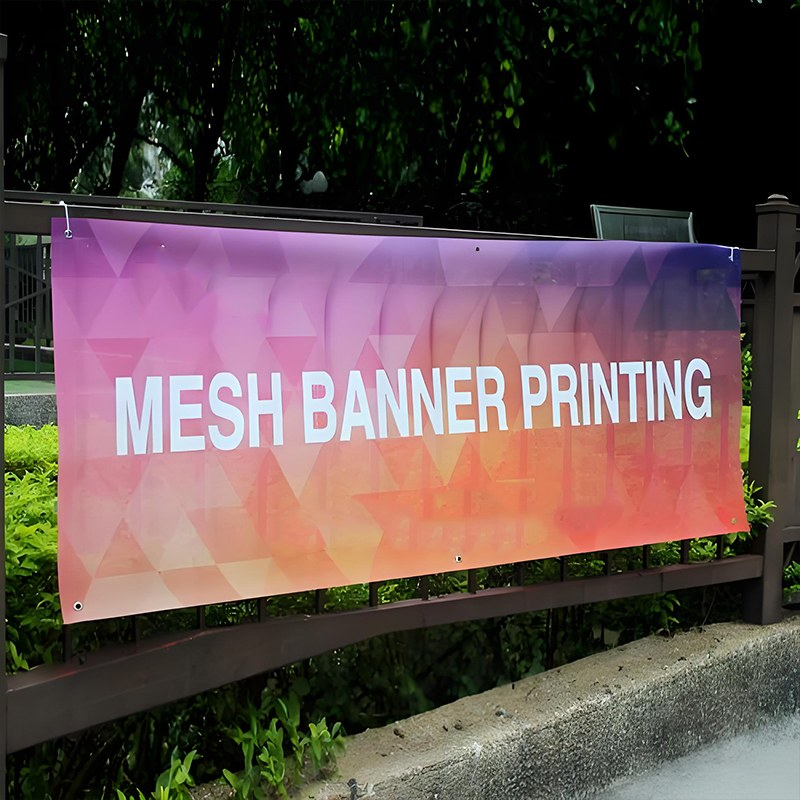
Mesh banner printing on a park fence: air passes through, the printed banner panel reads clean, and the fence keeps its shape in a gust. The format for every open-wind position from sports fields to construction hoardings.
Friday 27 November: Black Friday and the promotional banner arithmetic of a sale weekend
Black Friday lands on 27 November this year, with Small Business Saturday on the 28th and Cyber Monday closing the weekend on the 30th. For a print floor, that single weekend is the busiest promotional banner shipping window of the year: sale banner panels for storefronts, banner printing for car dealerships forecourts, vinyl banner runs for supermarkets, a hanging banner order for every mall, mesh fence banner stock for garden centres, and a hundred thousand small traders discovering on the Tuesday before that their storefront custom banner still wears last year's message.
The buyer maths that makes this weekend work is unglamorous. A 3 x 1 m vinyl banner covers a shopfront for a cost per visible day that no other local medium touches - and unlike a billboard, the printed banner is owned, not rented: the outdoor banner comes back after the sale, and next quarter only the vinyl banner print is re-ordered. Independent traders who standardise on one or two banner sizes discover a second benefit: the frames, bungees and brackets are bought once, and every seasonal banner re-print drops straight onto hardware they already own. That is the quiet pattern behind Small Business Saturday - the shops that look dressed every season are not spending more on banner printing, they are re-printing less often, onto hardware that never changes.
One more number worth knowing before the weekend: lead time. A straightforward custom banner order moves from artwork to dispatch in days, not weeks - e-proof in 1-3 working days, production behind it, air freight for the urgent single pieces. What does not work is the Friday-before-Friday container order for outdoor banner stock; the buyers whose promotional banner stock always arrives on time are the ones whose order book closed in October.
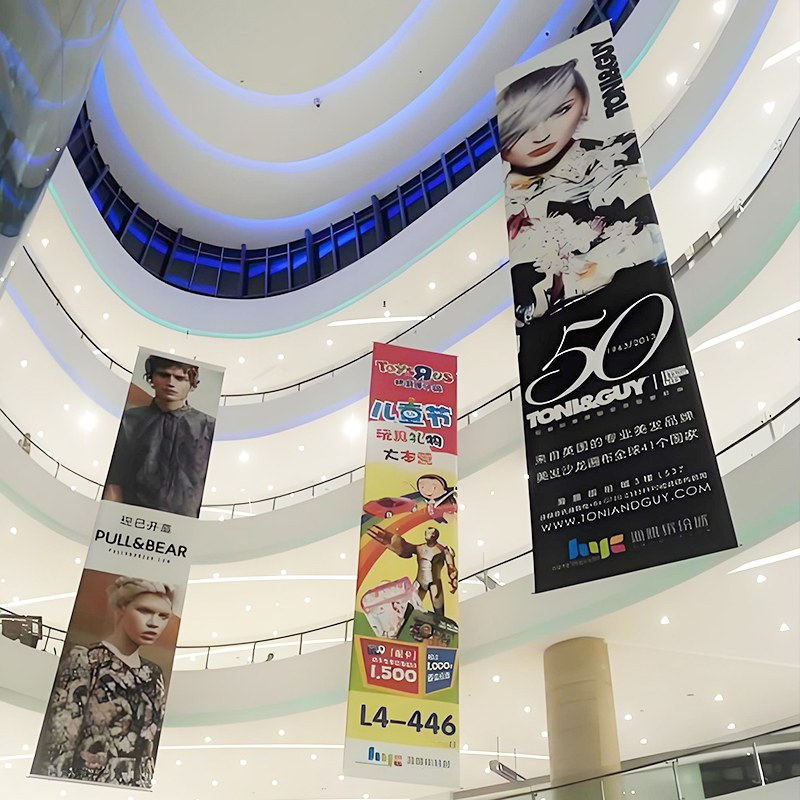
Where the volume goes: hanging banner rows in a mall atrium, each printed banner a different campaign on the same pocket-and-hanger system. One hardware platform, many prints - the fleet logic of retail banner printing.
Mid-November: the German Christmas markets open their lanes in printed banner weather
While American retail prints its sale weekend, Europe builds its villages. The German Christmas markets open through the second half of November - Cologne's markets around the 16th, Munich's from the 20th, Frankfurt's from the 23rd, and Nuremberg's Christkindlesmarkt, the most traditional of them all, from 27 November through Christmas Eve. Dresden's Striezelmarkt, first documented in 1434, opens its 592nd edition. Millions of visitors will walk lanes barely wide enough for two, past promotional banner boards and wooden stalls dressed for the season, in weather that runs from autumn mild to snow.
Look at those lanes the way a market trader does. Every stall front is a printed banner position: a name board, a produce banner, a small promotional banner above the counter - and because the same wooden stall frame stands in the same spot for six weeks, the fabric - usually a vinyl banner, sometimes mesh - has to survive sleet, freeze-thaw and six weeks of thermal cycling between mulled-wine steam and night frost. The traders who return year after year print on heavier vinyl, hem their banner panels against the frame itself, and re-print only when the artwork changes. It is the same custom banner consumable logic as Black Friday, at a different temperature.
The forward anchor for those buyers is already visible: Boxing Day on 26 December opens the January sale season in Britain and Australia, and the Boxing Day banner panels are ordered now, in the same container as the Christmas prints. One shipment, two seasons - the container arithmetic that separates a planned print program from a year of panic air freight.

A wide event banner strung between trees in a park: rope-through grommets, tensioned for wind, legible across the whole lawn. The municipal format for festivals, openings and every season that needs one big sentence.
The fence economy: the fence banner economy: sponsorship prints that pay for themselves
There is a corner of the trade where the printed banner panel is not a cost at all. Sports clubs, schools and local councils own hundreds of metres of fence line, and a fence banner with a sponsor's logo on it is rentable outdoor banner space: the sponsor pays for the season, the club pays nothing for the print, and both sides renew if the colour held. The specification that keeps those fence banner renewals coming is exactly the one amateurs skip - mesh rather than solid vinyl in open wind, grommets at close centres, UV-rated inks that survive a full summer without turning pastel. A sponsor whose printed banner fades by August does not renew in September.
The same print program scales down to a birthday in a garden and up to a stadium perimeter, and the buyers who run it well treat it as a system: one banner panel size, one tie-through method, one artwork template with the sponsor's slot where the logo goes. When the season changes, only the printed banner changes - the fence, the fixings and the template stay. It is the least glamorous and most profitable corner of banner printing, and it runs on exactly the printed banner panels shown below.
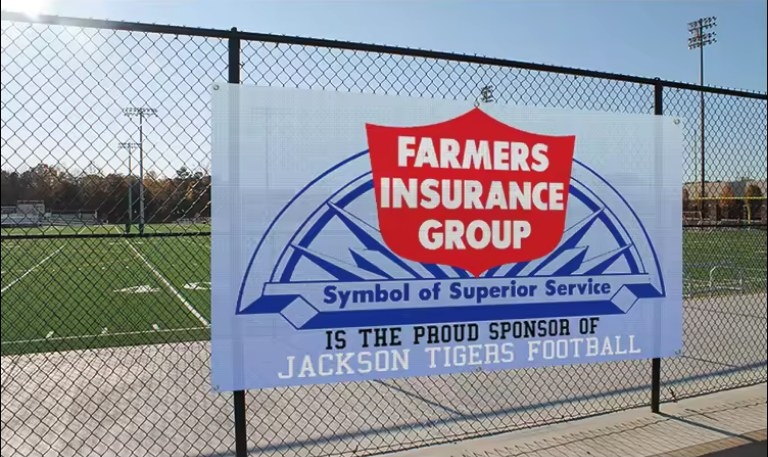
Fence banner panels on a sports field: sponsor artwork on mesh, tied through at close centres. The fence banner panel is a cost to nobody - the sponsor rents the visibility, the club rents the fence.
The artwork file: where most custom banner orders go wrong first
Between a good print and a re-print sits one email: the artwork check. The five errors arrive so reliably that we list them for every first-time buyer, because each one costs a production day when it is caught late:
● Resolution built for screens - 72 dpi artwork ordered at 4 metres wide. The fix is 150 dpi at full size, or vector files.
● RGB colour on a CMYK press. Brand blues shift, reds glow. Convert first, then check the proof.
● No bleed. Hems eat 3-5 cm per edge of the printed banner; a logo placed to the trim line disappears into the weld.
● Fonts not outlined. The print shop's computer replaces your typography with its own, and the proof of the custom banner looks like a stranger.
● One artwork ordered in two aspect ratios. A wide street banner squeezed into a square hanging banner distorts; each format earns its own layout.
Done properly, the ritual ends with an e-proof that matches the printed banner panel on the wall. Done casually, it ends with a very well-printed custom banner that says exactly what nobody asked it to say in public - and a very short email from the marketing department.
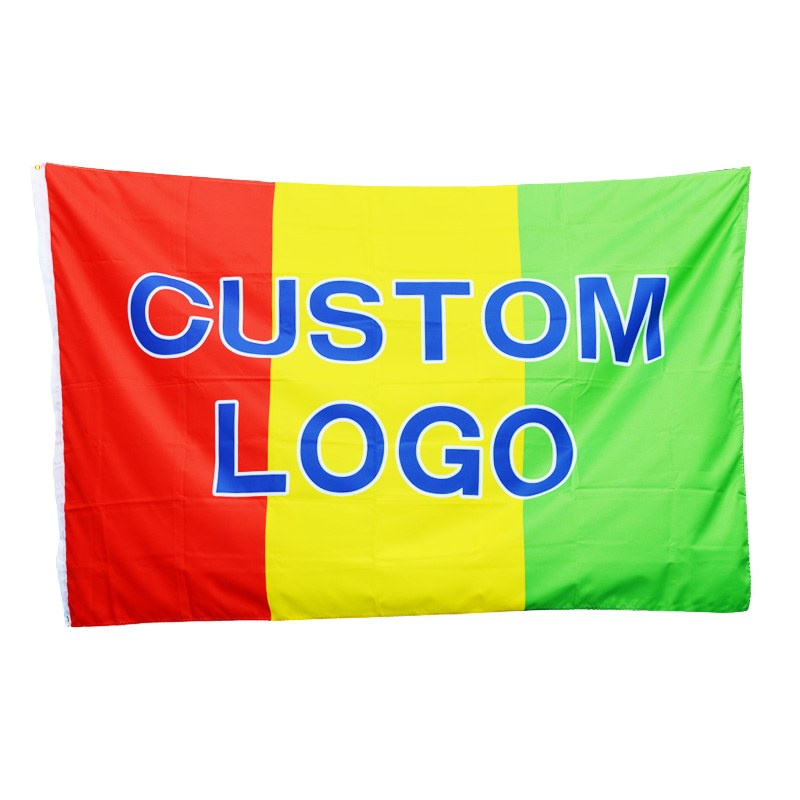
From the same print line: full-colour banner panels printed edge to edge with clean, saturated brand colour. The print is the easy half - the finishing table and the artwork file decide the rest.
A buyer's story: eleven weekends of banner printing on a market square
A traders' association we work with in a mid-sized German city runs a Saturday market that trades forty weekends a year. Two seasons ago the square looked patchy - every trader's banner was a different size, a different material, half of them solid vinyl banner panels sagging between the same four lampposts. The association re-based the whole square on two standard mesh banner sizes, one artwork template with each trader's name in the same type, and one set of shared brackets, so every printed banner hung identically. The re-print order now goes out once a season; the hardware has not changed since.
The numbers the association now reports: set-up per stall dropped from twenty minutes to under five with the shared brackets; the printed banner panels survive the full winter season without a single blown grommet; and when a trader leaves, the bracket stays and the next printed banner drops in. The fence banner runs around the car park - sponsor-funded, as described above - cover the fence banner program's cost entirely. It is the same story we hear from the parade-city print programs in New York and the Christmas market traders in Nuremberg: the buyers who treat the print as a system are the ones whose streets always look dressed.
The 10-point vinyl banner inspection we teach every buyer
Whether you are auditing last season's banner panels or inspecting a sample on arrival, these ten checks take twenty minutes and catch ninety per cent of future banner failures:
● Stretch a corner of the printed banner panel by hand - the print should not crackle or whiten at the fold lines.
● Run a thumb along every hem; a weld that lifts under thumb pressure will lift under wind.
● Count and wiggle the grommets; any eyelet spinning in its reinforcement patch is a failure waiting for a gust.
● Check grommet spacing against the quote - 50-60 cm centres, not the stretched-out 1 metre that saves the finisher money.
● Hold the vinyl banner up to light: even scrim weave, no thin streaks where the coating ran light.
● Read the printed banner from ten metres; halftone banding shows up at distance, not at the desk.
● Compare the printed banner colour against the approved e-proof, in daylight, not under office lamps.
● Measure the pole pockets on street banner panels against the bracket drawing, to the millimetre.
● Weigh a sample banner panel if the order is large; a 13 oz banner panel that weighs like 10 oz is really a 10 oz sheet.
● Photograph everything and keep it against the purchase order - re-prints are warranted, but only against evidence.
Eight questions to ask before you place the custom banner order
● What is the exact material weight of the vinyl banner in oz or gsm per grade - and is it scrim or non-woven?
● Are the hems welded on both faces or single-sided, and is there a corner reinforcement patch?
● What is the grommet spacing and grommet metal on the printed banner - brass or plated steel?
● Which ink system is used, and what is the outdoor banner UV life in months, in writing?
● Is the mesh banner grade air-permeable by specification, and what wind load does the mesh take off the fence?
● What artwork format does the prepress team want, and is an e-proof included in the price?
● What is the rolled-versus-folded packing choice for my banner panels, and how does it change freight?
● Which spare hardware - brackets, bungees, pocket tape - ships with the order, and at what price?
Three mistakes buyers make with a printed banner
Mistake one: buying the cheapest square metre. A promotional banner is quoted per square metre, and the cheapest custom banner quote is usually the lightest material with the widest grommet spacing and a stitched hem. It will look identical on the day the vinyl banner is hung and torn by the day it matters. The honest comparison is landed cost per season of service, not per printed banner.
Mistake two: ordering solid vinyl banner stock where the wind lives. The banner panel does not fail alone; it fails with its fence, its frame and its fixings. The correct question for any outdoor banner is what the whole assembly holds in what wind on what fixings - and the honest answer comes in a range, not a single heroic number.
Mistake three: treating artwork as an afterthought. The most expensive banner panel in the trade is the one that has to be re-printed because the file was RGB at 72 dpi without bleed. Every operator who skipped the artwork check has a story about a deadline rescue by air freight; the story is never as cheap as the check.
Freight maths: rolled cartons, folded boxes and the printed banner container
Banners are the lightest products on our printing floor and the easiest to ship badly. A folded banner panel in a box costs a fraction of a rolled banner panel in a tube - but folding sets creases into the PVC that show as white lines across the printed banner, which is why premium outdoor banner grades travel rolled and standard vinyl banner stock travels folded, flat-packed into cartons that stack like books. Ask which banner grade ships which way before you compare quotes; the packing sheet changes the landed cost more than the unit price does.
For fleet buyers the deeper number is re-order velocity. A banner panel is a consumable: a shopping street re-prints per campaign, a market per season, a fence banner sponsorship program per contract. Buyers who standardise banner panel sizes across all of it can consolidate a whole year of banner printing - vinyl banner, mesh banner, hanging banner - into two or three containers a year, on a schedule they set - and their hardware, their templates and their freight forwarder all stop being puzzles.
Banner FAQ: the questions that arrive every November
Q: What is the minimum order for a custom banner? A: One piece. Every banner panel size and material grade runs from a single-unit minimum, an e-proof goes out in 1-3 working days, and a sample banner panel can follow by courier before a fleet decision.
Q: Vinyl or mesh banner for my site? A: Match the outdoor banner material to the wind, not the price list. Walls, frames and storefronts take solid vinyl banner stock; open fences, scaffolds and coastal sites take a mesh banner. If the printed banner panel will hear wind without a structure behind it, the answer is mesh.
Q: How long does an outdoor banner last? A: With UV-rated inks and the right grade, three to twelve months of continuous outdoor exposure depending on climate and sun, and many years in rotation for seasonal use where the printed banner panel comes down between campaigns. Lifespan of a printed banner is specified in months of exposure - ask for the number in writing.
Q: Can you match our brand colours exactly on a printed banner? A: Close enough to pass the daylight test, if the artwork arrives as CMYK or Pantone-referenced files. The proof, approved in writing, is the contract; the press matches the proof.
Q: Double-sided banner panels - how are they made? A: Two vinyl banner prints laminated with a blockout layer between, so neither face reads through in sunlight. Heavier and pricier than a single-sided custom banner, and the right answer for lamppost street banner programs where both faces face the traffic all season.
Q: How big can one banner panel be printed? A: Wide-format printers handle seamless custom banner panels of several metres; beyond that, banner panels are welded in sections with the weld placed away from focal artwork. Tell the print team the viewing distance and they will place the seams where nobody looks.
Q: Do you supply the printed banner hardware too? A: Yes - brackets for lamppost street banner programs, bungees and ties for fences, frames for wall-mounted banner panels. Because the printed banner panel is only half the system, most fleet buyers order the printed banner fixings on the same purchase order and stop improvising at install time.
Q: How are banner panels packed for export? A: Standard vinyl banner stock folded and flat-packed in cartons; premium, laminated and long-term outdoor banner panels rolled in tubes or on reels. The packing choice is on the printed banner quotation, because it moves the freight number more than the print price does.
Q: What turnaround should I plan for a seasonal banner re-print? A: An e-proof of the printed banner in 1-3 working days, production behind it, express air freight for urgent single pieces, sea freight for container programs. The honest planning number for a seasonal banner re-print is two weeks door to door by air, and a booked container slot for fleet volumes.
Q: Can one artwork feed several banner formats? A: Yes, if it is built as one banner system - one master layout, re-composed per aspect ratio, with the bleed and safe areas set per format. The template costs one hour of design time once and saves a printed banner re-print for years.
Q: Is a fence banner and a mesh banner the same thing? A: A fence banner is a position; a mesh banner is a material. Most fence positions take mesh because of wind, but a sheltered fence can carry solid vinyl. Decide the printed banner material after the site survey, not before.
Q: Do you print from our files or design the custom banner for us? A: Both. Most buyers send print-ready artwork and receive an e-proof; others send a logo and a sentence and the printed banner layout comes back with the proof. Either way, the proof is where the banner order is actually agreed.
Ordering, freight and lead times for a custom banner
We supply the full ladder - 10 oz economy through 13 oz standard to 18 oz blockout vinyl banner panels, air-permeable mesh banner grades, pole-pocket street banner formats, fence and hanging banner systems, and the brackets, bungees and frames that hang every vinyl banner and mesh banner. Minimum order is one piece; an e-proof of the printed banner panel goes out in 1-3 working days, and a physical sample can follow by express courier. Shipping is EXW or FOB from Guangzhou, Shenzhen or Foshan, and because flat-packed banner panels are volume freight rather than weight freight, a 40-foot container absorbs a season of printed banner stock for a whole shopping street - which is why banner printing programs are standardised onto one banner panel system and re-printed, rather than re-invented, campaign after campaign.
The first week of November is when the professionals quietly load their December with banner printing. New York is dressing its avenue for a hundredth parade, one street banner at a time. Munich is calling its traders to the square. The sale banner panels are already on the press for the 27th. Under every one of those decisions is the same custom banner purchase order, for the part everyone photographs: the printed banner.