


One wall, three fairs, three weeks: the straight tension fabric display enters Europe's October triple-header
Frankfurt opens its book fair on October 7 with Czechia as Guest of Honour, Friedrichshafen celebrates the 30th Fakuma from October 12, and SIAL Paris fills Villepinte from October 17 to 21. Three industries, three cities and thousands of very different stands — but one product behaves identically at all of them: a straight pop-up display that packs into a single carry bag and stands up in under ten minutes.
FRANKFURT / FRIEDRICHSHAFEN / PARIS — September 22, 2026
Three of Europe's biggest trade fairs open their gates on three consecutive weeks this October, and they could hardly be less alike. Frankfurter Buchmesse (October 7 to 11) is the world's largest publishing event, welcoming Czechia as Guest of Honour and debuting a new hall concept. Fakuma in Friedrichshafen (October 12 to 16) marks its 30th edition with more than 1,900 plastics-processing exhibitors and a brand-new Innovation Award. SIAL Paris (October 17 to 21) brings 8,000 exhibitors from 130 countries and 400,000 food products to Paris Nord Villepinte. Different industries, different buyers, different floors — and yet the same item sits at the top of every stand-fitting kit list: the tension fabric display, the freestanding display wall — an aluminum frame dressed in printed fabric — that turns an empty booth into a brand. Buyers walking all three fairs this month will pass thousands of printed walls, and most will be a fabric back wall or a display wall in one of five widths; whether the catalogue calls it a trade show backdrop or an exhibition backdrop, the tension fabric display is the common denominator of the season.
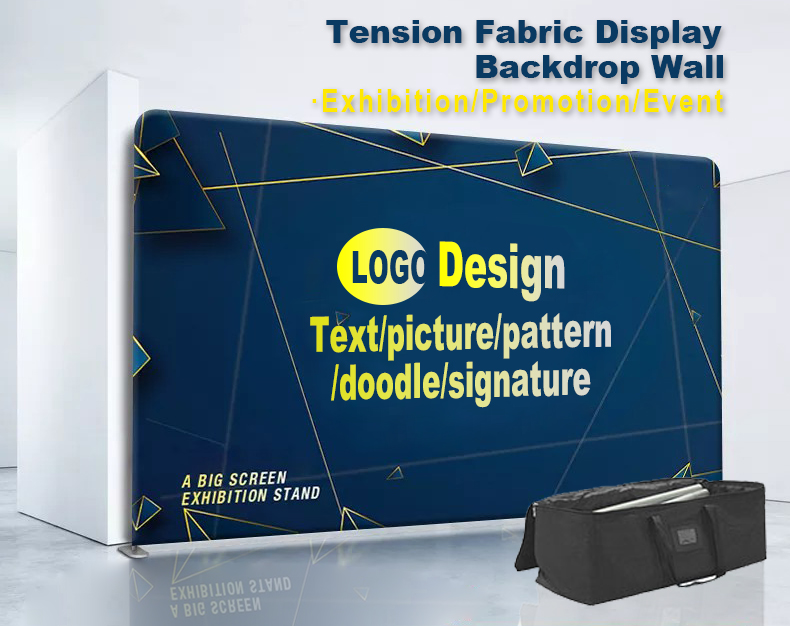
The straight tension fabric display in its shipping configuration: a 230×300 cm fabric back wall beside the wheeled carry bag that holds the entire kit — snap-together frame, zipped printed cover and flat steel feet. One bag, one person, one exhibition backdrop.
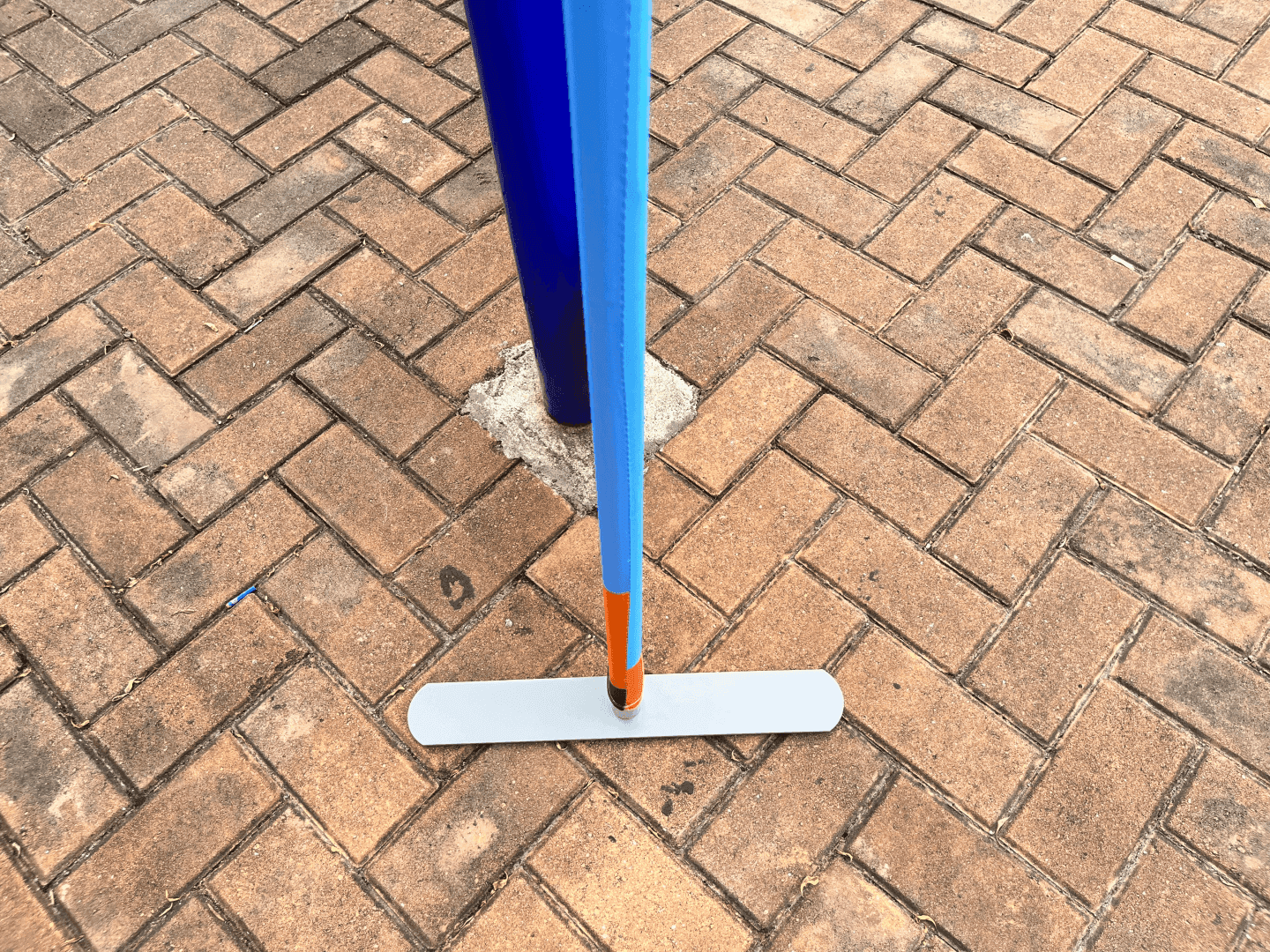
The product itself has barely changed in a decade, which is precisely why it keeps winning orders. A tension fabric display is an aluminum frame of snap-together tubes wrapped in a printed polyester cover that zips shut like a pillowcase. The fabric stretches over the frame under tension, which keeps the graphic wrinkle-free and edge-to-edge; the feet of the aluminum frame are flat steel plates that project only a few centimetres onto the booth floor. Standard straight sizes for this straight pop-up display run from 230×250 cm up to 230×600 cm, all standing a uniform 2.3 metres tall, so two or three units can be zipped side by side into one continuous fabric back wall — a backdrop wall run of up to six metres — without a visible seam. Assembly needs no tools, no ladder and — in most cases — no second person: the straight pop-up display is engineered so that whoever reaches the stand first finishes the build alone. For buyers comparing quotations, the detail that matters in an aluminum frame is tube thickness and joint type, because a display wall that wobbles at its first unzipping was built from tube that was too light.
From a buyer's desk, the first question is never what the trade show backdrop looks like; it is what the trade show backdrop weighs. A 230×300 cm tension fabric display packs into a wheeled carry bag small enough for a car boot, and the whole kit — frame, cover, feet and bag — is light enough for one person to handle unaided. Compare that with the rigid alternatives: foam-board panels crack in transit, roller blinds — the older trade show backdrop format — arrive dented, and a printed timber display wall eats a pallet on every leg of the tour. Because the backdrop wall travels as a bag rather than a crate, a marketing team can send it ahead as excess luggage instead of booking a dedicated freight line. A fabric back wall also has no orientation problem — it folds on any axis, while a rigid wall has to be crated exactly the way it stands — which is why the tension fabric display, not the panel-and-batten exhibition backdrop of the last decade, is what buyers now write into their autumn fair specifications.
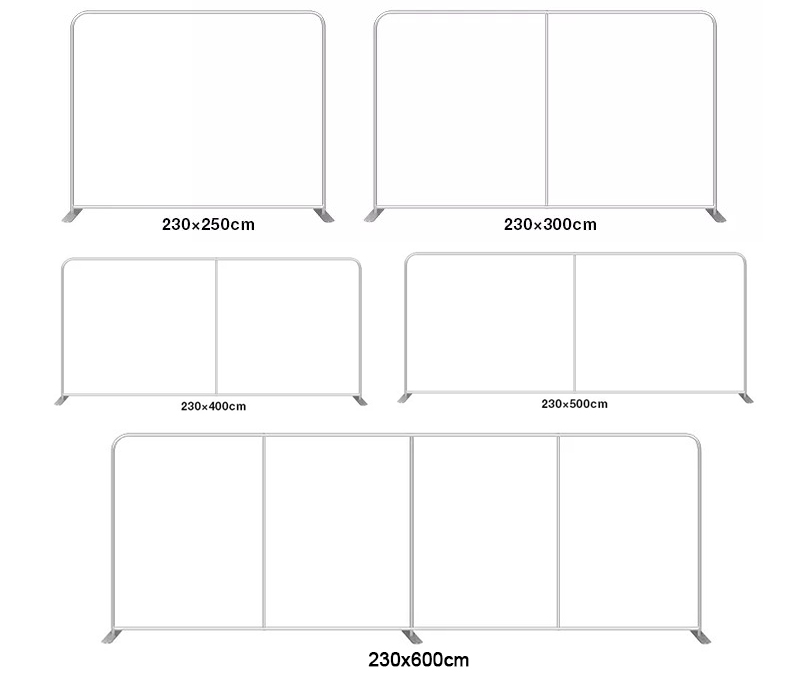
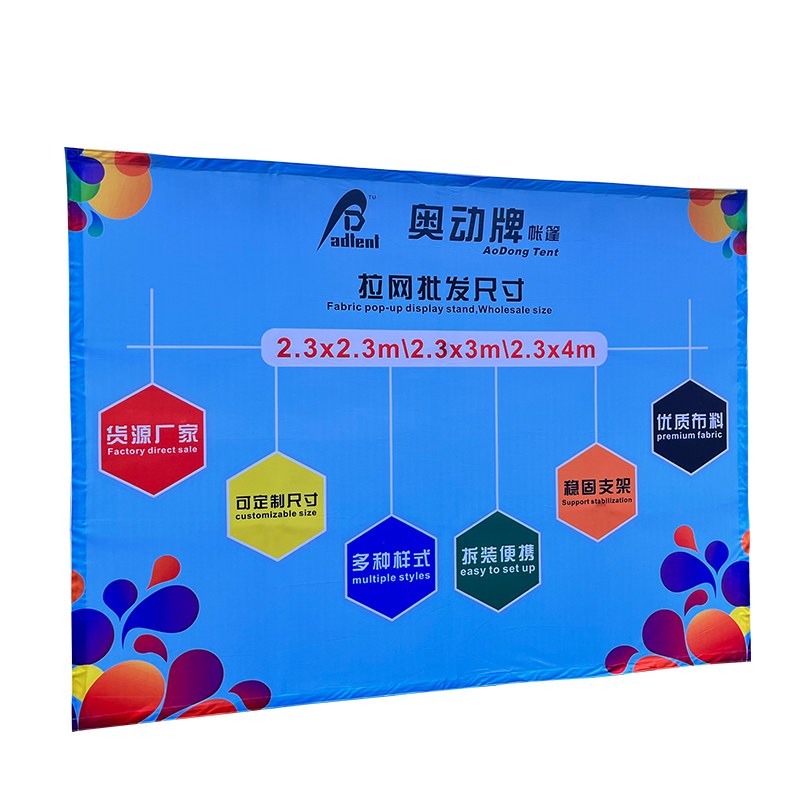
The straight pop-up display size ladder: 230×250, 230×300, 230×400, 230×500 and 230×600 cm. All five trade show backdrop formats stand a uniform 2.3 metres tall, so units can be zipped side by side into one continuous display wall for wider booths.
Frankfurt is the first stop. The 78th Frankfurter Buchmesse runs October 7 to 11 with Czechia as Guest of Honour, and 2026 brings the fair's most visible layout change in years: a new hall concept that concentrates international trade business on the upper levels while the ground-floor halls serve the general public. Set-up days run October 5 and 6, with every stand complete by 10 p.m. on the Tuesday. For publishers, that timetable is exactly where the straight pop-up display earns its keep: an exhibition backdrop that one person can stand up and zip closed in ten minutes turns a half-day display wall fitting into a coffee break, and leaves the crew free to argue about shelf plans instead of fabric back wall plans. An exhibition backdrop that is already standing when the aisle carpets go down — a display wall worth two site visits later in the week — is also the quiet reason set-up day ends on time at a fair of more than 4,000 exhibitors, which is what Frankfurt has been since 2025.
A 2.3×3 m straight pop-up display photographed in the manufacturer's outdoor test area with the matching fabric counter alongside: the standard trade show backdrop kit for a shell-scheme booth — one fabric back wall, one counter, one bag.
The buying pattern among publishers is easy to describe. A mid-sized house that exhibits at Frankfurt in October, Leipzig in spring and Bologna after that does not buy a new display wall for every fair; it buys one straight pop-up display per market and re-skins the fabric for each season's titles. The frame is the asset and the cover is the consumable, so the second exhibition backdrop costs a fraction of the first while the first trade show backdrop keeps earning year after year. The same fabric back wall that fronts a signing table at noon doubles as an interview display wall for an author by four o'clock — and because the cover is textile rather than board, a coffee stain from the morning's press briefing disappears in a hotel-room sink overnight. Rental houses report the mirror image: they buy straight pop-up display stock in one size and hold a cover library, so every client gets a custom exhibition backdrop from a hire frame.
Eight hundred kilometres south-east, the calendar moves to Lake Constance. Fakuma marks its 30th anniversary from October 12 to 16 in Friedrichshafen, and the 2026 edition adds a first: the Fakuma Innovation Award, judged across six categories from injection moulding to recycling, with the winners honoured on the fair's opening day. More than 1,900 exhibitors will fill the halls with running machinery, and machinery changes the job description of a wall. On a plastics stand the tension fabric display rarely carries the product — the machine does. What the trade show backdrop — on most plastics stands a 230×500 cm fabric back wall — carries is the argument: cycle times, energy figures, recycled content. A 230×400 cm fabric back wall — the display wall format most Fakuma stands order — gives visitors something to read between cycles. Engineering halls also ask more of a wall than a book fair does: dust, daylight and ten-hour days, and a tension fabric display shrugs off all three, which is why it has become the default exhibition backdrop — and the most common backdrop wall — on the plastics fairground.
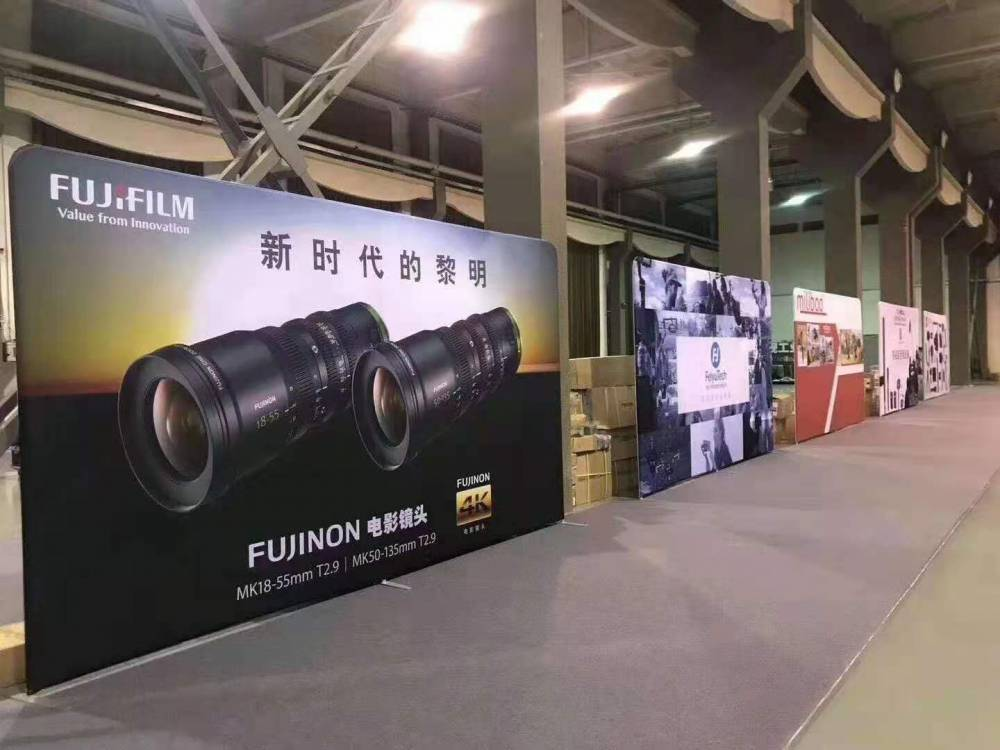
A row of tension fabric display walls in live use at a brand launch event: each straight pop-up display stands freestanding against the venue wall, no drilling, no rigging — the exact compliance profile European exhibition venues now require.
Buyers specifying an exhibition backdrop for engineering fairs ask a different set of questions, and the straight pop-up display answers most of them by construction. Can the cover be printed edge to edge, including the curved returns at the top? Yes — the zipper closure means the graphic wraps the entire silhouette of the tension fabric display. Can two 230×300 cm tension fabric display units be joined into one 600-centimetre run? Yes — the shared uprights butt together under the fabric and the seam disappears. How far do the feet project into a metered booth floor? A few centimetres, which matters when a stand builder pays for floor area down to the last square metre. And because the aluminum frame is tubular rather than panelled, the display wall survives a factory-floor tour, a riggers' pallet and three fairs in three weeks without a scratch kit — the one trade show backdrop an engineering crew will not baby. The question buyers forget is weight per square metre: an aluminum frame straight pop-up display at 2.3×4 m is still a one-person lift in parts, while a rigid display wall of the same area is a two-person, one-trolley negotiation.
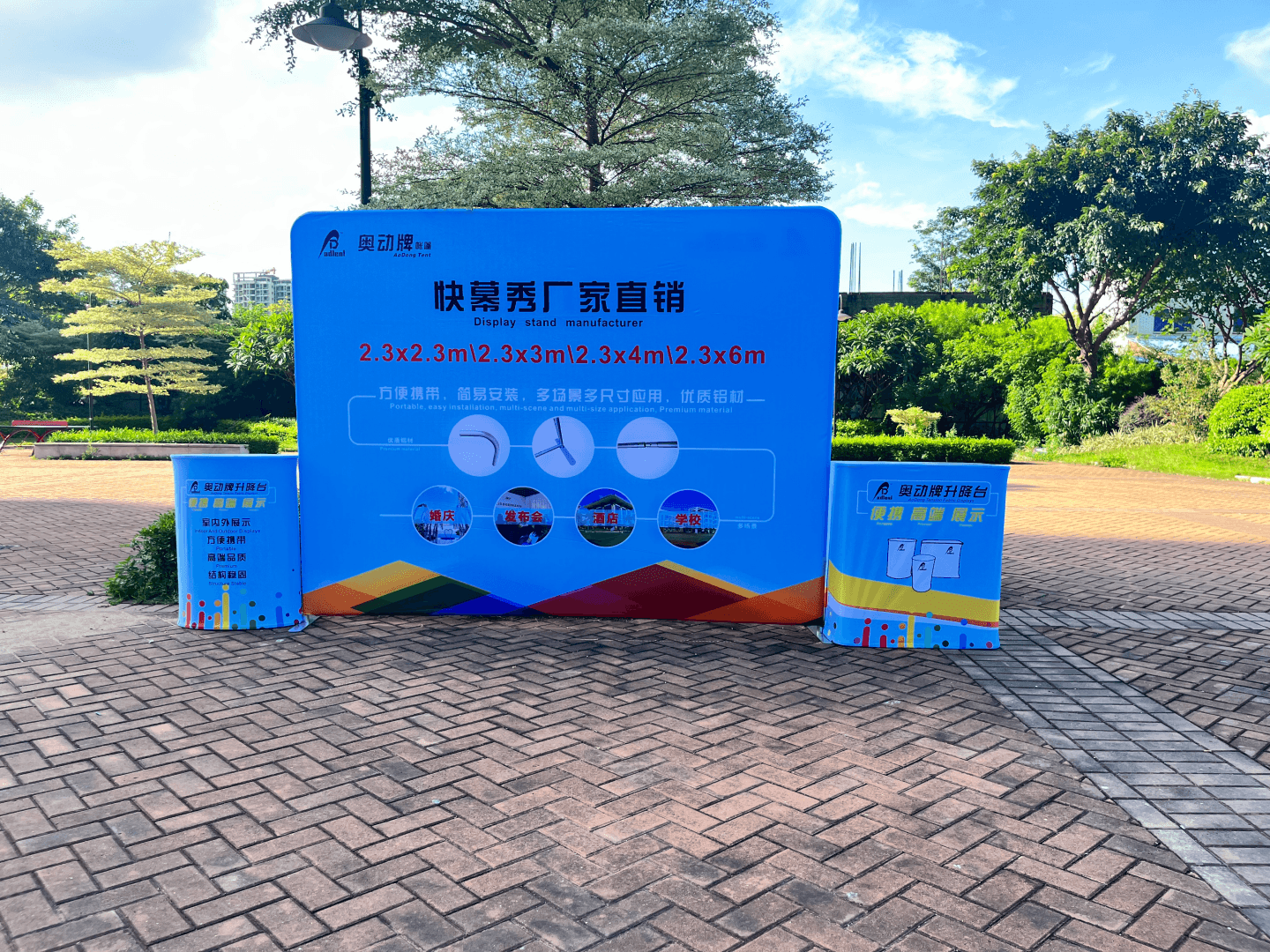
The full straight pop-up display family staged together: a 230×300 cm tension fabric display flanked by two matching fabric counters. Buyers standardise on one silhouette so every exhibition backdrop and counter in the fleet shares the same spare parts and cover pattern.
Then Paris. SIAL Paris runs October 17 to 21 at Paris Nord Villepinte and opens on a Saturday — a deliberate move by the organiser to spread arrival peaks — with 8,000 exhibitors from 130 countries, 400,000 products on display and a start-up pavilion of 650 young companies. Food brands bring constraints that publishing and plastics never see: hygiene rules, washable surfaces, and stands that must look spotless on Saturday morning and again every morning after. The fabric covers on a modern tension fabric display are removable and washable, so a smeared exhibition backdrop — like any trade show backdrop in food service — resets overnight instead of calling out a stand-fitter. For tasting zones, product counters and display wall end-caps, matching fabric counters clip the smaller display wall pieces into one coherent, colour-blocked stand that photographs as well as it sells, and the backdrop wall reads from three aisles away. A tension fabric display also packs to almost nothing, which matters when the exhibition backdrop's freight window at Villepinte is measured in hours rather than days.
For the 650 start-ups in the Villepinte pavilion, the arithmetic is sharper still. A first international fair is a budget event, and the fabric back wall is its biggest single saving, and a complete stand — one straight pop-up display at 230×250 cm, a fabric counter, a printed floor runner — costs less than a single rented LED wall would for the same footprint. The trade show backdrop then works twice: front-of-stand during meetings, and behind the tasting table as the display wall that visitors tag on their phones. Marketing teams have learned to design the backdrop wall with a camera in mind — logo high, contact details low, colours that survive a phone flash — because at a food fair the exhibition backdrop is the most-photographed surface in the booth and the cheapest marketing channel in the building. And because the tension fabric display reuses the same aluminum frame every season, the second fair's budget line shrinks to a reprint; in practice the display wall becomes the start-up's business card.

A complete booth built around one central tension fabric display: the trade show backdrop carries the brand statement while flanking fabric back wall towers and counters carry product detail — a modular straight pop-up display system for a mid-size stand.
Underneath all three fairs sits one commercial logic. The display wall itself is bought once; the fabric is reprinted as often as the campaign changes, and a replacement cover ships flat in an envelope that clears customs faster than the frame ever will. A stand team that runs Frankfurt, Friedrichshafen and Paris in three weeks is not freighting three sets of walls — it is freighting one set of aluminum frame walls and a stack of rolled covers. That is why the aluminum frame has become the quiet standard across the industry: it does not age visibly, it does not go out of specification, and the same aluminum frame that carried last year's graphics carries this year's without a service visit. A tension fabric display bought in September is a tension fabric display still working at the spring fairs; the trade show backdrop fabric changes, the fabric back wall graphic changes, and every backdrop wall in the fleet earns its winter storage.
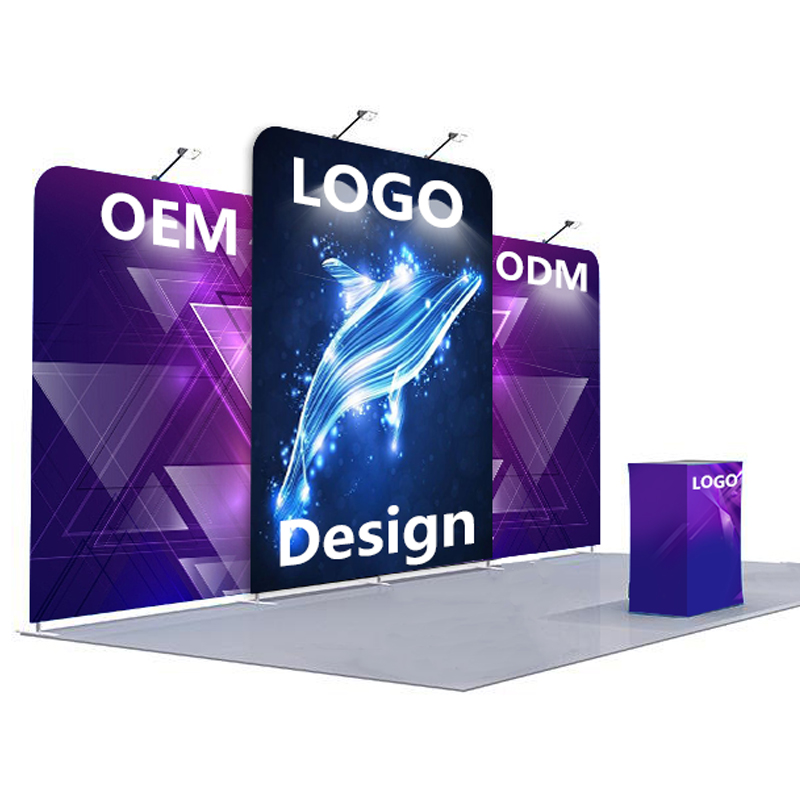
OEM and ODM covers on the same aluminum frame platform: identical straight pop-up display hardware, different graphics. Replacement covers ship flat, which is what lets one display wall serve a different campaign at every fair on the calendar.
Ask the crews what they like and the answer is shorter than the manual. One person stands the tension fabric display's aluminum frame, feeds the cover over the top rail, zips it shut and steps back — under ten minutes for a 230×300 cm fabric back wall, with no ladder because no part of the build is above shoulder height until the final zip. There is nothing to bolt into venue walls, which keeps the trade show backdrop compliant in the many European halls that ban drilling and restrict rigging. At pack-down the reverse happens just as fast: unzip, strip, fold, and the entire straight pop-up display disappears into the same bag it arrived in, ready for the drive to the next city on the October run — the display wall that took ten minutes to raise takes six to strike. That is also why rental companies stock the straight pop-up display ahead of every other wall type: a passenger van swallows a fabric back wall, a counter and a box of covers in one load, so an exhibition backdrop that packs to shoulder width has no logistics chain at all.
Warehouse storage is the other half of the buying decision, and it is where the fabric back wall quietly beats every rigid backdrop wall format. A folded straight pop-up display stands less than thirty centimetres deep on a shelf; a season of covers for six display wall units lives in one archive box; and the trade show backdrop that comes off the van folds back onto the same rack it came off in January. Rental inventories are counted in frames and covers rather than crates, which is why the tension fabric display has become the default exhibition backdrop for fleets that turn their stock over fast.
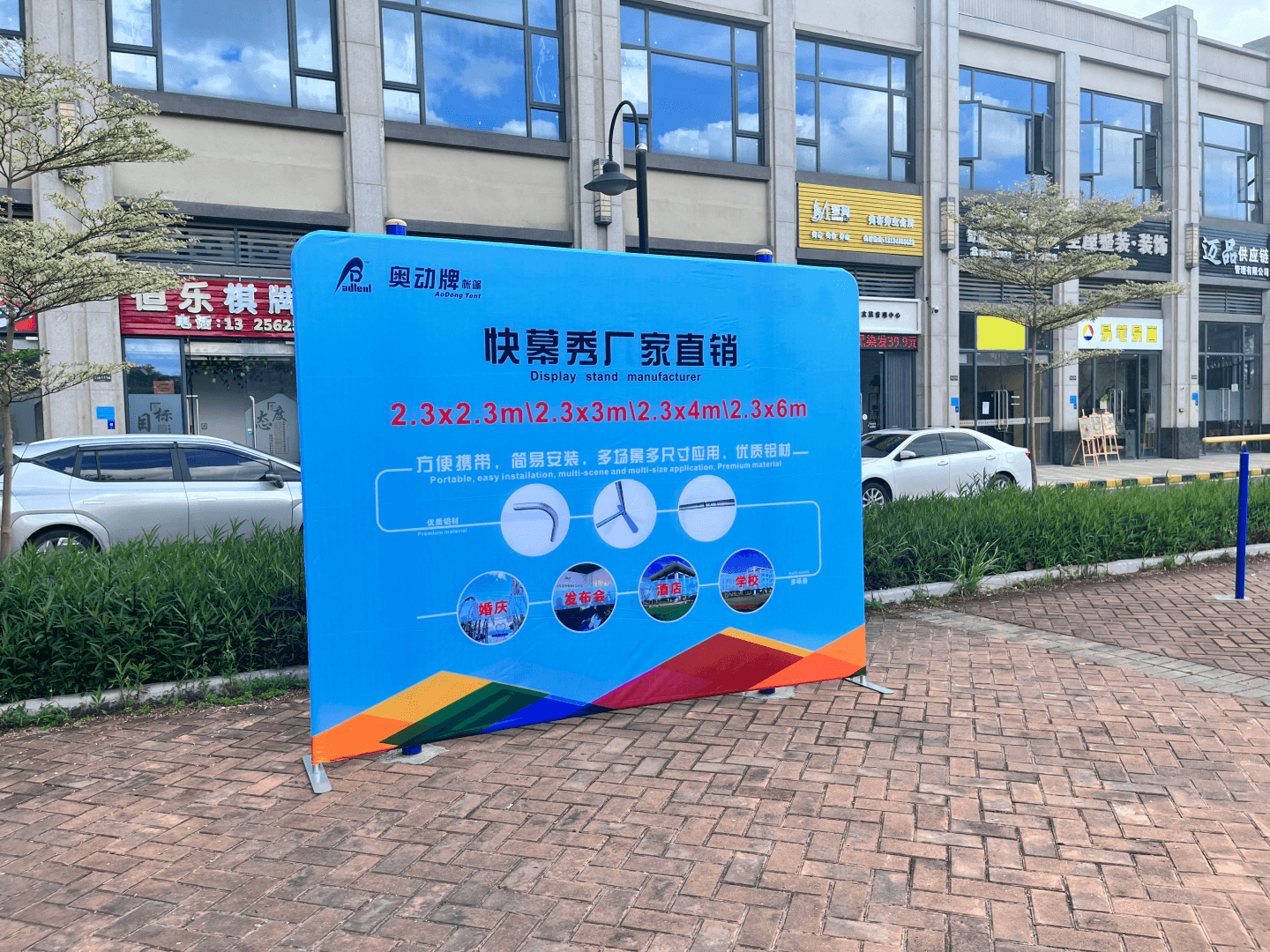
A 230×300 cm tension fabric display in street-side service: the freestanding trade show backdrop holds its square edge outdoors on level ground, the same exhibition backdrop hardware that does duty inside the hall.
For buyers drawing up a trade show backdrop order before the October season, six questions sort the specification. One: width — 250 centimetres for a shell-scheme back wall, up to 600 for an island stand. Two: single- or double-sided, because a double-sided exhibition backdrop opens aisle-facing positions that single skins cannot serve. Three: foot projection, checked against the booth's boundary line. Four: replacement-cover pricing, since the straight pop-up display is only as economical as its second skin. Five: matching counters and end-caps, ordered in the same graphic language as the fabric back wall. Six: the supplier's reprint turnaround, which decides whether a November product launch is on the display wall by the December fair. A tension fabric display that passes all six tests is not stationery for one show — it is the backdrop wall that every later show reuses. And if the answer to question six is five working days, the buyer can treat the exhibition backdrop as a just-in-time product: order the display wall in September, approve the artwork in mid-October, and hang a fresh fabric back wall at the December fair.
Three weeks from now the first of the three halls opens its doors. Between them, Frankfurt, Friedrichshafen and Paris will put more than eleven thousand exhibiting companies in front of the world's buyers this October, and almost every one of those companies will stand in front of a printed display wall of some kind. The teams that chose the straight pop-up display will have built theirs before the aisle carpets are laid, re-skinned the fabric back wall between cities, and folded the exhibition backdrop into the boot of a hire car on the way home. In a season this compressed, the trade show backdrop that travels light is not the cheap option — it is the only schedule that survives three fairs in three weeks, and the backdrop wall that buyers keep on the van all year. The tension fabric display will not trend on any feed this month, but a straight pop-up display in a carry bag has outlasted every format that promised to replace it.