


One table, four floors, twelve weeks: the printed table cover works Q4 2026
IMEX America opens at Mandalay Bay on October 12 with Design Matters as the season's talking point. IAAPA Expo fills the Orange County Convention Center from November 16, where the organiser supplies the drape and almost nothing else. Central Europe's Christmas markets start their build in mid-November under charters that admit only handmade goods. GITEX GLOBAL reopens on December 7 with a scale summit at Dubai World Trade Centre, moving its main expo into a brand-new home at Expo City Dubai from December 8 to 11. Four audiences, four continents, one product doing the same job at every one of them — the custom printed table cover.
LAS VEGAS / ORLANDO / NUREMBERG / DUBAI — September 24, 2026
The last twelve weeks of 2026 are the densest stretch on the global events calendar and the busiest season any printed table cover supplier sees all year, and they are also the twelve weeks in which the smallest surface in the room — the table cover — does the most selling, and the printed table cover is the one item all four of them order. IMEX America opens at Mandalay Bay in Las Vegas with a day of free education on October 12 and a trade show floor running October 13 to 15, where a trade show table cover is the first thing a visitor photographs. IAAPA Expo takes over the Orange County Convention Center in Orlando from November 16 to 20, where the fitted table cover is the only surface the organiser does not supply. Across Central Europe the Christmas markets begin their physical build in the second half of November, with Nuremberg's Christkindlesmarkt among the last to open on November 27 and a printed table cover on every food counter. And on December 7 GITEX GLOBAL reopens with a scale summit at Dubai World Trade Centre and moves its main expo into a brand-new home at Expo City Dubai from December 8 to 11, where a custom table cover fronts every hospitality lounge. Four audiences, four continents and four completely different rulebooks — yet one product behaves identically at all of them. A custom printed table cover turns a folding table into a brand stand, a printed table cover costs less than the table it dresses, and a custom table cover ordered in September is still working at the December fair — and a table throw ordered in October is working at the Christmas market. In a quarter this crowded the table cover — and specifically the custom table cover — is the cheapest permanent advertising a company can own.
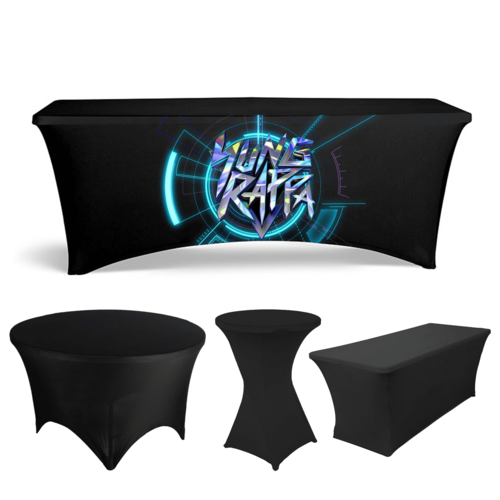
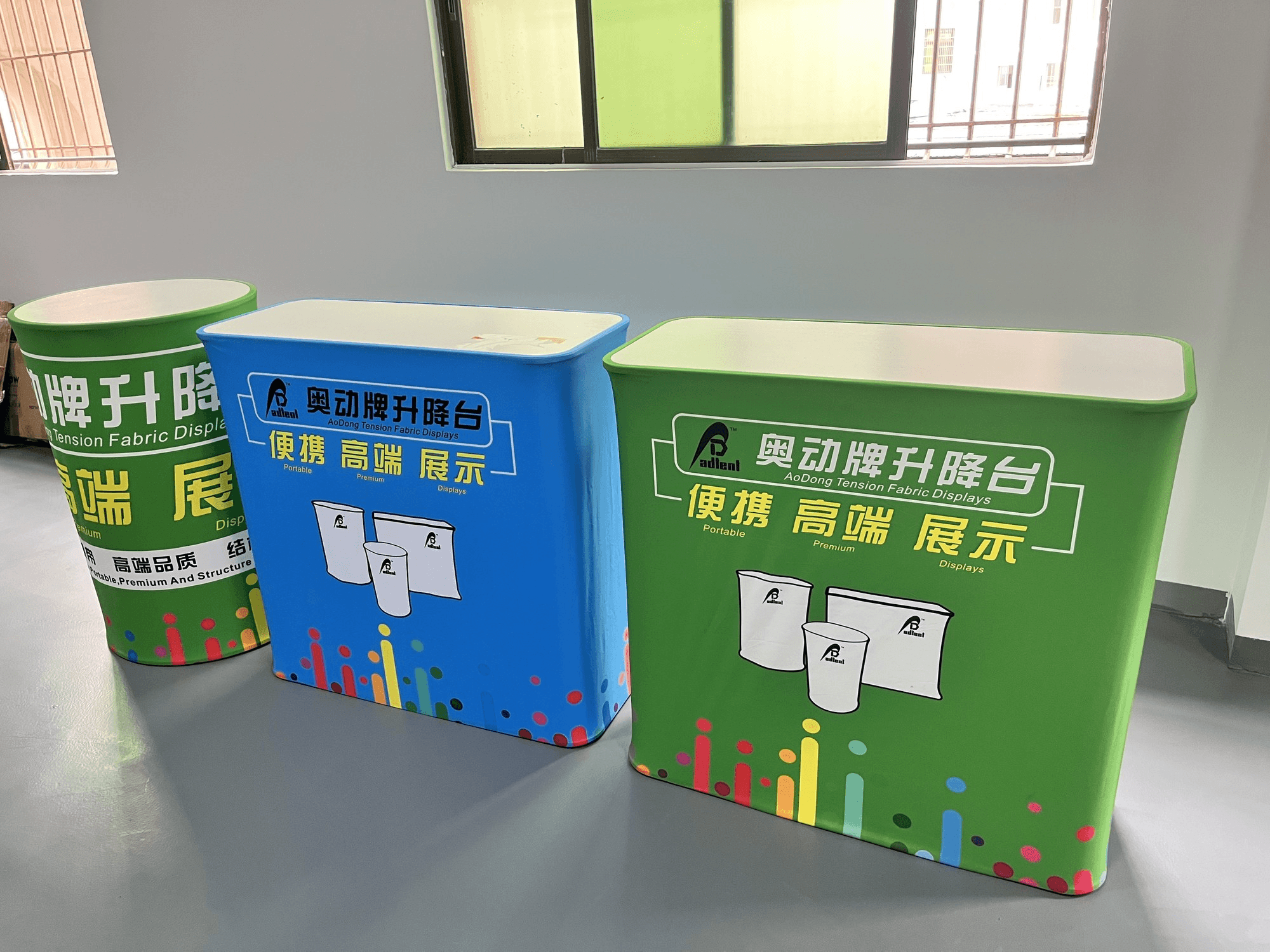
A full-print stretch table cover in service beside the other two shapes in the same family: a rectangular stretch table cover, a round table cover and a cocktail table cover, all dressed in one dye-sublimated design. One artwork file, three table shapes, and a corner table that reads exactly like the bar table in the next aisle.
The family behind that phrase is wider than most buying sheets admit. A standard table cover — the article older catalogues still file as a table cloth — drapes over a trestle and falls to the floor in pleats, and it remains the lowest-cost way to dress a folding table — the only table cover in the range that needs no elastic, and the cheapest tablecloth to replace. A fitted table cover is boxed at the corners, so the front panel reads as one flat print field instead of a row of folds, which is why a custom table cover on that cut prints edge to edge. A stretch table cover is cut from an elastic knit and pulls over the table like a second skin, which is why the stretch table cover has become the format exhibition buyers default to, and why a printed table cover packs smaller than any other printable surface in a booth. A table cloth of the same footprint folds to twice the volume. A table throw covers the top and the front only and leaves the back open, so staff working behind the table keep access to stock stored underneath. And a round table cover — sold most often as a cocktail table cover — dresses the high poseur tables that carry the drinks at every stand party in the hall. Sizes are standardised rather than custom: 4, 6 and 8 foot tables dominate, with the fitted table cover and the stretch table cover both built to those three lengths, and the table throw graded in 60 inch and 30 inch drops. The cocktail table cover runs on 30 inch and 32 inch bases, and the round table cover on the 4 foot banquet table every hotel already owns, and the standard table cover on the folding trestle in every store cupboard, while a printed table cover does the same job on any of them.
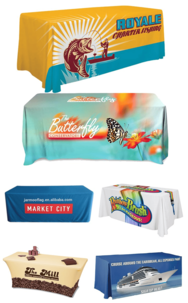
Six finished orders off the same production line: draped and fitted table covers printed for a charter fishing operator, a butterfly conservatory, a market stall, an art-supply brand, a coffee roaster and a cruise line. The branding is the only variable — the cut, the seam and the elastic pocket are identical.
From a buyer's desk the arithmetic is simple, and it is the reason procurement teams have quietly moved table dressing out of the furniture budget and into the marketing budget. The table itself is an asset that lasts a decade, and the table cover is the only part of it that changes; the printed table cover is the consumable that gets replaced whenever the campaign changes, and the second printed table cover — or the second custom table cover — costs a fraction of the first. A hundred custom table covers — or a hundred table throws — ship folded in a single carton, which means a distributor can hold an entire campaign of printed table covers in a wardrobe rather than a warehouse. Compare that with the rigid rival to the fitted table cover and the stretch table cover: a printed counter or a branded cabinet arrives on a pallet, needs a fitter, and is obsolete the moment the design changes. The stretch table cover carries one further advantage that only becomes obvious at pack-down. Because it holds its shape under tension and folds flat, the whole front of a stand — every table cover in it, from the table throw to the cocktail table cover — can be struck in three minutes and carried out in a tote bag. That is why rental houses now stock stretch table covers in white and black and simply overlay a client print for the weekend, and it is why a custom table cover and a tablecloth are quoted alongside the hire price rather than after it. A plain table cloth is the budget line in the same quotation.
Las Vegas is the first stop and, for anyone who sells into the events industry, the most important one. IMEX America runs its trade show floor from October 13 to 15 at Mandalay Bay, after a Smart Monday of free education on October 12, and the scale explains its reputation: more than 3,700 exhibiting companies from over 80 countries, more than 6,100 buyers, and 300-plus education and networking sessions across four days. The show's talking point for 2026 and 2027 is Design Matters, a deliberate invitation to treat design as a commercial instrument rather than decoration — the design of a trade show table cover included. That theme lands hardest on the smallest objects in a stand, and on nothing harder than a trade show table cover. On a six foot table the front panel of a fitted table cover — or of any custom printed table cover — is a billboard roughly 72 inches wide and 29 inches deep: wider than most laptops, wider than the average product shelf, and set exactly at the eye level of a visitor who is standing. A table throw, by contrast, prints the top and the front only — a smaller canvas, but the one that faces the aisle. On a plain table cloth that same area is broken into pleats, and a third of the print disappears into the fold. The buyers walking that floor are the people who order table covers, and every printed table cover, for everyone else — destination management companies, event agencies, hotel groups and venue chains — and most of them are sourcing a printed table cover, usually a stretch table cover, by the hundred for the season ahead.
The practical questions a meetings buyer asks about a printed table cover are rarely about looks. Can the cover be printed edge to edge, so the graphic wraps the corners instead of stopping short of them? With dye sublimation on a stretch table cover the answer is yes, and the print runs over the seam and around the curve. Does a printed table cover read as a solid colour at distance, or does convention-centre lighting turn it grey? A heavy-weight elastic knit — the body of every stretch table cover in the range — holds colour under the mixed tungsten and LED rigs that Mandalay Bay and most convention centres run. Can a standard table cloth be printed on the front and left plain at the back? Yes, and that is what most event agencies order: the plain reverse of a printed table cover, or of any table cloth printed on one face only, hides service access, power leads and the boxes of stock that accumulate by mid-afternoon. Can a custom table cover be ordered in a single colour for a distributor's own range? It can, and the same printed table cover file then repeats across every later order. And how does it ship? Folded, in a poly bag, inside a carton. A fitted table cover weighs about as much as a shirt, a table throw weighs less, and a stretch table cover weighs less still.
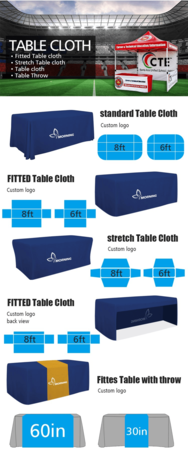
The printed table cover range in one chart: standard table cloth, fitted table cloth, stretch table cloth and the fitted table with throw, each graded in 6 ft and 8 ft, with the table throw supplied in 60 in and 30 in drops. Custom logo placement is standard on every format.
A note on the language, because it costs buyers money. Distributors in North America ask for a table throw; European buyers ask for a table cloth with a printed front panel; event agencies in the Gulf ask for a custom table cover in a stretch cut. All three are quoting the same object, and all three will be quoted a custom table cover. A supplier who prices a printed table cover against a fitted table cover without asking which cut is being compared will be comparing a flat print panel with a pleated one — the two are not interchangeable at the table, and neither is a plain tablecloth. Where an order mixes formats, the safest specification names the table first and the cut second: a 6 ft stretch table cover for the reception desk, an 8 ft fitted table cover for the product counter, a round table cover for the poseur tables and a cocktail table cover for the bar. Every one of them can be produced as a custom table cover built from a single artwork file, which is what keeps a four-format stand looking like one brand. It also keeps the reprint of a fitted table cover simple: when the campaign changes, the printed table cover is the only item in the order that has to be re-cut, and the table cloth, the table throw and the custom table cover all follow the same file.
The second stop has a different rulebook, a different set of requirements for the table cover, and a much more literal problem to solve for the table cover. IAAPA Expo runs education sessions from November 16 and opens the show floor from November 17 to 20 at the Orange County Convention Center in Orlando, spread across the South and West buildings of one of the largest facilities in the United States. The organiser's own exhibition rules set the tone: linear and perimeter booths come with an 8 foot high back drape and 3 foot side drapes in blue and grey, aisle carpet colours are assigned by pavilion — red for food and beverage, black for haunted attractions, green for games and arcades — and exhibitors with indoor booths must supply their own floor covering because none of the halls are carpeted. The shell scheme therefore decides the walls, the floor and the colour of the aisle, and offers no trade show table cover, no round table cover and no cocktail table cover of its own. The table is one of the few surfaces an exhibitor still owns outright, which makes a trade show table cover the last piece of real estate in the booth — and the only table cover the organiser will not supply. For the food and beverage exhibitors and for the park operators who buy from them, a fitted table cover or a stretch table cover in a colour that survives a service counter is not decoration: it is the front of the shop, and it is the surface a visitor photographs: a fitted table cover is the most photographed object in a food booth. A printed table cover, or a trade show table cover, on a concessions counter does duty as the queue barrier, the menu board's frame and the brand mark, all at once.
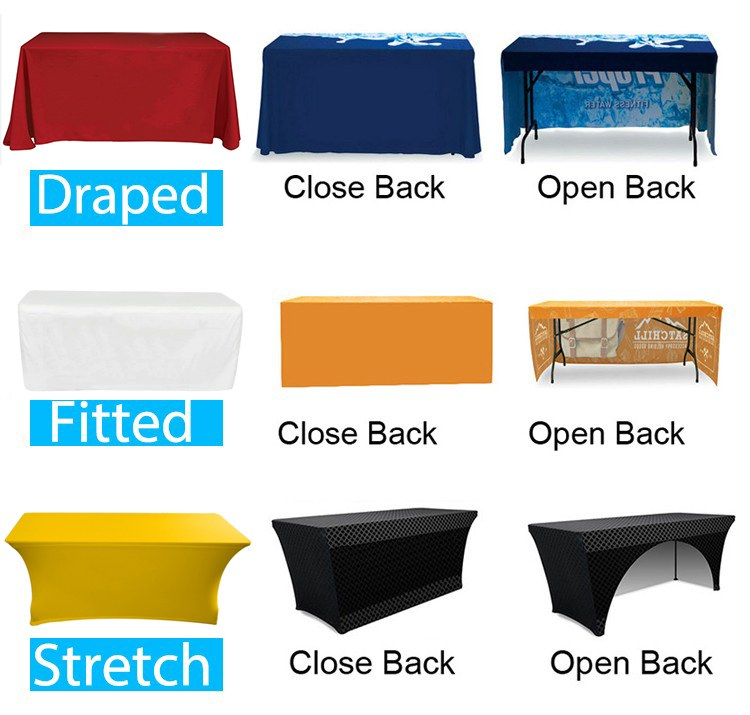
The three cuts side by side, each in closed-back and open-back versions. Draped, fitted and stretch do the same job three different ways: a drape for volume and low cost, a fitted table cover for one flat print panel, a stretch table cover for a wrinkle-free skin that packs to nothing.
Food service buyers raise a specific set of requirements, and they are the reason the waterproof backing matters as much as the print. A fitted table cover built for catering work is lined on the inside with a PVC coating, so a spilled drink or a tray of hot food does not soak through to the table beneath — the failure mode of an unlined tablecloth and of every cheap table cover. The outer face is a heavy duty oxford weave with double stitching at the stress points, and the result is a trade show table cover that can be wiped down mid-service and machine washed at the end of it. Concession operators at attractions work the same table cover across a whole season, and being able to pull a soiled tablecloth off at closing time and put a clean one on the next morning is the difference between a stand that looks maintained and one that looks tired by week three.
Two buyer types order in volume and order the same way every year, and both have moved to this format. The first is the rental and event-production house, which buys stretch table covers and table throws by the hundred in white and black, keeps a printed table cover library for repeat clients, and charges a premium when a client wants a custom printed table cover on a two-day turnaround. The second is the institution — a university, a hospital trust, a city authority — which equips a fleet of recruitment stands and then reprints the same custom table cover — sometimes the same printed table cover file for a decade — every year with a new campaign line. Both buyers converge on one specification list, and both will buy a custom printed table cover before they buy a counter: a stretch table cover that survives a van, a trade show table cover that survives a hall, a fitted table cover that survives a service counter, and a printed table cover that survives a wash. Neither of them wants a rigid counter, because a printed counter cannot be re-skinned when the campaign changes, and neither wants to iron a tablecloth at seven in the morning. When the same custom table cover is ordered for the eleventh year running, that is the whole argument.
The closed back and open back decision gets made here rather than in the design studio. A closed back fitted table cover — or a closed back stretch table cover, or a closed back round table cover — hides everything under the table, which is right for front-of-house and wrong if staff need to reach printing stock, bags or spare samples during the day. An open back cover leaves a slot at the rear, which is what retail pop-ups, ticket desks and recruitment stands order. Both cuts take the same artwork, a table throw is the third version, a cocktail table cover the fourth and a round table cover the fifth, and both are graded for a 6 foot or an 8 foot table, so a buyer can split an order across the versions without paying for a second design or a second table throw.
Then the calendar turns northern and the audience changes completely. Central Europe's Christmas markets are not one event but a season of them, and they are built — physically built — during the second half of November. Cologne's market at the cathedral opens around November 16; Munich's Christkindlmarkt opens November 20; Frankfurt follows on November 23; Dresden's Striezelmarkt opens for its 592nd edition in the last week of November and trades to December 24; and Nuremberg's Christkindlesmarkt, the most traditional of them all, opens on the evening of November 27 and runs to December 24. Across the border, Strasbourg's markets have been held since 1570 and open on November 27, while Colmar's six markets open on November 25 and run to December 29. Almost every stall that serves food or drink needs a tablecloth — in practice a fitted table cover — that will survive the weather, which is why stallholders sign their contracts and place their printed table cover orders in October, weeks before the first crate of glühwein arrives. For most of these operators the table cover — often the only tablecloth in the stall — is the only printed surface, and the same fitted table cover has to work in rain, in snow and in a queue of two hundred people.
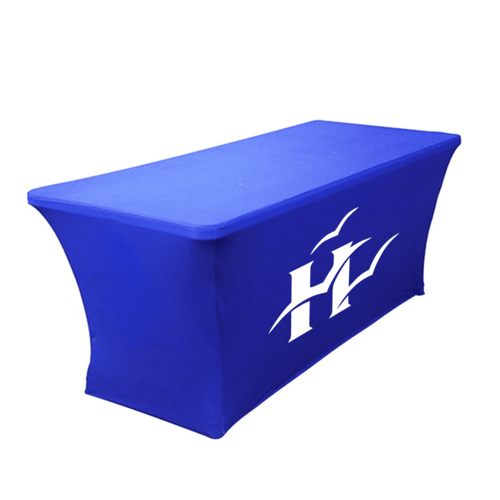
A royal blue stretch table cover carrying a single block logo on the front panel — the format food-service and concessions buyers order most, because the smooth elastic face wipes clean and the flat panel reads from across an aisle.
The buyer at a Christmas market is not an exhibition manager. They are usually a family business renting one wooden stall with perhaps two metres of frontage, a counter to serve over and a seating area no visitor ever sees. Nuremberg enforces that character in its own rules: the market admits only handmade goods from the region and bans mass-produced plastic, which means the stall's only piece of mass production is the thing the goods sit on — a printed table cover. A custom table cover does something no sign — and no table cloth — can do inside a wooden stall: it carries the name at counter height, where a visitor reading the menu is already looking, and it does it in the one place the market's design code leaves room for modern print. The practical requirements are equally clear. A printed table cover in this trade has to survive rain, snow and a hot drink spilled on it every twenty minutes, which is why a waterproof backed tablecloth — PVC lined inside, oxford weave outside — outsells every plain table cover here. And a round table cover, or a cocktail table cover, printed in the same design as the rectangular covers turns the standing tables at the edge of the stall into part of the same brand, while a stretch table cover on the back counter finishes the job.
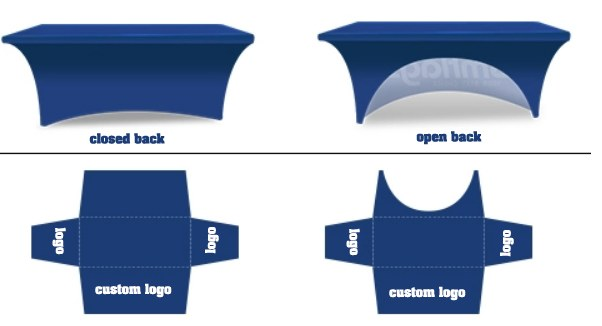
The buying decision in one drawing: closed back versus open back, and where the logo and the side-panel artwork land on each. An open-back printed table cover leaves staff access to stock stored under the table; the closed back hides it completely.
Almost every wrongly sized order that comes back into the factory traces to one cause: the buyer measured the table and not the tablecloth, or the other way round. The numbers a supplier needs are the length of the table top, the width of the table top and the height from the floor to the top edge, because a printed table cover is cut to the table it has to wrap. A standard table cloth, or a plain table cover — or a standard table cover under its older catalogue name — is then specified as the table length it fits — a 6 foot table, an 8 foot table — not as a finished measurement taken off the old cloth. A fitted table cover and a stretch table cover both add the depth of the drop to the front and back panels, so the same 6 foot specification on a different table top width produces a different cover. And a stretch table cover is graded by the table it stretches over, which is why one that fits a 6 foot folding trestle will fight a 6 foot counter with a wider top. Length, width and height: three numbers, and every sizing failure in this trade starts with one of them missing. The rule that saves the order is simple — measure the table, order the table cover for that table — a fitted table cover or a stretch table cover — and leave the finished dimensions to the factory.
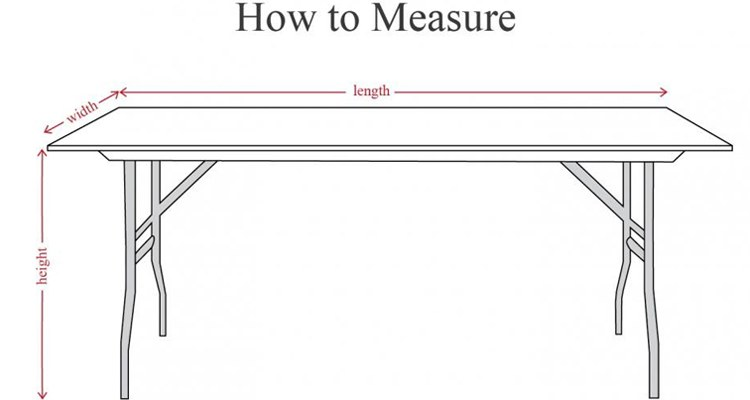
How to measure, and the only three numbers a supplier needs: length, width and height of the table top. Orders come back wrongly sized when a buyer measures the tablecloth instead of the table, or quotes a finished cover length instead of the table it has to wrap.
Before the order goes to the factory, four artwork questions are worth settling. First, the print method: full-surface dye sublimation covers the whole table cover in colour, while a single-colour logo can be applied to a standard table cloth, a fitted table cover or a table throw at a lower cost. The stretch table cover is the format that gains most from a full print, because the design runs over the seam and around the corner without a visible break. Second, the dieline: a round table cover and a cocktail table cover take a different artwork file from a rectangular printed table cover, and a custom table cover built for a 6 ft table cannot be moved onto an 8 ft one by scaling the artwork alone. Third, the safe area — the first thirty centimetres of a draped table cloth, of a table throw and of a long fitted table cover disappear into the fold, and the bottom of a closed back fitted table cover is never seen at all. Fourth, colour: a warm-lit wooden stall and a daylight-flooded convention hall render the same ink differently, which is why buyers who order for both ask for a printed table cover — and a custom table cover for the stall — in a deeper tone than their own brand guide suggests.
Installation is the other half of the buying case, and it is not a detail. A cocktail table cover — the elastic cover that dresses the high round poseur tables used for standing receptions — takes four moves and about ninety seconds: drop it over the table top, pull it down over the legs, work the reinforced elastic pockets onto the feet, and smooth the fabric at the seam. The foot pockets are the tell of a good cocktail table cover, of any round table cover on a tall base and of a stretch table cover on a 6 ft trestle. On a cheap one the fabric creeps up the leg during an evening's service and the table cover is showing its ankles by ten o'clock; on a properly built one the pockets hold the cover in tension for the whole event. Washability closes the loop. Every cover in this range is machine washable, so a custom printed table cover that comes home from a conference with wine on the front panel — or a table throw, or a tablecloth, with grease across it — is back in service after one cycle, and a rental fleet that washes its covers weekly never has to buy replacements mid-season.
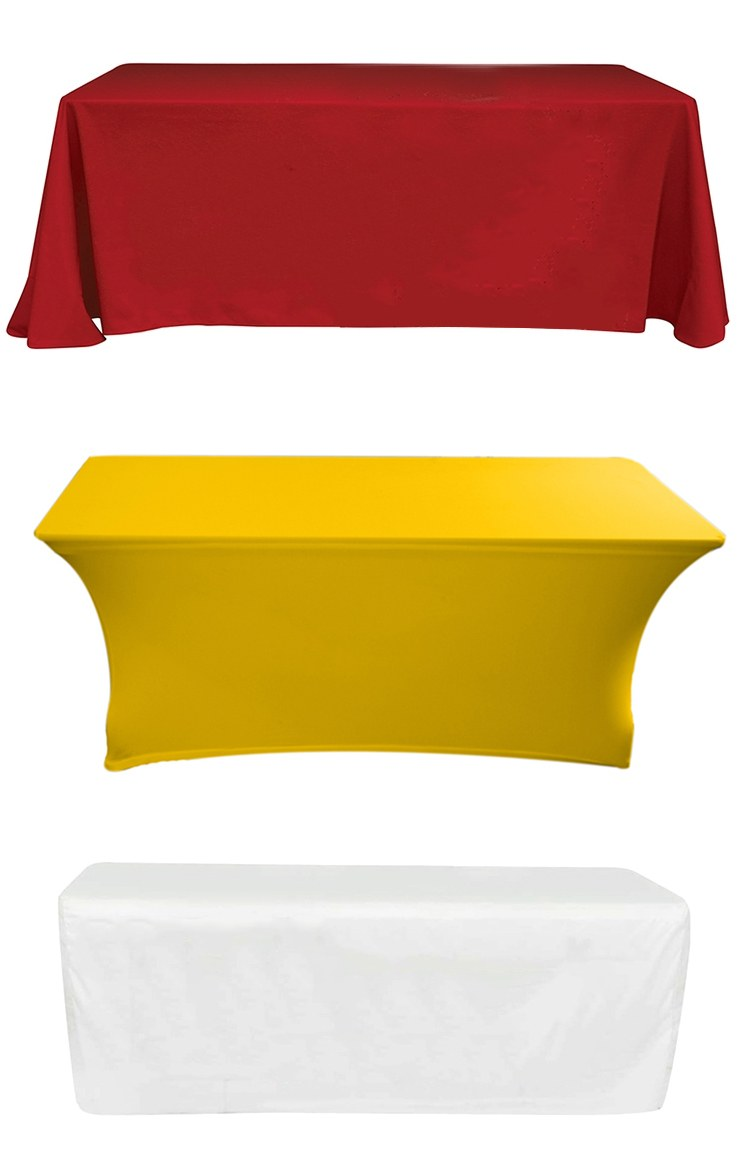
Four moves, about ninety seconds: a cocktail table cover goes over the top, down the legs, onto the reinforced elastic foot pockets, and the seam is smoothed. The foot pockets are what stop the fabric creeping up the leg by ten o'clock in the evening.
Buyer reference — the table cover range in one column
- Standard table cover, or table cloth: drapes to the floor on 6 ft and 8 ft trestles, printed front panel, the lowest cost per table cover.
- Standard table cloth, unprinted: the stock item a distributor pairs with a printed table cover.
- Fitted table cover: boxed corners, one flat print field, 6 ft and 8 ft, closed back or open back, PVC-lined waterproof backing over a heavy duty oxford outer.
- Stretch table cover: elastic knit skin for 4 ft, 6 ft and 8 ft tables, wrinkle-free, machine washable, print running over the seam.
- Trade show table cover: the fitted table cover or the stretch table cover cut for a shell-scheme booth.
- Table throw: 60 in and 30 in drops, covers the top and the front, leaves the back open for stock access.
- Round table cover: 4 ft banquet tables and tall poseur bases.
- Cocktail table cover: reinforced elastic foot pockets, four-step install, about ninety seconds per table.
- Printed table cover, custom table cover, table cloth: three catalogue names, one production file.
- Printing: full-surface dye sublimation or a single-colour logo, with a standard table cloth as the budget version, built from one artwork file across every format.
- Order terms: minimum order 1 pc on printed fabric work, electronic proof and sample in one to three days, EXW or FOB Guangzhou, Shenzhen or Foshan, shipped by express, air or sea.
A buyer writing a table cover specification for Q4 can settle the whole order with eight questions. One: which table shapes are actually in the room — rectangular, round, or poseur? Two: which cut — standard table cloth, fitted table cover, stretch table cover, table throw or cocktail table cover? Three: closed back or open back? Four: table length, and whether it is the standard 4, 6 or 8 foot format, since a stretch table cover or a fitted table cover sized for one will not fit the others. Five: full colour print or a one-colour logo, and where on the panel the logo sits. Six: what the cover has to survive — air-conditioned indoor halls, outdoor rain, or food service. Seven: how many spare covers the operator wants for mid-season changes. Eight: the delivery date, calculated backwards from opening day rather than forwards from the order. On that last question the manufacturing realities are worth knowing before a deadline is agreed. This production line runs a minimum order of one piece on printed fabric work, so a single custom table cover carries the same lead time as a full container, and a sample printed table cover is normally dispatched within one to three days of the artwork being approved as an electronic proof. Shipping is by express, by air or by sea depending on the deadline, dispatched from Guangzhou, Shenzhen or Foshan on either EXW or FOB terms.
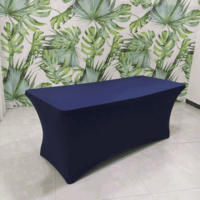
A navy stretch table cover in a real interior on a 6 ft trestle. No pleats to iron, no cloth to pin, no skirt to adjust — the elastic body of the printed table cover holds its own shape on a floor that has been laid for a one-day event.
By the time the last market closes on Christmas Eve, the same table cover will have worked a trade show floor in Nevada, a concessions counter in Florida, a wooden stall in Bavaria and a buyer's lounge in Dubai — four formats, four climates and four sets of rules, on hardware that never changed. That is the quiet argument for putting a printed table cover, a fitted table cover and a table throw at the top of the Q4 kit list rather than the bottom. A custom table cover is the only piece of branding a marketing team can reprint in a week, carry on a plane and stand up in a minute, and in a quarter where four global audiences are being served at once, the product that keeps up — the printed table cover, the custom table cover, the table throw — is the product that gets ordered again. The venues supply the walls. The exhibitor supplies the table — and the table cover — for most stands the printed table cover — is the part of it that speaks.
— keyword density report (longest-match, non-overlapping) —
word_count=4335 total_keyword_phrases=216 density=4.98% per-keyword: custom printed table cover=6, printed table cover=34, custom table cover=21, stretch table cover=25, fitted table cover=26, trade show table cover=9, cocktail table cover=12, round table cover=10, standard table cover=4, standard table cloth=6, table throw=19, tablecloth=11, table cloth=11, table cover=22
Event dates verified 24 September 2026 against official organisers: imexamerica.com (Mandalay Bay; Smart Monday 12 Oct; floor 13-15 Oct), iaapa.org (Orange County Convention Center; education 16-19 Nov; floor 17-20 Nov; 8 ft back drape, 3 ft side drape, pavilion aisle-carpet colours), christkindlesmarkt.de (Nuremberg, 27 Nov - 24 Dec), striezelmarkt.dresden.de (592nd edition), gitex.com (GITEX GLOBAL; 7 Dec Dubai World Trade Centre; 8-11 Dec Expo City Dubai).