


One cassette, three cities, eleven weeks: the roll-up banner owns November
Web Summit opens at the MEO Arena in Lisbon on November 9 with more than 70,000 attendees and seventeen content tracks. MEDICA follows in Düsseldorf from November 16 to 19 with 4,821 exhibitors from 70 countries and 78,000 trade visitors from 160. And on November 27 Black Friday floods the high street with an audience no venue sells tickets to. Three audiences, three rulebooks, one product doing the same job at every one of them — the roll-up banner.
LISBON / DÜSSELDORF / THE HIGH STREET — September 29, 2026
November is the densest month on the European events calendar, and it is also the month in which the least glamorous object in the marketing cupboard — the roll-up banner and the retractable banner stand that carries it — does the most selling. Web Summit gathers more than 70,000 founders, investors and journalists at the MEO Arena and FIL in Lisbon from November 9 to 12 — four days on which the roll-up display outsells every other printed surface in the industry, across seventeen content tracks and the evening networking circuit the organisers call Night Summit. On the exhibit floor the roll-up banner is the unofficial uniform. A week later MEDICA opens at the Düsseldorf fairground from November 16 to 19, filling halls 1, 3 to 7, 10 to 12 and 15 to 17 — a roll-up banner at almost every numbered wall — with 4,821 exhibitors from 70 countries and 78,000 trade visitors from 160. Then, with no organiser, no venue and no badge scanning at all, Black Friday — the one day of the year when every portable banner stand in Europe works overtime — arrives on November 27 and Small Business Saturday on November 28, and every shop window, café and pop-up counter in Europe needs its message changed by breakfast, and a roll-up display is the fastest message in the building to change. Three audiences, three completely different rulebooks — yet one product behaves identically at all of them, and the product is the roll-up banner stand. A retractable banner stand sets up in under a minute, packs into a shoulder bag, beats any rigid sign on cost and re-prints for less than the cost of the taxi to the venue. A spare replacement graphic rides in the same shoulder bag. In a month this crowded, the roll-up display and the pull-up banner are the pieces of hardware a marketing team reaches for first, and the roll-up banner is the one they reorder from.
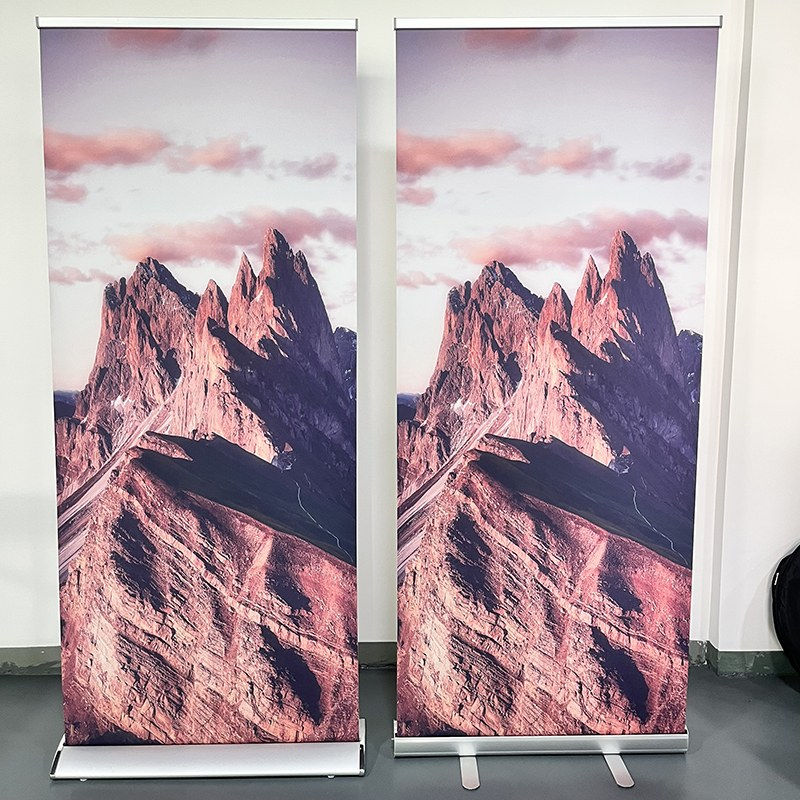
Two roll-up banner stands carrying the same mountain artwork, photographed as a pair — the standard single-unit footprint that turns two square metres of empty hall into a branded position. The wide-format print runs edge to edge on the 850 mm graphic, and the aluminium base stays square on a hard floor without ballast.
Lisbon explains why. The startup economy that Web Summit is built on runs on floorspace it does not own: early-stage companies exhibit in the compact tiers the conference sells for exactly this audience, and every tier ends with the same question — where does the roll-up banner go — and the stand they get is often little more than a numbered wall panel, a floor mark where a roll-up banner stand has to do the rest, and two square metres of carpet. Into that footprint goes a roll-up banner stand — base on the floor, bungee pole up, graphic tensioned, headline at eye level — a complete roll-up display in one gesture, done before the coffee arrives, which is exactly why the portable banner stand is the default exhibit at a conference of this size. There is no stand builder to brief, no rigging form to file, no printer to chase, no furniture order to reconcile, nothing to return at the end — and the roll-up banner stand folds back into its own bag. A founder flying into Humberto Delgado airport checks the pull-up banner through as cabin baggage, wheels it to the arena, and wheels it to the evening's Night Summit venue afterwards, and the portable banner stand has worked two venues in one day. The whole exhibit — one roll-up display, one print, one bag — costs less than one night of the hotel the investor meeting is held in, and at the end of the week the same founder folds the retractable banner stand back into its cassette and takes it home to use at the next city, because a retractable banner stand has no city-specific part.
From a buyer's desk the arithmetic is even simpler than the logistics, and it is the reason procurement teams have quietly moved portable signage out of the events budget and into the assets column, and the retractable banner stand is the line item that moved first. The aluminium cassette of a roll-up banner stand is the asset: it buys once and lasts for years of shows. The printed panel is the consumable, and the replacement graphic is its cheapest form: a replacement graphic drops into the same cassette in about sixty seconds with no tools, so a re-brand, a new funding round or a translated message is a replacement graphic, not a purchase. A second roll-up banner for a second market costs a fraction of the first — a replacement graphic and little more, because the second order for a roll-up banner buys only the panel. Compare that with the rigid rivals — a printed backwall that arrives in a flight case and is obsolete the day the pitch changes, or a wall graphic that needs a fitter and a ladder — while a roll-up display re-skins in a minute. Neither is one replacement graphic away from a second season; a roll-up display is. The pull-up banner does the opposite: the frame stays, the message changes, and the parcel that carries a pull-up banner to Lisbon in November carries it to Düsseldorf a week later.
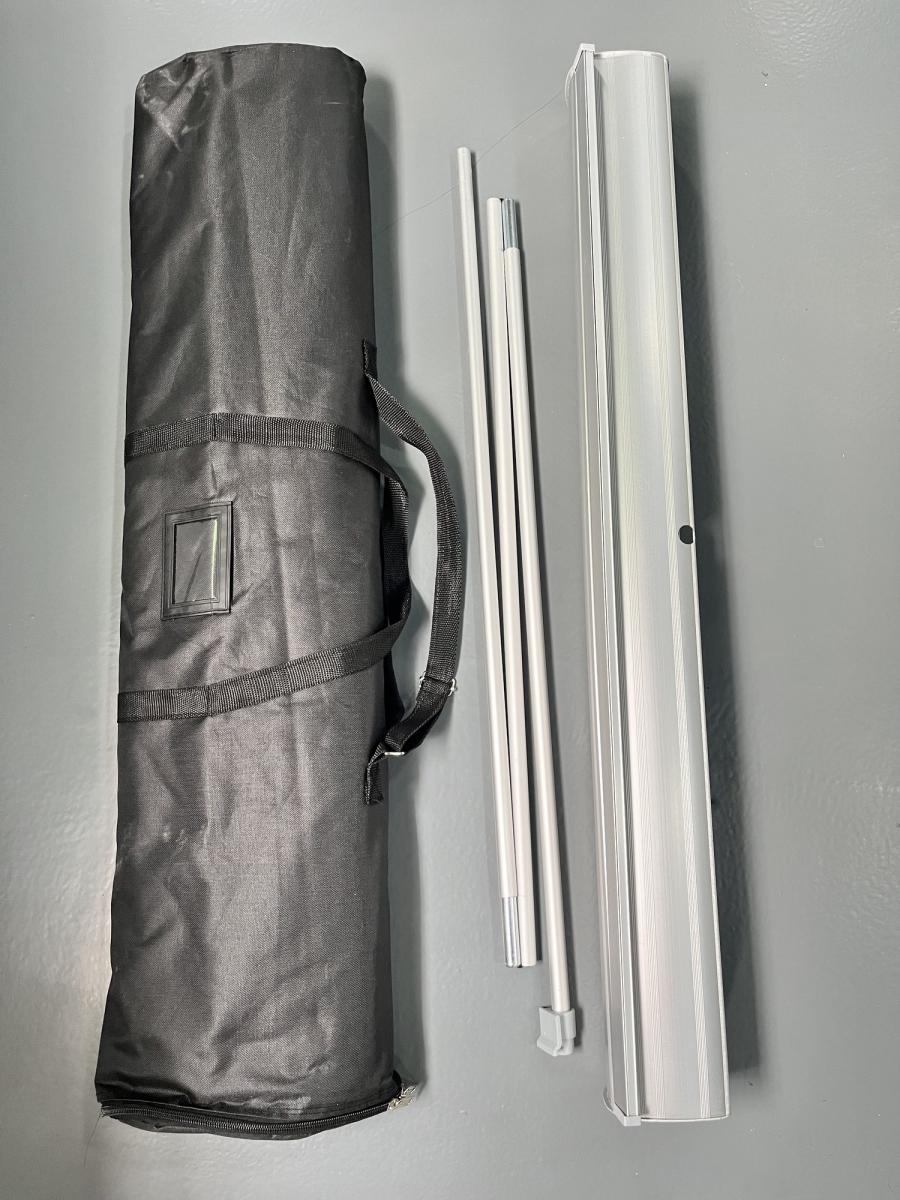
What actually travels: one padded oxford carry bag holding the roll-up banner cassette, the bungee pole set and the top rail. Everything a portable banner stand needs fits into a single shoulder bag that airlines treat as cabin baggage and couriers quote as a small parcel.
The anatomy explains the reliability, and it is worth a buyer knowing what is inside the bag of a roll-up banner stand before the order is placed. A roll-up banner stand is four parts: the cassette base, which houses the spring tension roller and carries the folding foot plates; the bungee pole, a segmented column that snaps together on an internal cord; the top rail or clip bar, which grips the graphic of a roll-up banner along its full width and keeps a trade show banner hanging square; and the print itself, pre-mounted to the cassette at the factory. Every portable banner stand in the range shares the same four parts, so a spare pole or a replacement graphic fits any roll-up banner stand in the range. Setup is a fixed sequence that makes the roll-up display a one-person job — unfold the feet, stand the pull-up banner pole in the socket behind the cassette, pull the panel up by its rail and hook the rail over the pole top — and the factory instruction that matters most on every roll-up banner is the small one: the print's visible line sits to the right of the rail, so artwork should be proofed the way it will hang. Pole choice is the buyer's upgrade point on any retractable banner stand: the economic pole is the budget column of the pull-up banner range, the clip pole locks off at height, and the high-quality clip bar with hook lets a replacement graphic be swapped without stripping the bar — the detail that separates a stand that survives one season from a portable banner stand that survives a decade of reprints.
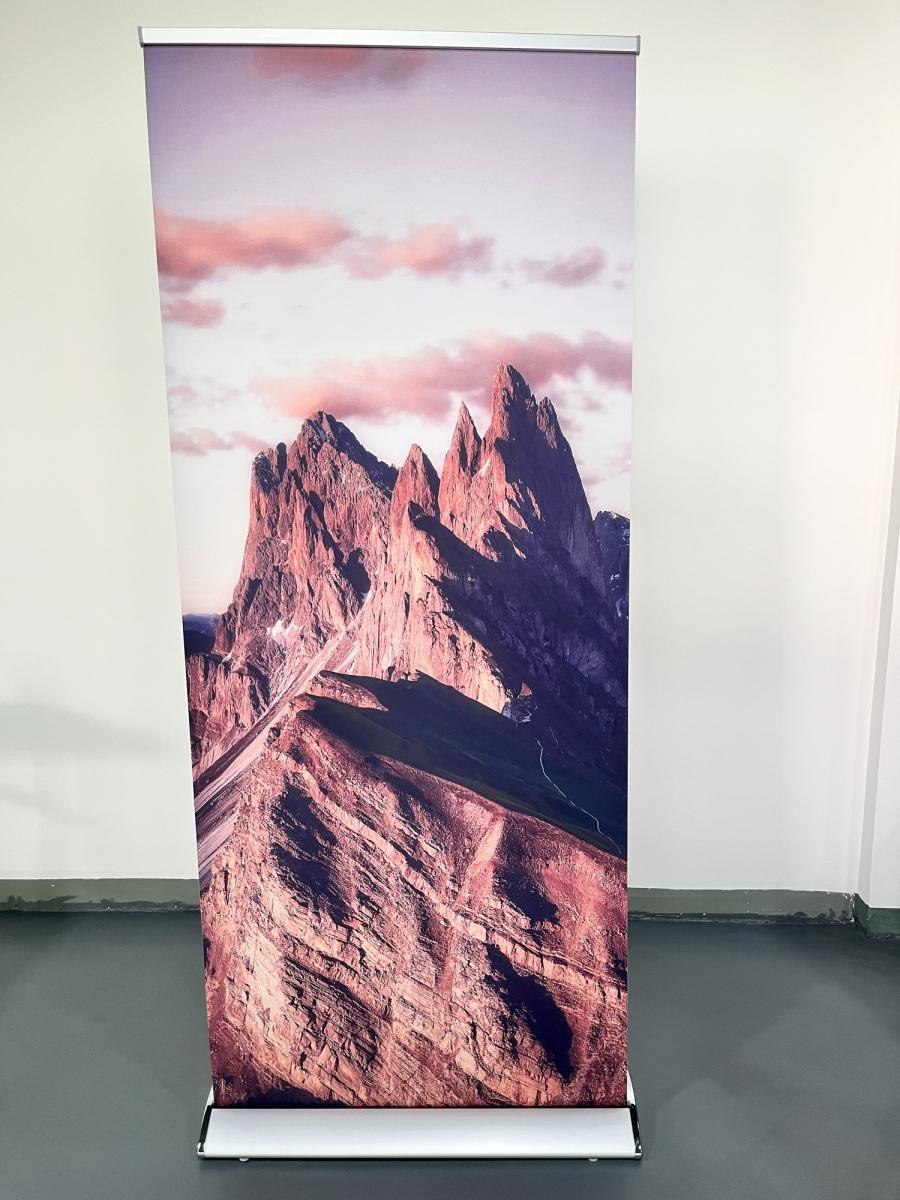
A roll-up banner stand set up and tensioned, front view. The graphic rides straight out of the aluminium cassette, up the bungee pole and onto the top rail — one person, no tools, under a minute. The 2000 mm print height puts the headline at the eye level of a visitor who is standing.
Sizes are standardised rather than bespoke, and that is what keeps the price and the lead time short on every roll-up display in the range. The graphic on every roll-up banner stand runs 2000 mm tall, in four widths: 850 mm, 1000 mm, 1200 mm and 1500 mm, seated on cassettes of roughly 840, 990, 1185 and 1480 mm — one roll-up banner stand per width. The 850 x 2000 mm unit is the volume seller, the width most first-time buyers of a roll-up banner start with, and the one that airlines and couriers treat kindly; the 1000 x 2000 mm format is the exhibition banner standard that most hall rules and most artwork templates are written around; the 1200 mm and 1500 mm widths are for buyers who want wall-like presence without buying a wall, or without buying a wide retractable banner stand into the next freight class. Weights sit between about 3.6 and 4.2 kg on the economic and teardrop roll-up banner models, and the packing carton on the compact formats is around 44 x 44 x 8 cm — the same case the teardrop roll-up banner ships in — small enough that a distributor can hold a hundred pull-up banners in a pallet space, and small enough that the freight line on a quote is a rounding error rather than a negotiation — a roll-up banner is one of the few trade show banners that ships cheaper than the brochure pack it stands beside.
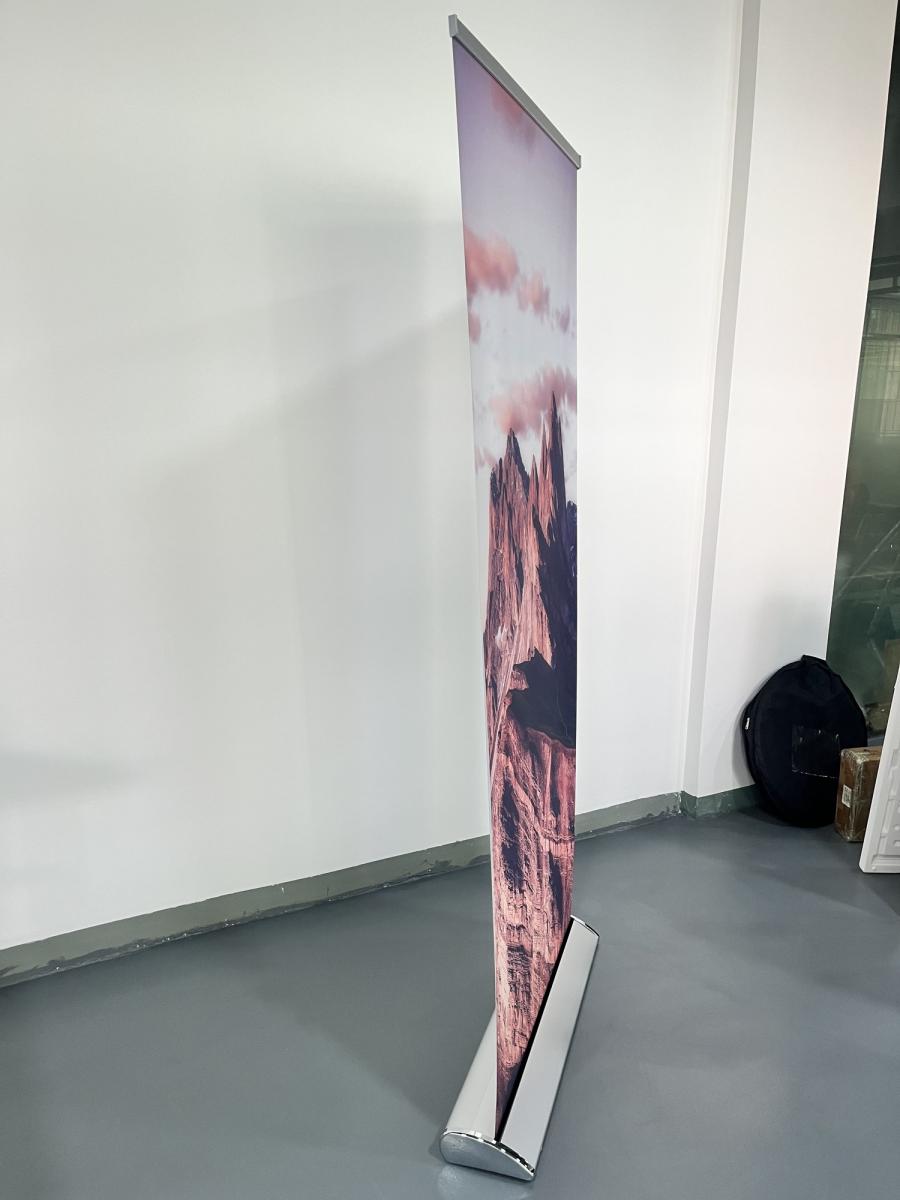
The same retractable banner stand from three-quarters: the foot plates fold flat against the base, the pole seats into the socket behind the graphic, and the panel stands vertical without wall support — which is why a roll-up display works in open floor plans, lobbies and foyers where a wall-hung banner cannot.
What the money buys is a ladder, and buyers climb it in a predictable order. The entry step is the economic roll-up banner — 850 mm, PP panel, economic pole — bought in tens for a single campaign, because the price sits below the cost of the meeting it was ordered for. It is a roll-up banner with one job and one season. The step most exhibition buyers settle on is the standard roll-up banner stand at 1000 mm with a PVC or PET panel and a clip pole: still a portable banner stand, but one that survives a season of weekends and takes a replacement graphic without complaint. The third step is the double-sided roll-up banner for the aisle-end positions described below, and the fourth is the teardrop roll-up banner, bought for shape rather than surface — the teardrop roll-up banner buys the glance first. Franchise and retail networks buy the whole ladder of roll-up banner stands: one cassette specification, one artwork template, and pull-up banners ordered per store, per season — one banner stand design, many doors. The ladder is also how distributors quote — three roll-up displays, one banner stand upgrade, one spare replacement graphic per market — and how the supplier's one-artwork-file system keeps every step of the roll-up display range consistent.
Düsseldorf is the test the same retractable banner stand has to pass a week later, and it is a different examination. MEDICA runs November 16 to 19 in halls where a roll-up display is the most-moved piece of signage on the floor, with stand construction from November 10 to 15 and dismantling through November 23; opening hours run 10:00 to 18:00 Monday to Wednesday and 10:00 to 16:00 on the Thursday, and a roll-up display that arrives with the exhibitor's freight on November 10 has six build days to earn its place. The 4,821 exhibitors and 78,000 visitors are not startups with two square metres — they are hospital groups, diagnostics manufacturers, physiotherapy brands and homecare suppliers, and not one of them buys a roll-up banner for a single day, and the hot topics on the programme — smart hospitals, AI in diagnostics, telemedicine, resilient health systems — are sold by people who also have to buy signage for wards, waiting rooms and department corridors — in practice, a roll-up display at every corridor end. A clinic that adopts a retractable banner stand buys it for reasons a trade show banner buyer never considers: the PET face wipes clean, the base of the roll-up banner stand is quiet on hard floors, the roll-up display moves between departments in one hand, and the message can be re-printed per department — one replacement graphic per ward: recruitment at one, patient information at another, wayfinding at a third — one roll-up display specification, many messages. Hospital procurement teams order roll-up displays — and pull-up banners for the entrance — in tens for exactly this reason: one cassette specification, many replacement graphics, one artwork template.
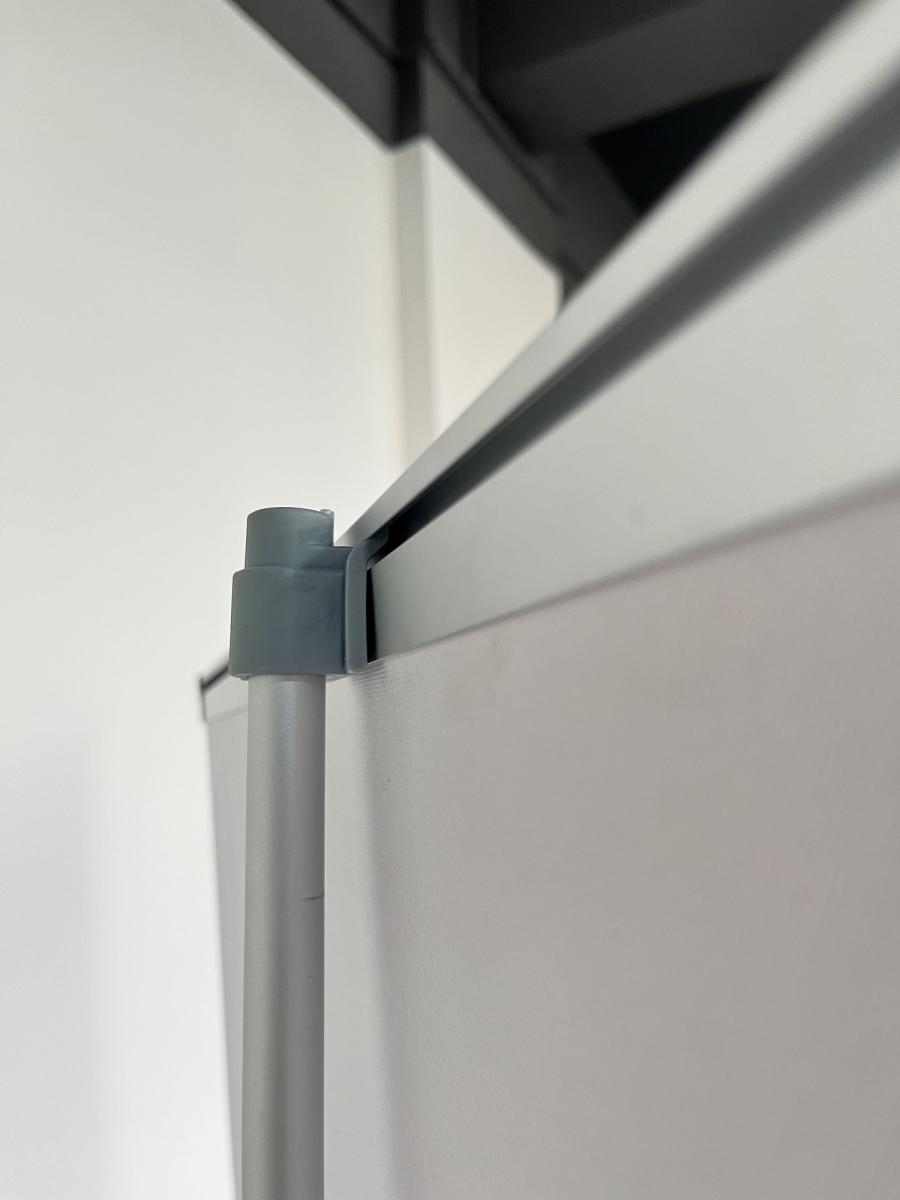
Close-up of the top rail and clip bar on a roll-up banner stand. The graphic locks into the bar along its full width, so the print stays flat and square instead of curling off a single hook. Buyers upgrading from the economic pole usually spec the clip bar with hook, which lets a replacement graphic drop in and out without stripping the rail.
That is also where the print material stops being a catalogue footnote and starts being a clinical and commercial decision. PP at about 160 gsm is the budget panel for a one-weekend roll-up banner — fine for a single indoor event, lighter in colour and prone to a soft curl at the edges of the roll-up banner by the second day. PVC at about 180 gsm is the workhorse panel for a roll-up banner stand in daily service: wipeable, opaque, and heavy enough to hang dead straight, at the cost of extra freight weight on a pull-up banner. PET at about 180 gsm prints with the sharpest photographic colour of any roll-up display panel and lays flattest, which matters when the artwork carries clinical imagery or dense text — the two things a MEDICA roll-up banner is most asked to hold. And PET twist at 420 gsm is the premium roll-up banner face — thick enough to be effectively blockout, which is what the double-sided roll-up banner and the wider retractable banner stand range depend on, since a see-through panel would show the reversed print on its own reverse. The corollary buyer errors on a roll-up banner are equally standard: ordering 850 mm artwork stretched onto a 1000 mm roll-up banner cassette, forgetting that the visible print line and the safe margins of a pull-up banner swallow the bottom fifteen centimetres, or proofing a panel flat when it will hang under tension. Every roll-up display buyer makes one of the three exactly once. Suppliers who e-proof the artwork against the correct cassette width remove all three errors before any pull-up banner panel is printed.
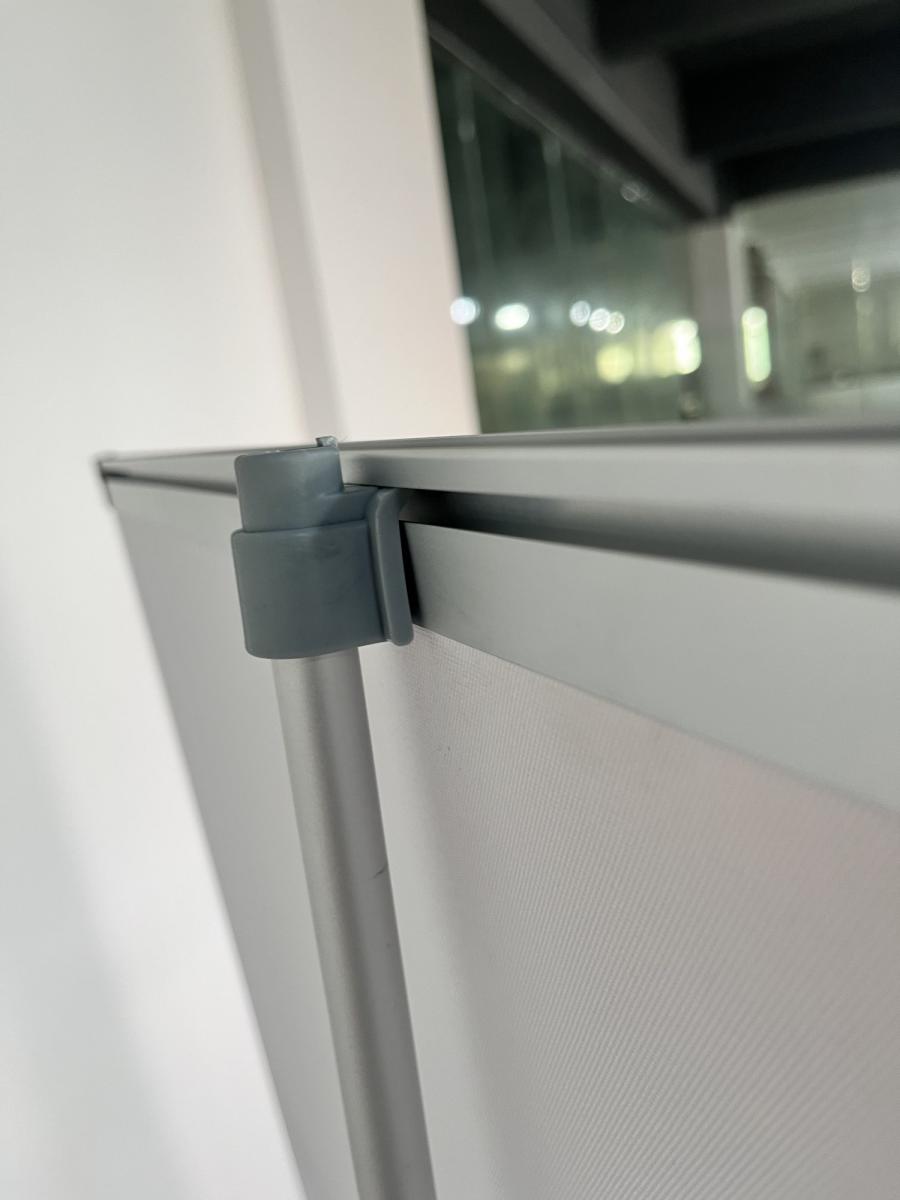
The bungee pole and corner detail of a pull-up banner: the segmented pole snaps together on an internal cord, seats into the base socket, and absorbs the lean of a graphic left tensioned for a full trade-show day. The reverse face of the cassette takes the same treatment — which is what makes the double-sided roll-up banner possible on one footprint.
The double-sided configuration deserves its own paragraph, because it is the version that changes how a floor plan is used. A double-sided roll-up banner puts two cassettes back to back on one base: two prints, two faces, one footprint, one plug-in that is still a single piece of luggage — the only double-sided roll-up banner that still counts as a portable banner stand. Aisle ends, corridor forks, lift lobbies and hall intersections are the natural habitat of a double-sided roll-up banner — at MEDICA, where 78,000 visitors navigate the halls in three days, the second face is free audience that a single-sided roll-up banner simply walks past. In retail the same logic holds from the other direction, and the double-sided roll-up banner earns its freight there too: one face of the roll-up display sells to the street through the glass, the other sells to the queue inside. The freight arithmetic is the honest counterweight on a double-sided roll-up banner — a double-sided unit weighs and ships like one and a half singles — so buyers who need two faces at one spot order the double-sided roll-up banner, and buyers who need two messages in two spots order two singles, or one single plus a replacement graphic per season.
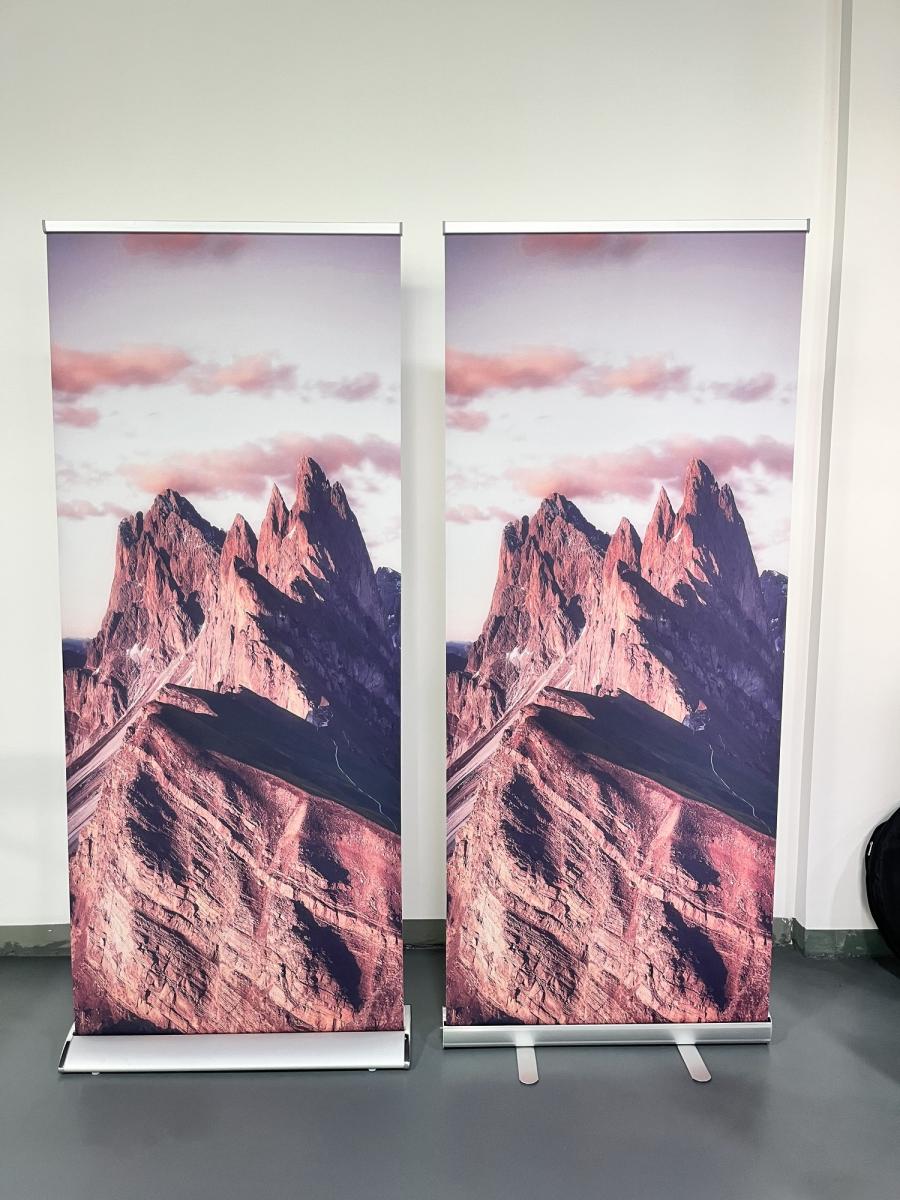
A double-sided roll-up banner pair photographed back to back in the workshop: two cassettes, two prints, one base. Aisle ends, corridor forks and lift lobbies are the natural territory of the double-sided roll-up banner, because the second face is free audience that a single-sided unit simply walks past.
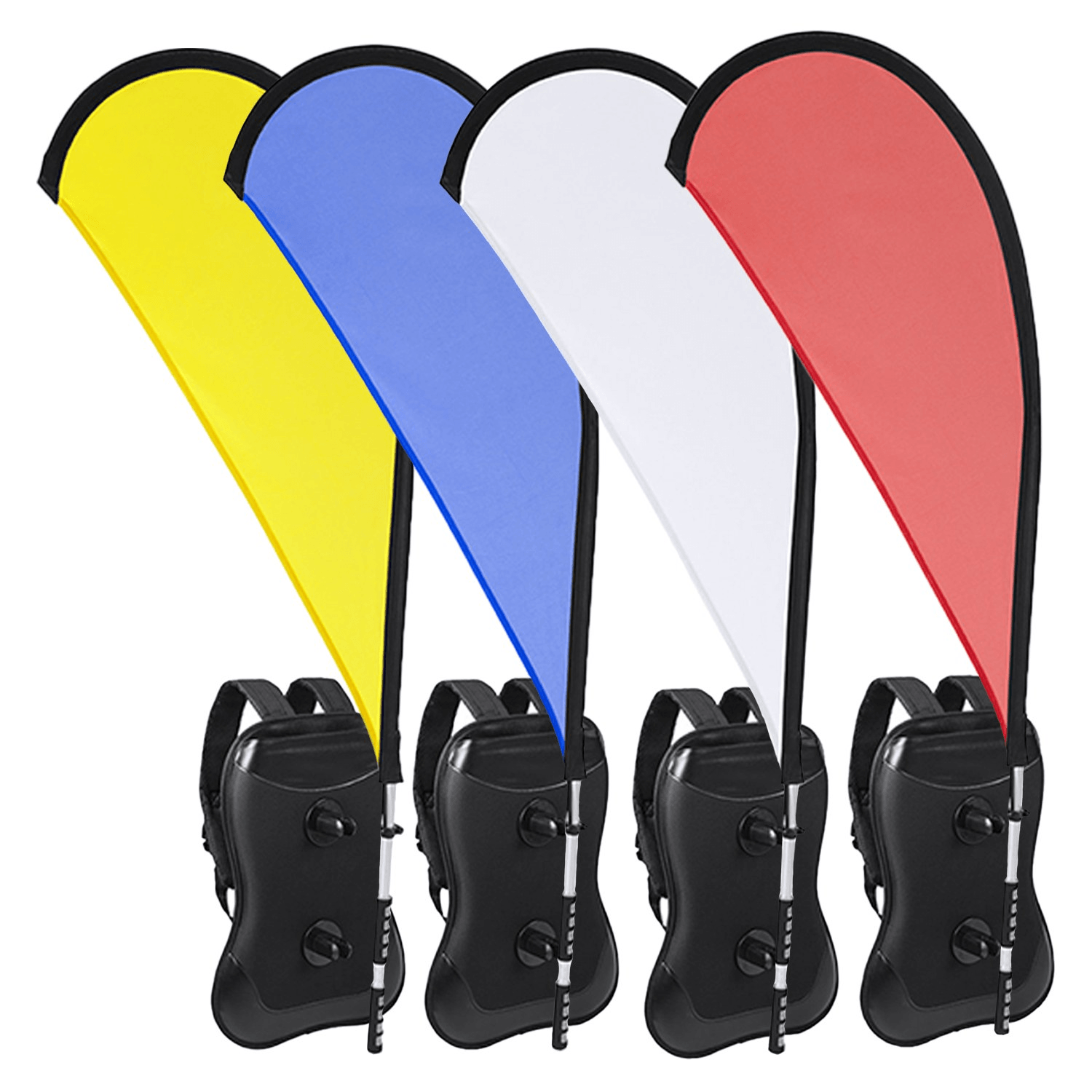
Between the rectangle and the wall sits the shape audiences actually remember — the teardrop roll-up banner, the one roll-up display bought for its outline as much as its print. Built on the same retractable logic as every other roll-up banner stand — an L-framed economic structure, a tensioned fabric face printed on the front side. At four metres the teardrop roll-up banner reads as a different species, and the profile softens the silhouette that every other stand in the hall shares. The standard formats carry an 850 x 200 cm graphic at about 3.6 kg and a 1000 x 200 cm at about 4.2 kg, and the compact packing case is the same 44 x 44 x 8 cm carton as any roll-up display in the range. In a trade-show hall that is a forest of rectangles, a curved exhibition banner is read from further away than its footprint justifies, and the teardrop roll-up banner is the format that delivers it, which is why product-launch teams and franchisors keep coming back to the teardrop roll-up banner even though the rectangular roll-up banner remains the cheaper panel per square metre and the faster reprint.
Then November 27 arrives and the third audience needs nothing from an organiser at all — the high street buys a roll-up banner the way Lisbon buys a flight. Black Friday, the day after the American Thanksgiving on November 26, is now the highest-grossing retail day of the European calendar, and the roll-up banner is its cheapest advertising, and Small Business Saturday on November 28 extends the weekend to the independents. No badge, no hall, no build-up schedule — but the same job, and a retractable banner stand is the signage that does it: a message that has to appear, change, and disappear on schedule. The café that a roll-up banner was practically invented for puts one by the door with the seasonal offer printed on the roll-up banner panel; the boutique changes a replacement graphic on the roll-up display in the morning and changes it back on December 1; the pop-up shop that signed a two-week lease on a bare unit furnishes it with two roll-up displays, a retractable banner stand by the till and a table, and opens on time with nothing in it but roll-up banner stock. Retail buyers buy the portable banner stand once and buy roll-up banner panels by the season — and the supplier who kept the artwork on file turns the February print around in days, because the roll-up display's frame never changed.
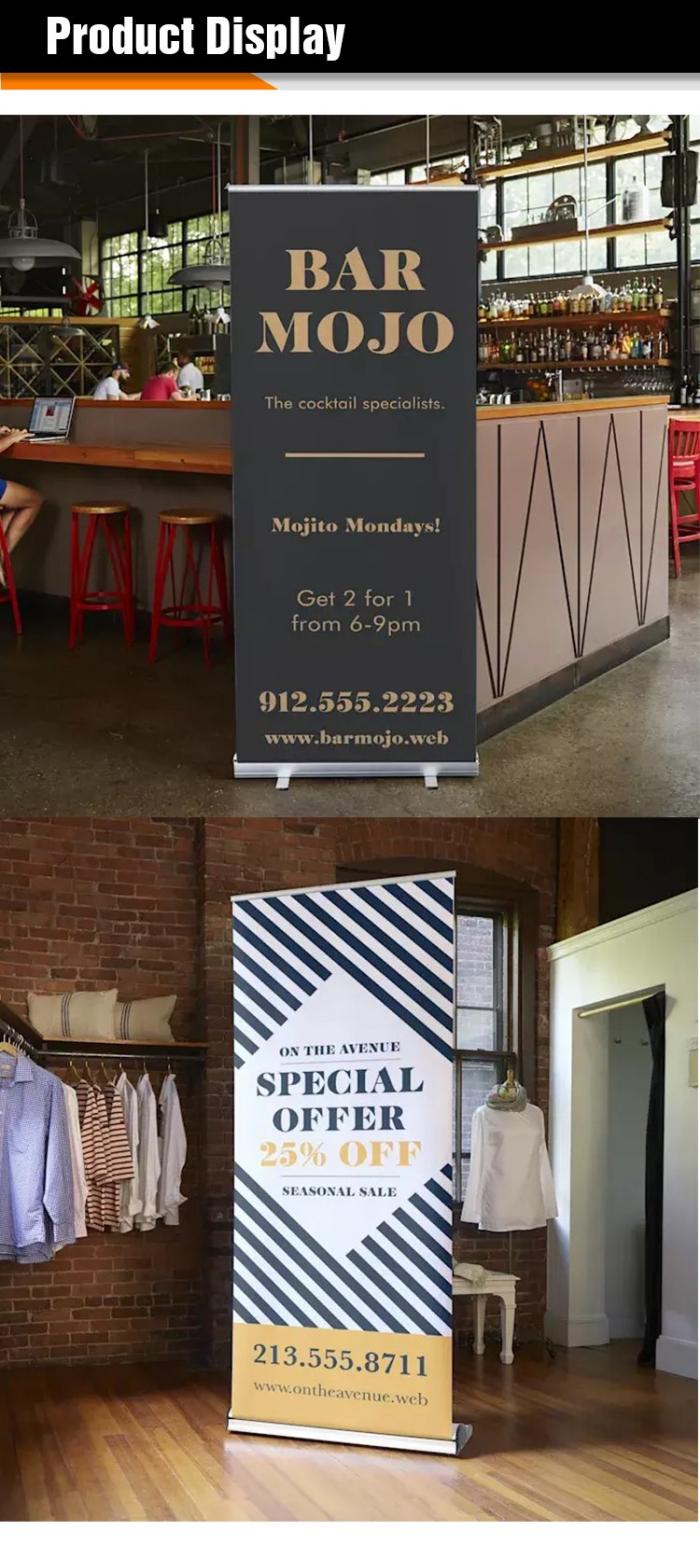
A roll-up banner in daily service at a café counter — the Black Friday use case that no organiser controls. Independent retailers, cafés and pop-up shops buy a portable banner stand once and re-print the seasonal message: the frame by the door stays, the November offer on the panel changes.
Freight is the quiet reason the roll-up banner wins November. An express courier moves a 44 cm roll-up display carton across Europe in three days for less than the cost of the roll-up banner's first print, so a replacement graphic ordered on the Monday is hanging in a Lisbon stand by the Thursday. No other trade show banner turns a deadline that fast. A pull-up banner checked in as luggage saves the exhibitor both the courier fee and the carousel wait — the pull-up banner is luggage, not freight. A hundred roll-up displays move by sea in a pallet space that would not hold five rigid backwalls — the roll-up display is the only exhibition banner that ships like stationery. And the retractable banner stand is the only trade show banner that can be re-printed on either continent: the cassette of the retractable banner stand is bought once, and the panels are printed locally wherever the quarter is being worked. Distributors who stock cassettes and print panels in-country rebuild the economics of the whole roll-up banner category — the hardware is standardised, the message is local, and the roll-up display is the only surface in the kit that carries both.
Buyer reference — the roll-up banner family in one column
● Roll-up banner stand, standard: 850, 1000, 1200 or 1500 mm graphic width on a 2000 mm print height, cassette of 840 / 990 / 1185 / 1480 mm, one-person setup in under a minute, tool-free throughout.
● Double-sided roll-up banner: two cassettes back to back on one base, two faces, one footprint — blockout PET recommended so neither print shows through.
● Teardrop roll-up banner: 850 x 200 cm at about 3.6 kg or 1000 x 200 cm at about 4.2 kg, curved L-frame, single-side fabric print, same 44 x 44 x 8 cm packing carton.
● Graphic materials: PP approx. 160 gsm (budget, single events), PVC approx. 180 gsm (wipeable, opaque, workhorse), PET approx. 180 gsm (sharpest colour, lay-flat), PET twist 420 gsm (premium, effectively blockout).
● Pole options: economic pole (budget), clip pole (locks off at height), high-quality clip bar, and clip bar with hook for tool-free graphic changes.
● Replacement graphic: drops into the existing cassette in about sixty seconds — reprint the panel, keep the asset, ship a 44 cm carton instead of a flight case.
● Travel kit: padded oxford carry bag for the roll-up banner stand, holds cassette, pole set and top rail; airline cabin-baggage footprint; courier-friendly as a small parcel.
● Artwork rules: 2000 mm roll-up banner height fixed, visible print line to the right, safe margins at the bottom rail, artwork proofed against the exact cassette width before printing.
● Cleaning: PVC and PET faces wipe down on any roll-up display for clinical and food-adjacent use; PP is a single-event panel.
● Custom widths and full-bleed print available from one artwork file across the whole range, so every exhibition banner, trade show banner and replacement graphic in a fleet matches.
● Order terms on a printed roll-up banner: minimum order 1 pc, electronic proof and sample in one to three days, EXW or FOB Guangzhou, Shenzhen or Foshan, shipped by express, air or sea.
Which roll-up banner for which November buyer: the Web Summit startup orders an 850 mm roll-up banner stand with a PP panel and economic pole; the MEDICA exhibitor orders a 1000 mm or 1200 mm retractable banner stand in PET twist 420 gsm with a clip bar with hook; the Black Friday retailer orders a portable banner stand and one replacement graphic per season.
Fleet logic: one cassette specification across every roll-up display, one artwork template, and pull-up banners ordered per store or per department — the frame is the asset, the replacement graphic is the budget line.
Reading a roll-up banner stand quote: cassette width, graphic width, panel material, pole type, carry bag — five lines, and the line most often missing from a pull-up banner quote is the carry bag.
What a replacement graphic cannot fix: a bent bungee pole, a tired spring roller, a cracked clip bar — inspect the roll-up display hardware before ordering the next print.
A buyer writing a specification for the November window can settle the whole roll-up banner order with eight questions. One: which width — 850, 1000, 1200 or 1500 mm — matches the floorspace, the artwork and the roll-up banner stand cassette it implies? Two: single-sided or double-sided roll-up banner? Three: which panel material, judged by how many days the roll-up banner must stand and how it will be cleaned? Four: which pole and rail — economic pole, clip pole, clip bar with hook? Five: does the artwork carry type in the bottom fifteen centimetres, where the safe margins of the roll-up banner live? Six: how many units per market, and does each need its own replacement graphic for its own market? Seven: who stores the pull-up banner cassettes between campaigns, and does the 44 cm carton of a roll-up banner fit that cupboard? Eight: the delivery date, calculated backwards from opening day rather than forwards from the order — the question that decides whether the roll-up banner flies or sails. On that last question the manufacturing realities are worth knowing before a deadline is agreed. This production line runs a minimum order of one piece on printed roll-up banner work, so a single roll-up banner — or a single replacement graphic — carries the same lead time as a hundred, and a sample is normally dispatched within one to three days of the artwork being approved as an electronic proof. Shipping for a retractable banner stand is by express, by air or by sea depending on the deadline, dispatched from Guangzhou, Shenzhen or Foshan on either EXW or FOB terms.
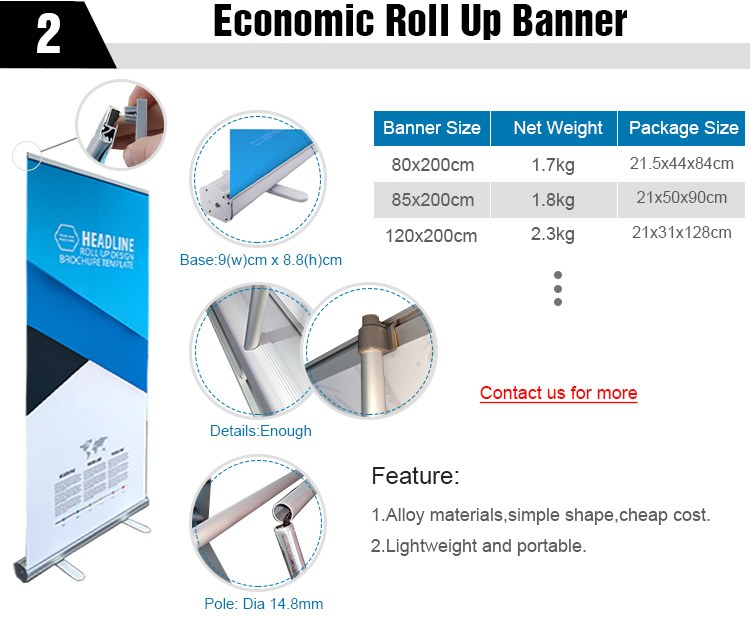
The roll-up banner size chart: 850 x 2000 mm, 1000 x 2000 mm, 1200 x 2000 mm and 1500 x 2000 mm graphics on cassettes of 840, 990, 1185 and 1480 mm. Four standard widths, one 2000 mm height, one artwork logic — the reason a roll-up display quote comes back in hours rather than days.
By the time Small Business Saturday closes on the evening of November 28, the same cassette will have done three jobs in three weeks — one roll-up display, three campaigns' worth of replacement graphics: a roll-up banner stand fronting a founder's whole company on a numbered wall panel in Lisbon, a roll-up display as a department sign in a Düsseldorf corridor, and a seasonal roll-up banner behind a café window — three audiences, three cities, one piece of hardware — one retractable banner stand — that never changed. That is the quiet argument for putting a roll-up banner, and a spare replacement graphic beside it, at the top of the November kit list rather than the bottom. A retractable banner stand is the only piece of branding — the only portable banner stand, the only roll-up display — that a team can reprint in a week, carry on a plane, stand up in a minute and update again for the next season without buying anything but a roll-up banner panel. The venues supply the crowds. The roll-up banner stand's cassette supplies the stand — and the panel is the part of it that speaks. For a buyer already planning November 2027, the roll-up banner is the first line of the order.
— keyword density report (longest-match, non-overlapping) —
word_count=3966 total_keyword_phrases=199 density=5.02% per-keyword: double-sided roll-up banner=10, retractable banner stand=18, roll-up banner stand=21, teardrop roll-up banner=9, trade show banner=6, portable banner stand=10, replacement graphic=24, pull-up banner=17, roll-up banner=48, roll-up display=34, banner stand=2
Event dates verified 29 September 2026 against official organisers: websummit.com (Lisbon, MEO Arena + FIL, 9-12 November 2026, 70,000+ attendees, 17 tracks, Night Summit) and medica-tradefair.com / virtual.medica-tradefair.com (Düsseldorf, 16-19 November 2026, 4,821 exhibitors from 70 countries, 78,000 visitors from 160 countries, build-up 10-15 November, dismantling to 23 November, opening hours Mon-Wed 10:00-18:00, Thu 10:00-16:00). Black Friday 27 November 2026 follows US Thanksgiving 26 November; Small Business Saturday 28 November.