


November is the counter season: from Singles' Day pop-ups to the Las Vegas Strip, one collapsible counter carries the whole month
On Wednesday 11 November, the world's largest 24-hour shopping event puts brands on streets and in malls for a day of sampling and selling. All month, Movember volunteers staff registration desks wrapped in moustache branding. In the first days of November, London switches on its Christmas lights and late-night shopping begins; from 19 to 21 November, Formula 1 takes over the Las Vegas Strip for its night race. Four events, four budgets, one piece of hardware at the front of each activation: the printed pop-up counter that folds flat, sets up in seconds and glows when the lights go down.
GUANGZHOU / LONDON / LAS VEGAS — 22 October 2026
Every event calendar has one piece of hardware it cannot do without, and for the month now opening that hardware — the pop-up counter — sits at the front of the activation, not behind it. On Wednesday 11 November, Singles' Day — the 11.11 shopping festival born in China and now marked by retailers on every continent — sends brands into malls, high streets and hotel lobbies with a collapsible counter in the van for a day of sampling, demos and last-metre conversion. All through November, the Movember campaign fills offices, pubs and campuses with moustache-branded registration desks — every one of them a pop-up counter or a folding counter borrowed for the month, collecting donations for men's health. In the first days of November, London switches on its Christmas lights — Carnaby Street fires up on Wednesday the 4th, with Oxford Street and Regent Street expected in the same week — and the West End settles into six weeks of late-night shopping, every sampling position anchored by a portable promotion counter or an LED display counter. And from 19 to 21 November, the Formula 1 Heineken Las Vegas Grand Prix turns the Strip into a 6.2-kilometre street circuit under floodlights, with fan zones, hospitality suites and merchandise positions — every one a pop-up counter or a fabric display counter — running from Thursday practice to Saturday's 8 pm start. Four events, four industries, four very different brands — and at the front of each one stands the same understated pop-up counter: a printed fabric display counter — pop-up counter to the trade — that travels flat, opens in seconds and carries the campaign at exactly the height where wallets, wrists and conversations happen: the pop-up counter, the folding counter and the pop-up table doing three different jobs on one shared chassis.
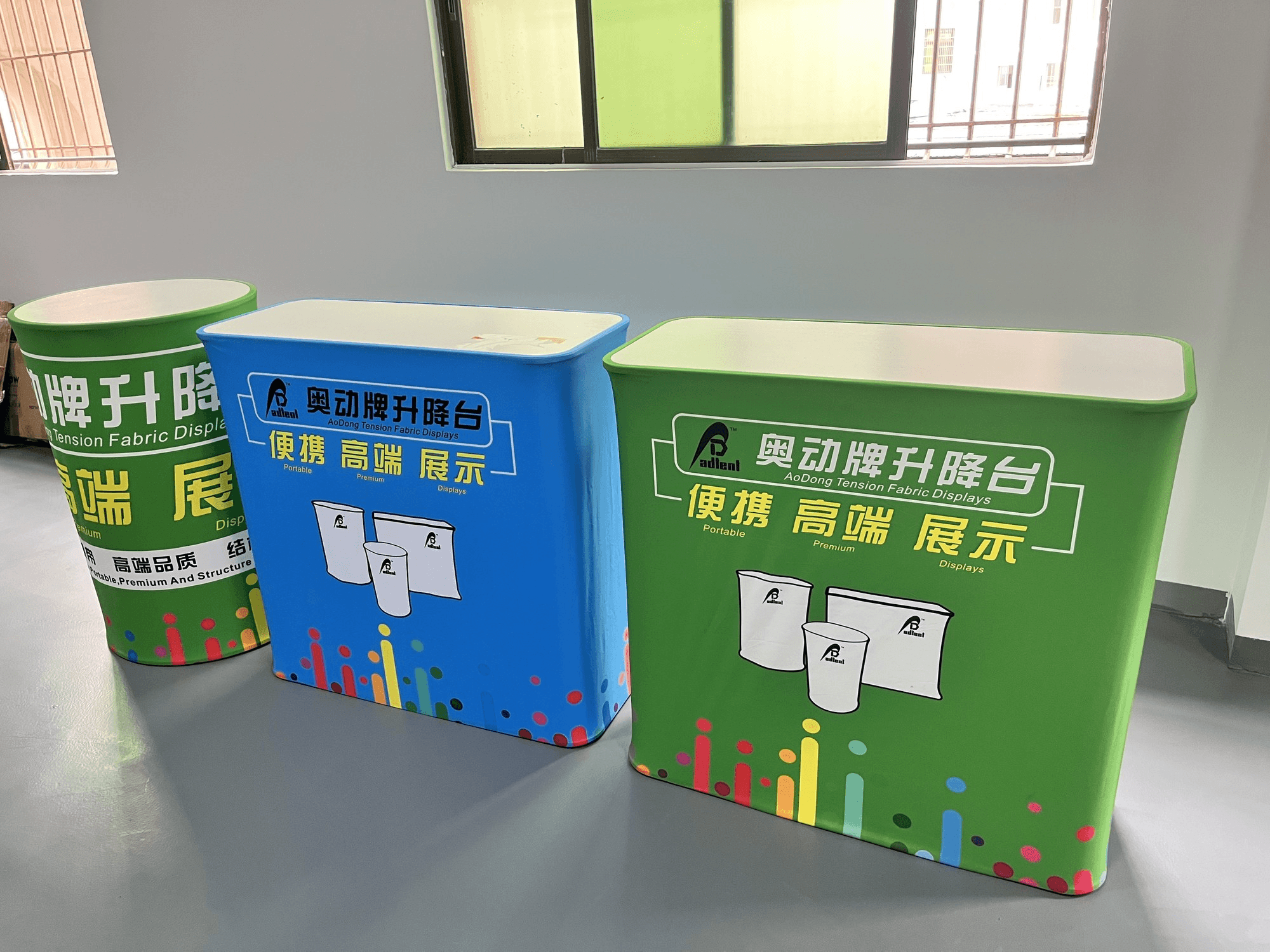
The family on one factory floor: a round promotion counter on its scissor-lift frame flanked by two rectangular fabric display counters, each wearing a full-dye printed stretch sleeve with a white working top. One footprint, three shapes, one hire fleet.
The category is worth naming precisely, because buyers search for it under several names and get served very different products. A true pop-up counter is a self-erecting unit: a sprung or scissor frame that expands from a collapsed stack to working height, wrapped in a printed stretch-fabric sleeve that grips the body like a second skin — the signature of every fabric display counter in the family, finished with a moulded or laminated top. It is not a trestle table with a throw over it, and it is not a hard-shell flight case with a lid — it is a collapsible counter engineered so that one person carries it, opens it and is taking orders before the second team member has parked the van. A collapsible counter earns its keep in those seconds; a portable promotion counter earns its keep over a whole season. In the trade it answers to portable promotion counter, exhibition counter, trade show counter, pop-up table and folding counter almost interchangeably, which is why serious buyers of a portable promotion counter specify by mechanism — scissor lift, concertina, fold-flat panel — rather than by marketing name, and by packed size — the measurement that separates a true folding counter from a trestle in a skirt. The distinction matters most in the two weeks the industry is about to enter, when a single brand may staff a mall sampling pop-up counter on the 11th, a charity folding counter on the 14th, a shopping-centre exhibition counter on the 20th and a race-week hospitality LED display counter on the 21st, all with the same bags — one pop-up counter per brief, one folding counter per island.
11.11: the day the pop-up counter meets its deadline
Singles' Day has outgrown its origins. What began as an anti-Valentine's novelty on four ones is now the largest single-day retail event in the world — the busiest date of the year for the portable promotion counter trade — and its gravity has spread far beyond the platforms that created it: department stores in Kuala Lumpur, beauty chains in Dubai, streetwear labels in Berlin and Los Angeles all run 11.11 activations — each with a fabric display counter at its centre — because their customers expect the date to mean deals. The format that travels best is the pop-up shop: a branded island in a mall atrium or on a sidewalk, open for a day or a weekend, selling the offer that expires at midnight. And the pop-up's most functional piece of furniture is the pop-up counter at its centre — the surface where samples are handed over, QR codes are scanned, product is tested and the till lives — the three jobs of a portable promotion counter in one footprint, which is why no exhibition counter ships plain. Retail teams that run these islands professionally think of the pop-up counter as the activation's checkout, its demo bench and its brand billboard at once, which is why the graphic wrapped around each exhibition counter is printed edge to edge with the campaign identity rather than left plain — a pop-up counter is a billboard with a till inside it.
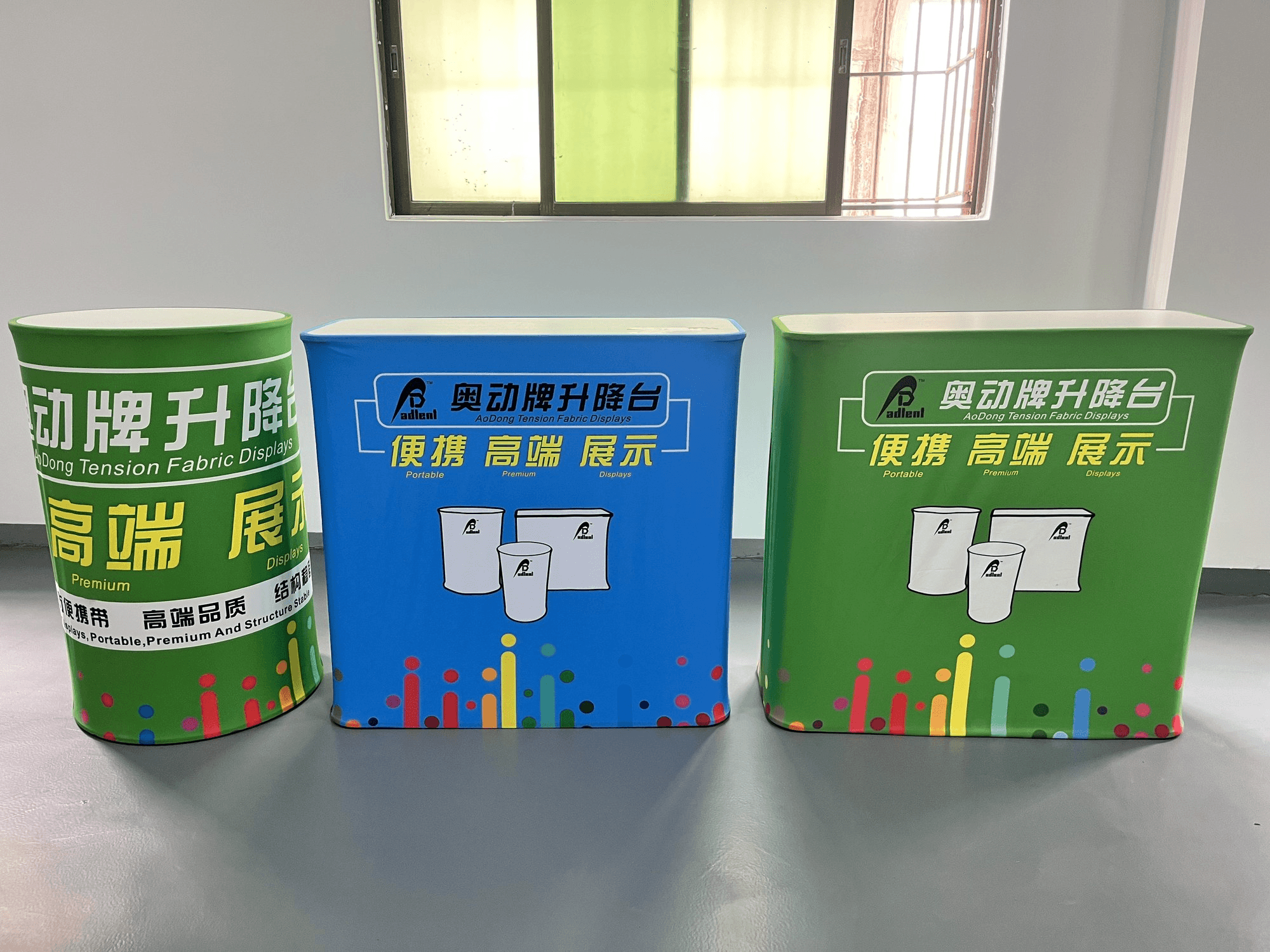
Front view of the trio: the fabric display counter at the left collapses to a disc, the two rectangular pop-up counters fold flat to slabs, and every graphic is a zip-off sleeve — the frame is the asset and the fabric is the campaign.
The buyer story that repeats every year at this point comes from brand-side marketing managers who left the counter order too late in 2024 or 2025 and spent the 11th improvising. The lesson they carry into this November has three parts. First, order one collapsible counter per island, with one spare folding counter sleeve per shape, not one unit per store — the pop-up counter is cheap enough that the constraint is crew, not budget, and a two-person team can dress three islands in a morning if each has its own unit. Second, order the fabric sleeve with the artwork bleed and zip placement confirmed on an e-proof before production; a sleeve that zips is a sleeve that can be re-printed for December, which turns the 11.11 spend into a two-campaign asset — and the trade show counter ordered next quarter inherits the template for free. Third, specify the round promotion counter shape where staff demonstrate and the rectangular shape where stock is stored — the round promotion counter reads friendly and camera-friendly, while the rectangular folding counter hides a shift's worth of inventory behind its skirt. Teams that write those three lines into the brief stop treating the pop-up counter as an afterthought and start treating it as the activation's infrastructure — one pop-up counter per island, one LED display counter per evening shift.
Anatomy of the family: scissor lift, folding box, glowing panel
The product family photographed for this article covers the three pop-up counter shapes the market actually buys, and its anatomy explains the portable promotion counter pricing tiers. The hero of the range is the round promotion counter: a cylindrical drum on a scissor-lift mechanism, and it is the mechanism that makes it special. Release the catch and the X-struts of the height-adjustable counter extend; the moulded top rises from packing height to working height and locks — a genuine height-adjustable counter, which matters more than it sounds, and which no fixed folding counter can imitate. A seated demonstrator lowers the surface to lap height; a standing greeter raises it to counter height; a school demonstration drops it to the height of the students' hands. Around it sit the rectangular models: the folding counter that opens like a chest and locks into a box, and the smaller pop-up table for cramped corners, each wearing the same zip-off stretch sleeve over a rigid body — every one of them a collapsible counter first and a shape second. All of them pack flat, and none of them needs tools — the whole collapsible counter category is designed around the belief that set-up time is the most expensive line in any activation budget, and a pop-up counter is the cheapest answer to it on the market.
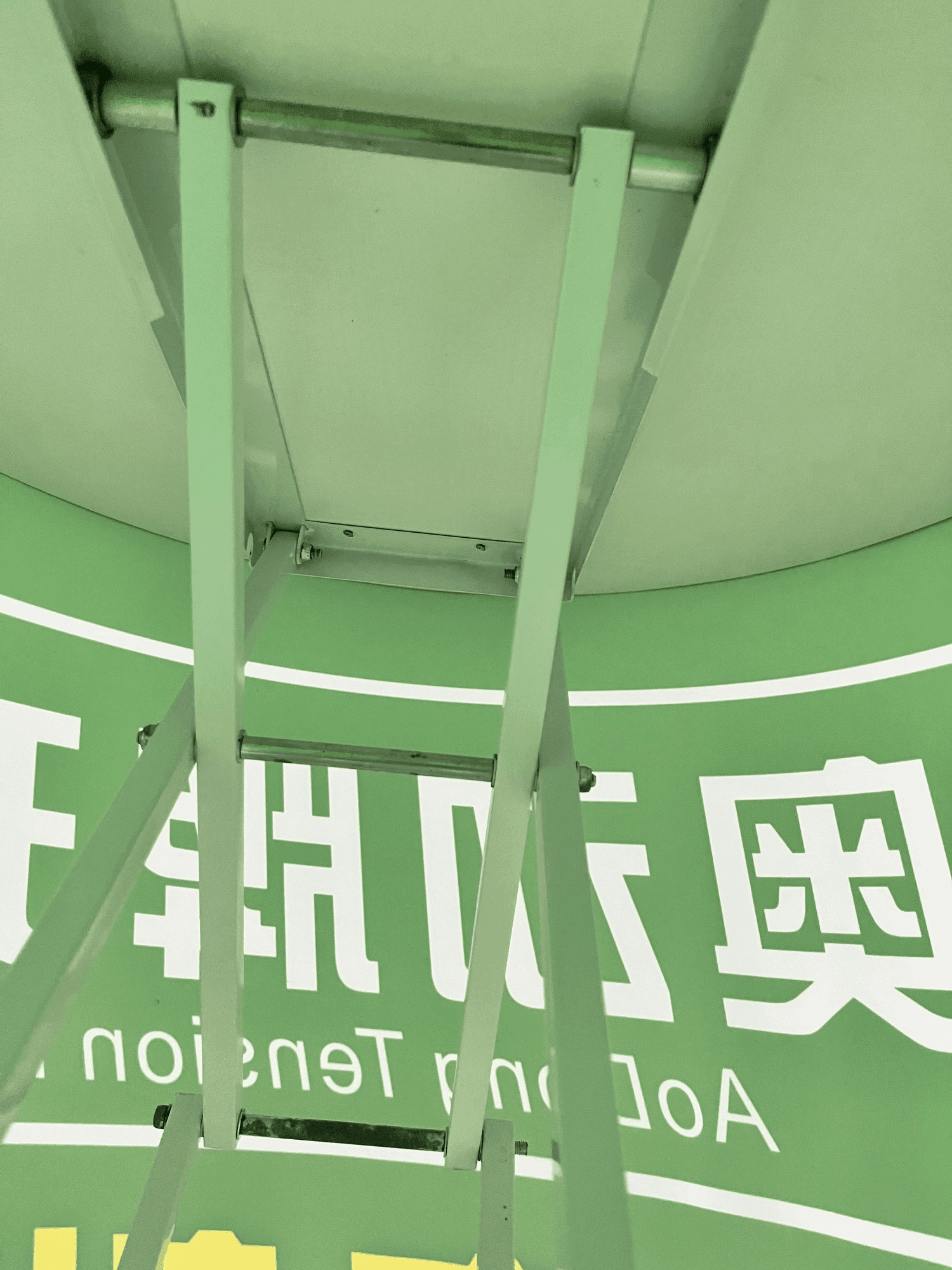
Under the round top: the scissor-lift mechanism that makes this a height-adjustable counter. X-struts in painted steel raise and lower the working surface, so the same portable promotion counter serves a seated demonstrator at nine and a standing greeter at noon.
The fabric is the half of the system that buyers learn to love second. The sleeve is a dye-sublimation print on elastic knit fabric: the design is first printed onto transfer paper and then bonded into the fibre under heat, so the graphic will not crack, peel or flake the way surface prints do when the fabric stretches. Because the knit is elastic, the sleeve tensions itself over the frame and reads smooth without wrinkles; because it zips, the fabric display counter re-skins without tools. A brand team therefore buys the fabric display counter frame once and the fabric repeatedly — the same collapsible counter wears the 11.11 graphic on Monday, a Movember graphic in mid-November and the December campaign by the time the Christmas lights are up. Print shops can turn a replacement sleeve around in days from the supplied pop-up counter template, which is the quiet reason exhibition counter fleets stay loyal to one frame standard for years: the graphics library accumulates, and every new campaign is a print job, not a furniture order — the whole promise of the exhibition counter category in one sentence.
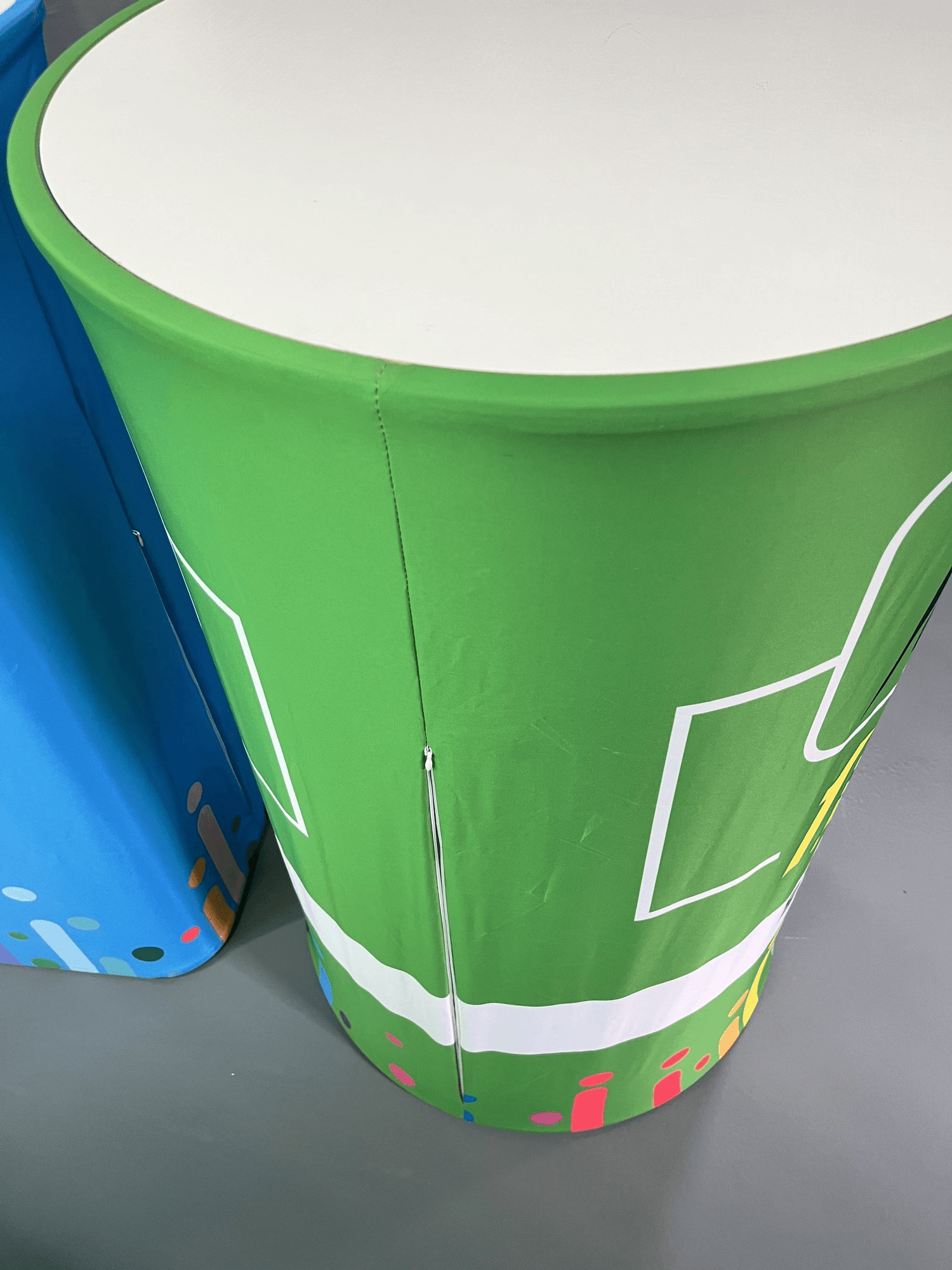
The full-length zip, photographed at working distance: the printed sleeve of the fabric display counter unzips from rim to base in one pull, so a crew re-skins a pop-up counter for the next campaign in the time a kettle takes to boil.
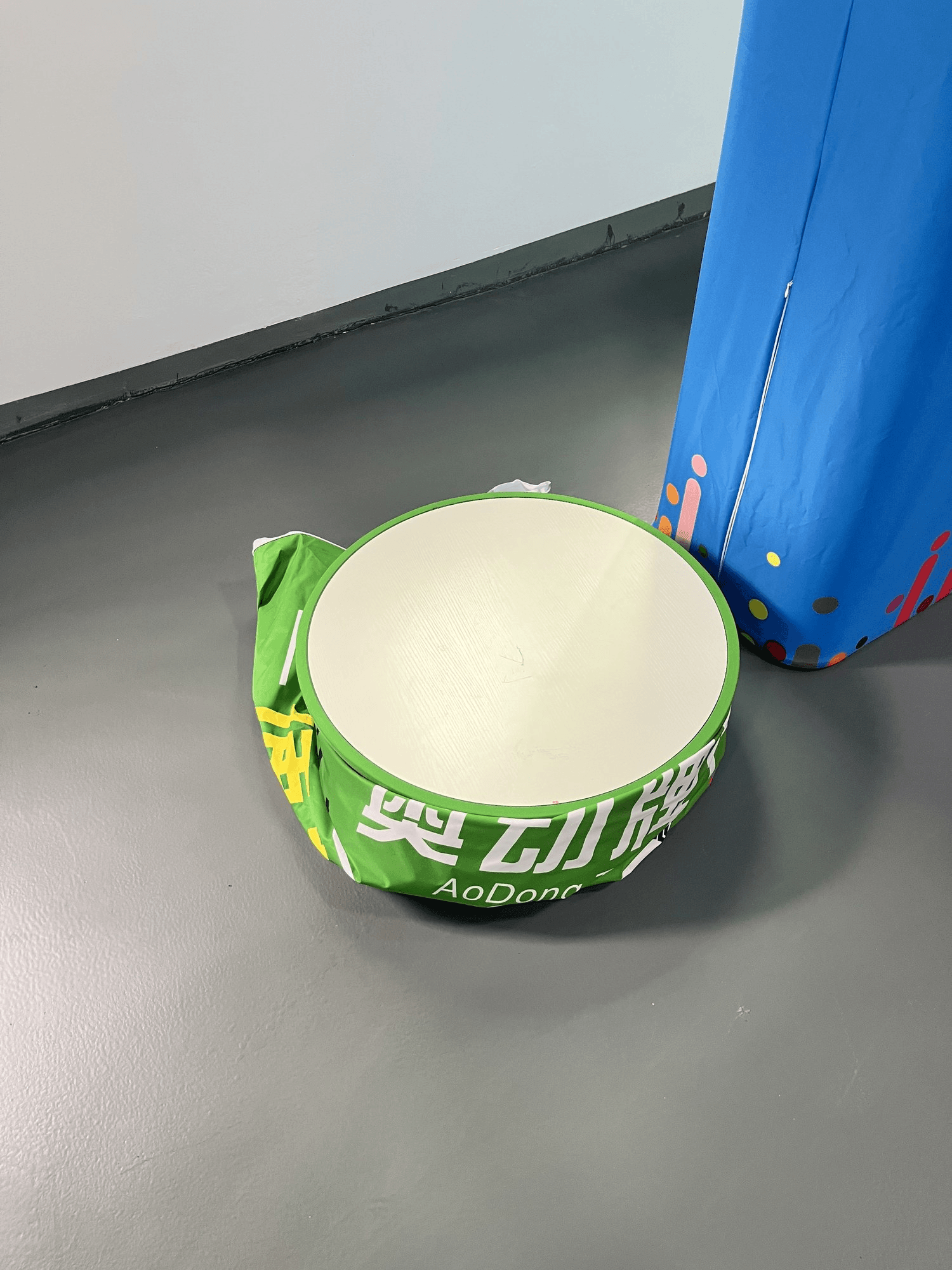
The freight story in one photograph: the round promotion counter collapsed to a flat disc on the studio floor. A collapsible counter that packs this thin ships by parcel post, rides a hatchback boot and stores on a shelf edge rather than a pallet.
Freight and storage are where the collapsible counter category earns its keep on paper. A round promotion counter collapses to a flat disc a hand-span deep; the rectangular folding counter folds to a slab that nests with its siblings. An entire activation — a round promotion counter, a folding counter, a pop-up table, a spare sleeve per shape, a box of LED strips — fits in a hatchback boot or a single parcel carton, which collapses the logistics cost that used to make pop-up retail uneconomic for single-day events — one collapsible counter, one carton, one courier. It also collapses the storage cost: a shopping centre that hosts a sampling island every weekend can shelve its stock of trade show counter units on one shelf in the space a single folding table occupies. For agencies running national roadshows, the arithmetic is blunter still — a portable promotion counter travels as accompanied baggage on the flights where a hard-shell kiosk would travel as freight, arriving when the team arrives rather than three customs forms later.
Which shape for which job: a purchase guide for the season
Buyers who call the factory in the last week of October tend to ask one question — which pop-up counter do we actually need? — and the honest answer is that the family divides by job, not by price, and not, despite the catalogue names, by anything a folding counter or a pop-up table cannot share. The round promotion counter is the demonstrator's tool: the height-adjustable counter top gives a seated staff member and a standing greeter the same surface on the same day, the cylindrical skirt prints beautifully in a full-circle wrap, and the pop-up counter reads as an island rather than a barricade, which is why sampling teams and beauty advisors reach for this height-adjustable counter first. The rectangular folding counter is the workhorse: a bigger working top for a till, a wrapping station or a laptop — the trade show counter duties, a storage body behind the skirt that swallows a shift of stock, and a fold-flat profile that nests ten folding counters to a shelf. The pop-up table is the space-saver for corners, queue ends and lift lobbies; the LED display counter is the after-dark specialist — an illuminated display counter glowing through its own sleeve wherever the house lights drop; and the whole set — round, box, small, lit — ships as one collapsible counter family with one fabric display counter template, so a portable promotion counter ordered this week wears the same campaign graphic as the trade show counter ordered last quarter, and as the exhibition counter ordered the quarter before that. Agencies that map shapes to jobs before they map brands to shapes end up buying less, because one fabric display counter standard covers every event on the client's calendar, from mall floor to trade show counter row.
A short worked example shows the mapping in practice. A beauty brand running an 11.11 island in a mall atrium books one round promotion counter for the demo position and one rectangular folding counter for stock, with a pop-up table for the queue, all wearing the same 11.11 sleeve. Two weeks later the same pop-up counter frames appear in a shopping centre late-night shopping evening as gift-wrapping stations — a pop-up table squeezed between them holds the ribbon — and by race weekend in Las Vegas the third collapsible counter in the set is a registration desk in a suite overlooking the Strip, its LED display counter sleeve glowing until the early hours. Three frames, four events, zero new hardware — only replacement sleeves for the fabric display counter fleet. That is the portable promotion counter economy in miniature — one exhibition counter standard, many skins, and it is why buyers who start with one pop-up counter for a single date so often finish the quarter owning a set of folding counters.
Movember: the month the folding counter works for free
Parallel to the retail calendar runs the charity calendar, and November owns it — the folding counter works its hardest month of the year. Movember — the campaign that asks men to grow moustaches through the month and put men's health, prostate cancer, testicular cancer, mental health and suicide prevention on the table — is staffed largely by volunteers in offices, pubs, gyms and campuses, and every one of those events needs a registration and donation desk that appears at lunchtime and vanishes by close of business — a folding counter borrowed after lunch, gone before the evening rush. The requirements are brutal in their own way, and a pop-up counter meets every one of them: the folding counter must set up in under a minute by a volunteer who has never seen it before, it must read as the campaign from across the room — which is precisely what the printed sleeve of a fabric display counter is for, and it must survive being carried up a staircase in a pub — the real-world test no trade show counter brochure mentions. A fabric display counter answers all three demands — the sleeve of the fabric display counter prints the moustache identity edge to edge, and the scissor or fold-flat frame opens without instructions, and the packed weight is measured in single kilograms, not in the double digits of a wooden register desk.
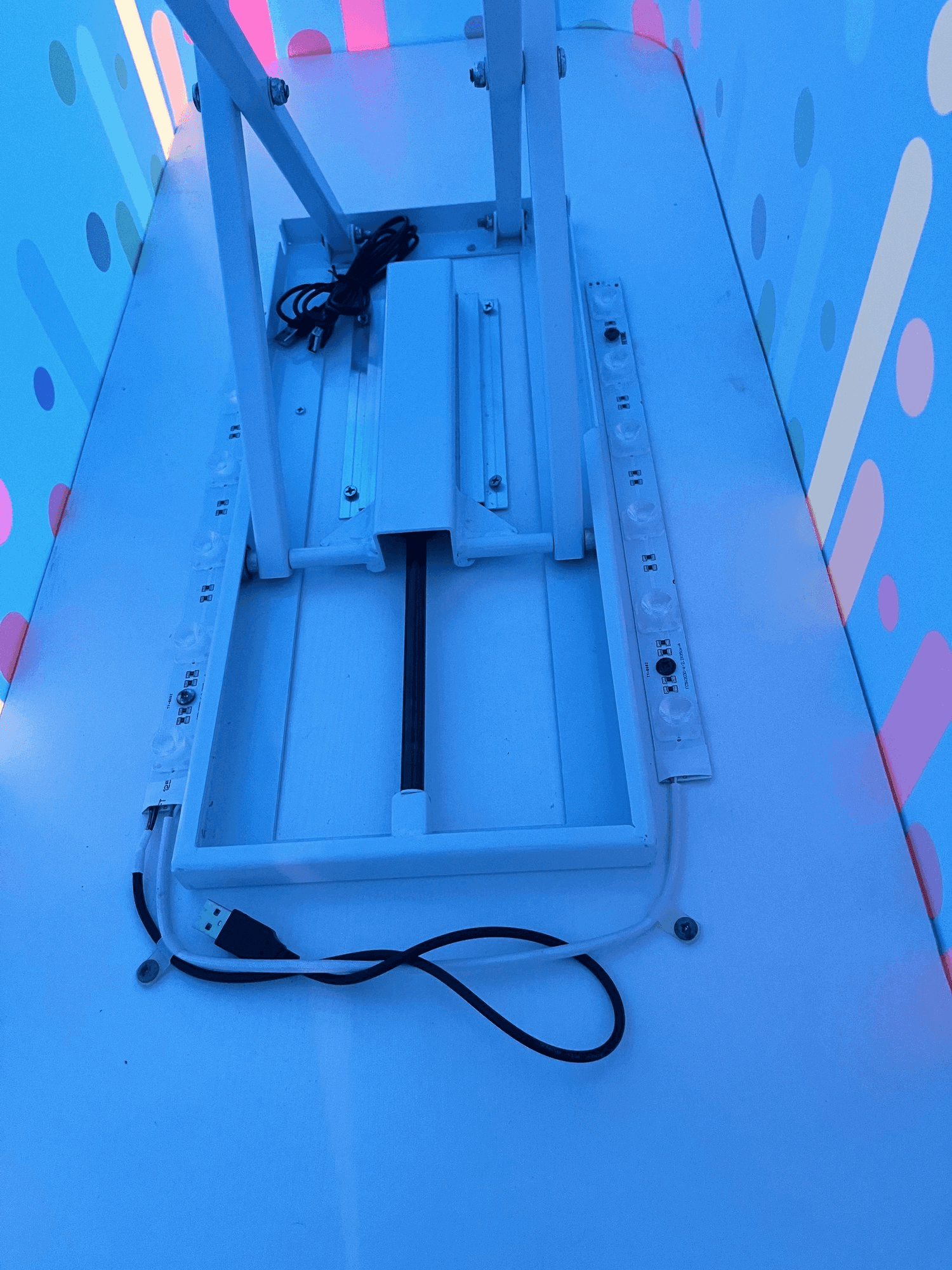
Inside the illuminated display counter: USB-powered LED strips mounted on the inner frame glow through the printed knit after dark. An LED display counter turns a sampling desk into a lantern — exactly what a Movember evening event or a fan zone wants at 8 pm.
The detail that charity-event organisers rave about, and the one retail buyers underestimate, is the illuminated option. The range photographed here includes an LED display counter with USB-powered light strips mounted inside the body, glowing out through the printed knit — and in a dim pub back room at 8 pm, an illuminated display counter is the difference between the donation desk being found and being missed — a collapsible counter that works as a lantern. Because the strips run from a standard USB plug, the power source is a power bank in the drawer: no mains socket, no extension lead, no venue electrical sign-off, no electrician's invoice on a charity budget. The same logic serves the winter evening events that follow, and an illuminated display counter outperforms every unlit pop-up counter — late-night shopping evenings, light trails, community carol nights — wherever a pop-up table must remain findable and welcoming after dark. Organisers who standardise on the illuminated version report a second benefit they did not plan for: volunteers photograph the glowing desk, the photographs go into the campaign's social feed, and the counter starts doing marketing work that no banner ever did — free advertising for the illuminated display counter category.
London, early November: the switch-on evenings and the retail floor
In London, the first week of November belongs to the switch-ons. Carnaby Street fires up its display on Wednesday the 4th; Oxford Street's famous stars and Regent Street's angels are both expected in the same first days of the month; and from 19 November, Hyde Park's Winter Wonderland opens its gates and runs through to early January. The switch-on evenings matter to this story because of what happens on the pavement behind the crowds: retailers extend their hours, brands station sampling teams — pop-up counter in hand — at the tube entrances, and shopping centres from the West End to the suburbs run their own count-down events with a folding counter at every mall entrance — and every one of those positions is anchored by a pop-up counter — usually a round promotion counter for the sampling team, sometimes a folding counter for the gift wrap. The exhibition counter is the natural retail floor citizen: it occupies roughly the footprint of a wheelie bin, and a collapsible counter that small asks no permission from the landlord, needs no fixture approval because a folding counter is furniture rather than a build, and can be carried to the pavement for the evening and back to the stock room before the shutters come down — the nightly commute of a collapsible counter.
Three shapes, one system: the exhibition counter family seen from the side, from the round scissor-lift unit to the two folding counter boxes. Agencies standardise on the family so one fabric display counter print logic covers every event on the calendar.
The retail buyer's decision tree for the season — one folding counter, one pop-up table, one LED display counter — is narrower than it looks. Where staff hand over samples or talk to queuing customers, the round promotion counter wins on approachability and on camera; where the folding counter must hold a till, a wrapping station or a shift's stock, the rectangular folding counter wins on storage capacity. Stores running gift-wrapping services through December standardise on a pair of pop-up counters — one portable promotion counter facing the aisle, one fabric display counter behind it holding ribbon and stock — and print both sleeves in the store's Christmas identity — one portable promotion counter facing the street, one fabric display counter facing the till. Multi-site retailers add a discipline the single-store buyer can skip: they buy every exhibition counter and pop-up table from one frame standard, so a sleeve printed for one branch fits every branch, and the head-office graphics library becomes a genuine asset rather than a drawer of one-offs. The pattern echoes what happened with the hire industry years ago — uniform frames, printed skins, one price list — and it is the reason the family in these photographs is photographed as a family rather than as three unrelated products: every pop-up counter, folding counter and LED display counter in the range shares one print template.
Las Vegas, 19-21 November: race week and the licensed-activation lesson
The month's most extravagant test of portable exhibition counter hardware happens under floodlights. The Formula 1 Heineken Las Vegas Grand Prix returns to the Strip from 19 to 21 November — practice on Thursday, qualifying under the lights on Friday, and the Grand Prix itself at 8 pm on Saturday over 6.2 kilometres and 17 turns of public road, with the all-female F1 Academy series closing its season on the same bill. Around the circuit, the race organiser builds official fan zones with activations, live entertainment and food and drink positions, and the resorts along the Strip fill their lobbies, rooftops and terraces with branded hospitality running the full four days, much of it dressed around a trade show counter or two. The counter relevant to this story is everywhere in that periphery: the check-in desk of a rooftop activation, the merchandising position in a hotel lobby, the sampling island in a fan zone, the registration point of a ticketed party — each one a portable promotion counter doing a different job on a different exhibition counter budget. A portable promotion counter suits race week precisely because the week is temporary — builds go up on Wednesday and are gone by Monday, and the trade show counter is the furniture that survives that schedule — the furniture that travels flat and sets up toolless, the definition of a folding counter.
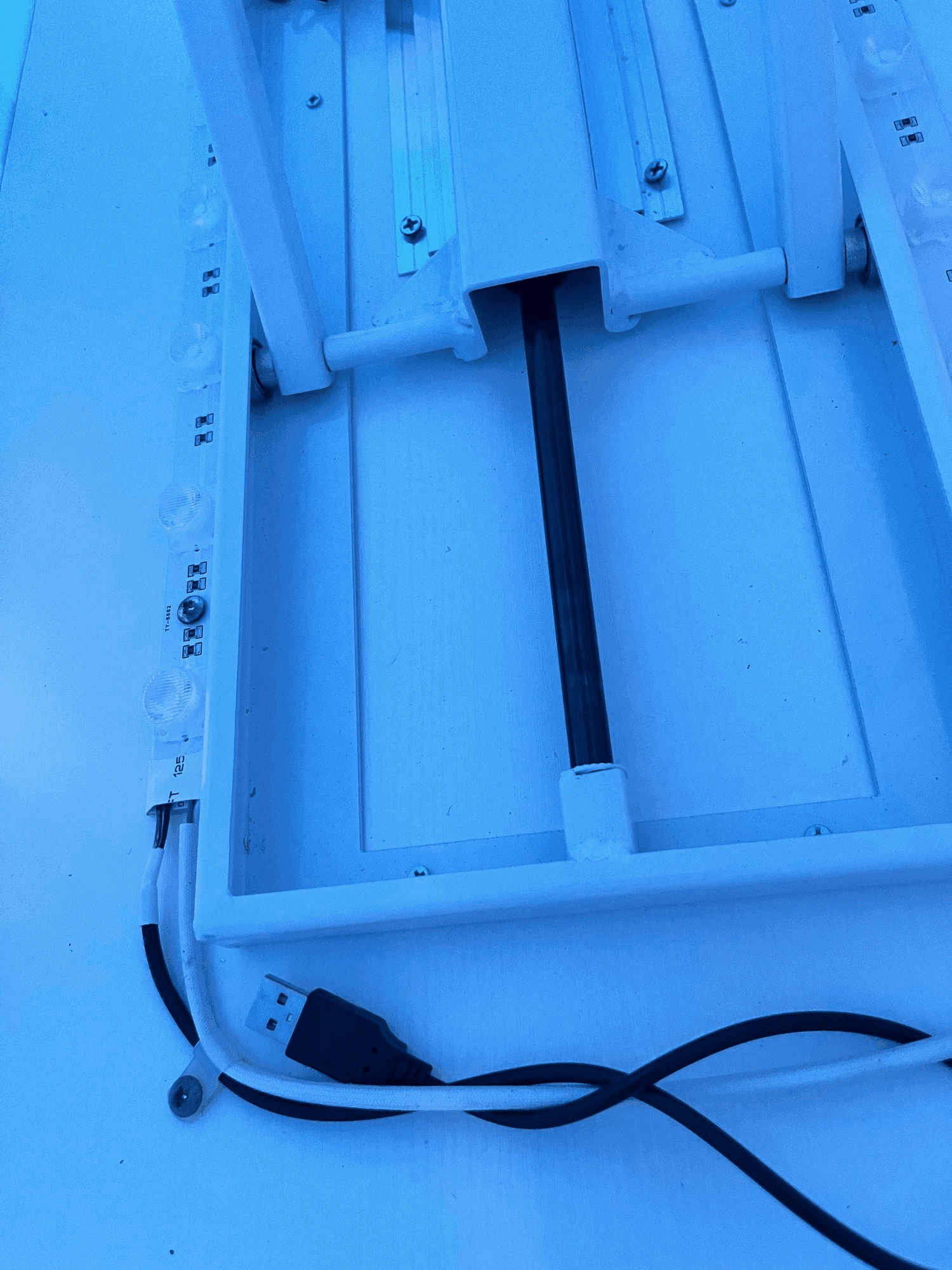
The power detail buyers ask about first: the LED strip runs from a standard USB plug, so an illuminated display counter needs no mains socket, no electrician and no venue permit — a power bank in the drawer lights a pop-up table for a full evening shift.
Race week also supplies the sharpest compliance lesson of the season, and it is worth stating plainly because it shapes what gets printed on the sleeve. The event's organisers are explicit that Formula 1's marks and typefaces may not be used by third parties without a licence: unauthorised association with the event is not permitted, tickets may not be offered as prizes without authorisation, and even public screenings of the race require the correct licence. The practical consequence for brands activating a pop-up counter in Las Vegas that week is simple — the graphics on a trade show counter or pop-up table must carry the brand's own identity, not the race's, unless the brand holds a licence. Buyers who understand this early — and print the campaign, not the circuit, on their exhibition counter — come out ahead twice: their artwork — the sleeve that turns a pop-up table into a branded desk — is approved by the venue before the build deadline instead of being pulled mid-week, and because their sleeve carries their own campaign rather than someone else's trademark, the same fabric display counter works the following weekend in Phoenix or Portland with zero re-printing. Compliance, in this case, is also the cheaper logistics.
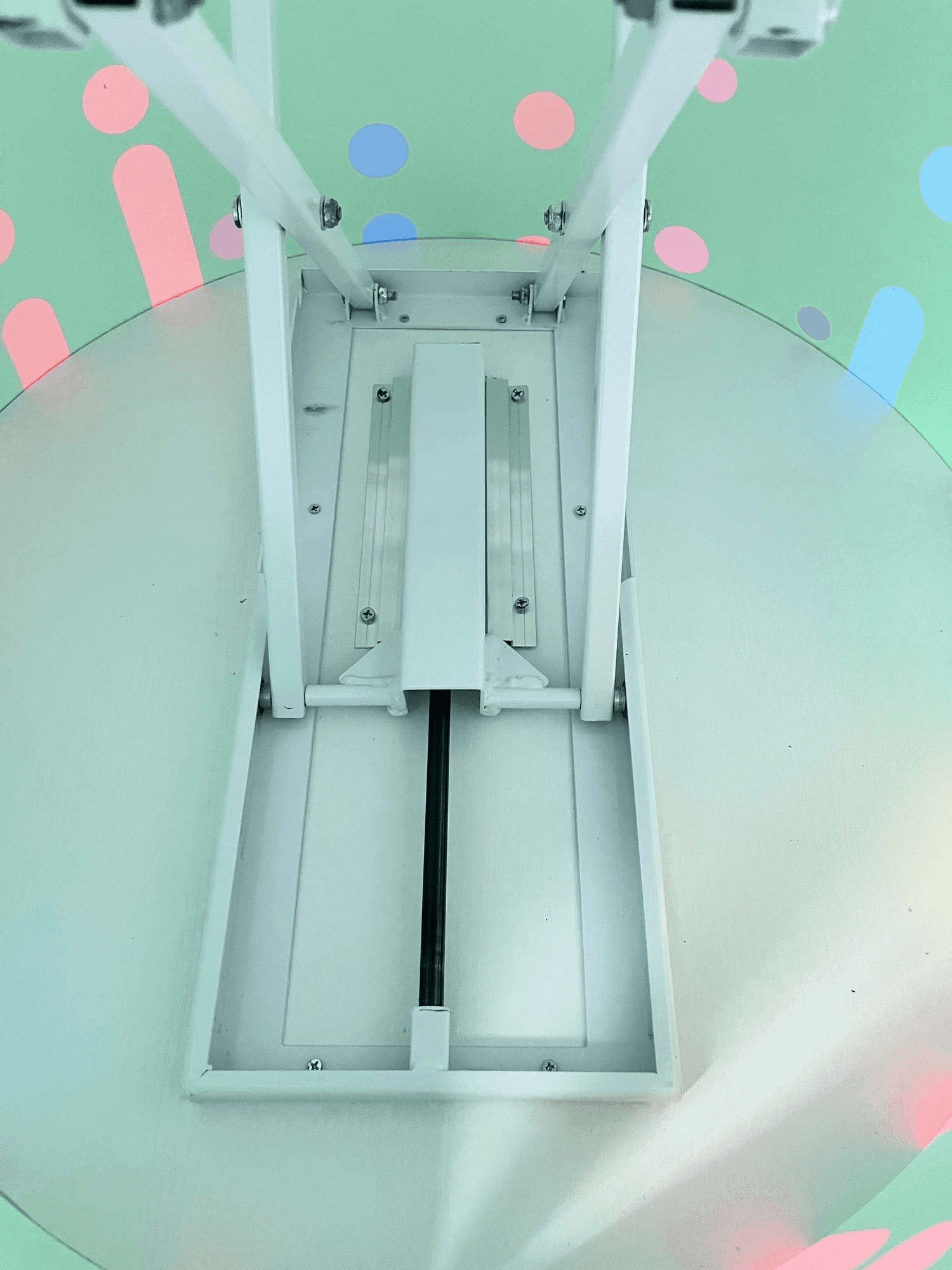
The inspection view: looking down into the round promotion counter at the scissor struts, the pivot bolts and the central spine of the height-adjustable counter. Thirty seconds of thumb-and-eye on these parts predicts years of daily set-ups better than any certificate.
The fleet view: hire houses, agencies and multi-site retail
The buyers who buy most are not buying for one event at all. A party-hire or exhibition-services company buys a pop-up counter the way a hotel buys chairs — in tens — and every folding counter and pop-up table in the stock room is rental income, and the specification of a trade show counter reveals what survives commercial cycling. Hire houses confirm the scissor mechanism of the height-adjustable counter first, because a unit that locks loosely comes back from every job looser; they specify replacement sleeves for every collapsible counter in stock — a fabric display counter is only as hireable as its current print, because the graphic is what the client actually sees and the sleeve is what the client actually damages; and they buy the rectangular folding counter in deeper numbers than the round promotion counter, because box shapes stack in a van and drums do not, and a trade show counter fleet earns nothing sitting in the van. Their economics reward exactly the discipline a first-time buyer should copy: one frame standard, a print template on file for every exhibition counter and pop-up counter, a graphics library that grows with every campaign, and a trade show counter fleet that rents out for a decade while the prints turn over quarterly — the arithmetic that keeps a portable promotion counter fleet profitable.
Multi-site retail runs the same logic from the other direction. A chain that wants a portable promotion counter in every branch buys one exhibition counter and trade show counter specification, one template, and a rolling print schedule: the Christmas sleeve goes on each pop-up counter in November, the sale sleeve in January, the spring launch after that, each fabric display counter re-skinned by store staff in the time a morning briefing takes — no tools, no fitters, no folding counter downtime. The pop-up table joins the set wherever floor space is tight, and the LED display counter covers the evenings that the winter calendar makes long — an illuminated display counter in the window, a collapsible counter at the door. Buying this way converts the pop-up counter from a purchase into a programme — the folding counter becomes a fixture that never dates because the skin always does, and the finance department stops asking why marketing keeps ordering furniture — one pop-up counter after another — it already owns.
The buyer's inspection: what to check before a month of daily set-ups
Whichever pop-up counter a buyer chooses, the hardware rewards thirty seconds of physical inspection more than any certificate in the quotation pack. The scissor mechanism is the heart of the round promotion counter: cycle it through its full travel and feel for grit, sag or side-play at the pivot bolts; a height-adjustable counter that locks positively at each position on day one will still lock positively after a season of daily use, while one that clunks or drifts will be propped with gaffer tape by New Year — no height-adjustable counter survives a season of drift. On the folding counter models, open and close the box twice and check that the locking braces of the folding counter seat without persuasion; look at the top edge, which takes the knocks; and lift the unit packed — if the folded slab resists being carried one-handed, the activation crew will notice before the buyer does, and no folding counter survives a resentful crew for long.
- Cycle the scissor or fold-flat counter mechanism five times; it should move freely and lock positively at every position.
- Check every pivot bolt and brace for play; tight hardware now is tight hardware in December.
- Test the zip of the fabric display counter sleeve end to end — a sticky zip means a re-skin becomes a two-person job on any fabric display counter.
- Stretch a corner of the sleeve and release it; the knit should snap back with no permanent bagging.
- Inspect the working top of each folding counter for edge lamination and load rating; this is the surface the till and the samples live on.
- Confirm the LED display counter strips, if ordered, run from a standard USB power bank and are accessible for replacement.
- Pack the collapsible counter away unaided: if it needs two people or a manual, it fails the volunteer test that every collapsible counter must pass.
- One pop-up counter per staffed position; one folding counter per two positions for stock and overflow.
- One LED display counter per evening or after-dark event, with USB power banks rated for the full shift.
- One spare sleeve per portable promotion counter in circulation, printed from the stored template.
- Round promotion counter for sampling and demonstration; rectangular folding counter for tills and gift wrap; pop-up table for corners and queues.
- Every exhibition counter ordered from one frame standard, so any sleeve fits any frame in the fleet.
- Spare LED display counter strips stocked at one set per five illuminated units in the field.
- Weigh and measure the packed collapsible counter and put those numbers on the purchase order — they decide the freight.
The questions serious buyers put to suppliers compress into a short list of exhibition counter questions, and suppliers who answer them without hesitation are usually the ones whose folding counter hardware passes the inspection. Ask how the sleeve attaches and whether replacement sleeves for the pop-up counter can be ordered separately against a template; ask what the fabric weight is and whether the print is dye-sublimation rather than surface transfer; ask the packed dimensions and weight of each pop-up counter shape; ask whether the round promotion counter is genuinely height-adjustable or fixed; ask what the top surface is made of and what load it takes; ask whether LED display counter versions are USB-powered and replaceable; ask the minimum order quantity — for this collapsible counter family it is a single piece, which lets a brand test one pop-up table across one event before ordering a fleet of folding counters; and ask the e-proof and sample lead time, which for stock shapes runs one to three days.
Three buying mistakes account for most of the disappointment in this category. The first is buying a collapsible counter on the standing photograph alone — two pop-up counters can look identical dressed and differ completely in mechanism, so insist on the packed dimensions and a video of the set-up for each folding counter and pop-up table. The second is treating the sleeve as permanent: the graphic that zips off is the entire economic argument for the pop-up counter, and a buyer who orders one sleeve per collapsible counter has bought furniture, not infrastructure — three folding counter sleeves per frame is the working ratio. The third is under-ordering pop-up counter spares for the season — one spare sleeve per graphic and one spare set of LED strips per five LED display counter units costs less than the courier fee for the urgent replacement that a December weekend will otherwise demand.
The November arithmetic, and the order that covers it
Set the four events side by side and the arithmetic of the season is visible. A brand that activates a pop-up counter on 11.11, staffs a Movember folding counter the following week, holds a folding counter through the London switch-on evenings and pours samples in Las Vegas in race week from a third pop-up table has bought four events for one collapsible counter and three replacement sleeves — less than the cost of a single hard-built kiosk and a fraction of the freight of any fixed exhibition counter. The same arithmetic scales down to a single pub raising money on one Friday night, and up to an agency dressing forty malls in four countries; the mechanism does not care which — one collapsible counter covers the whole range. For buyers working the 2027 calendar already, the same family of fabric display counter shapes slots under the winter fairs that follow, with an exhibition counter for every gallery lounge — Art Basel Miami Beach opens its public days on 4 December across the convention centre campus, and the galleries and partner lounges around it run on exactly this class of furniture — pop-up tables by day, LED display counters after dark.
Ordering a pop-up counter is deliberately unexotic. The range photographed here is available from a Foshan-based manufacturer shipping EXW and FOB through the Guangzhou–Shenzhen–Foshan ports, with a minimum order quantity of one pop-up counter, electronic artwork proofs and samples in one to three days for stock shapes of the portable promotion counter family, and full custom sleeve printing from supplied templates for every folding counter, pop-up table and LED display counter in the range. Units ship packed flat, which means a December deadline ordered in early November is a production schedule rather than a gamble — and the sleeve ordered today for the switch-on evenings is the same sleeve, unzipped and re-printed, that will greet the first customer of the January sales, on the same collapsible counter.
Every November the events get bigger and the calendars get tighter, and every November the same pop-up counter carries more of the season than anything else on the floor. The pop-up counter does not headline. The folding counter stands at the front of the activation, printed with somebody else's best idea, a portable promotion counter in a borrowed skin, glowing politely after dark like an LED display counter, packing itself away before the cleaners arrive — and then it does it all again the next day, in a different campaign, for a different brand, at a different height — the habit of a well-bought pop-up counter. That is what infrastructure looks like when it is done well.