


London's pop-up September runs on one small blue dome: why the hexagon promotion tent is the busiest structure in Britain this fortnight
London Design Festival closes on Sunday, London Fashion Week opens tonight and York Food & Drink Festival starts Friday. Between them sit three weeks of pop-up kiosk sites — plazas, courtyards and street corners — and on most of them stands the same dome kiosk: a folding event gazebo with a hexagonal display counter built right in.
LONDON / YORK — September 15, 2026
Britain is in the middle of its densest pop-up fortnight of the year. The 24th edition of London Design Festival is running across twelve design districts until September 20, London Fashion Week opens tonight and runs to September 21, and on Friday the York Food & Drink Festival spreads across the medieval city until September 27. Three very different audiences — design buyers, fashion press and food tourists — and one piece of kit that appears at all of them: the hexagon promotion tent, a dome-shaped event gazebo with a hexagonal display counter built into its base. The dome kiosk — part sampling booth, part event gazebo — is small, quick and photogenic, and in a season built entirely on pop-up kiosk sites it is the street promotion tent doing the work.
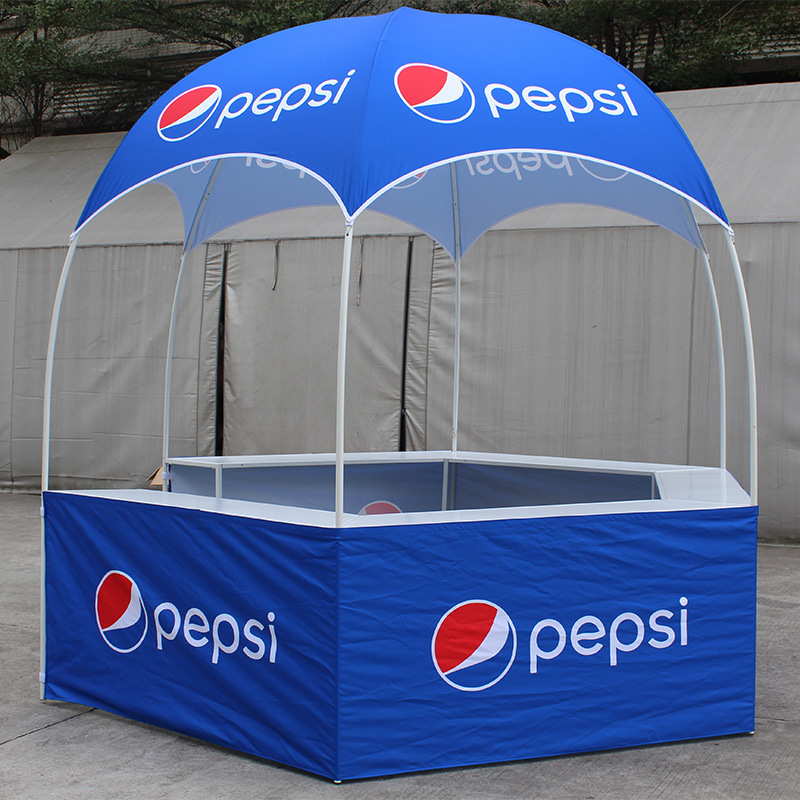
A beverage-brand dome kiosk in full-wrap blue: the hexagon promotion tent canopy and the hexagonal display counter carry the same logo, the classic sampling booth setup for a plaza activation during the London Design Festival closing weekend.
Walk any activation plaza between Bloomsbury and Shoreditch this week and you will pass at least one dome kiosk before lunch. The street promotion tent is simple to the point of being obvious: a folding steel dome canopy overhead, and a six-sided counter around the staff, so a two-person crew can work the whole promotional kiosk tent from inside — stock on the counter, giveaways over the rail, samples handed across the worktop. As a sampling booth it solves the problem every field marketer knows: where does the product actually sit while the crew talks to the public? In this format the answer is the hexagonal display counter itself, at counter height on all six sides — which is why the pop-up kiosk keeps beating the folding table.
From a buyer's point of view that is the entire pitch. A field-marketing manager booking sites for a soft-drink sampling campaign is not shopping for a tent — a tent is easy. The buyer is shopping for a working pop-up kiosk: somewhere to store stock, a work surface, shade for the crew, and a branded silhouette that reads from fifty metres across a plaza. A hexagon promotion tent delivers all four in one purchase — one sampling booth, one order, one van — which is why beverage and snack brands keep re-ordering the same promotional kiosk tent spec for city tour after city tour.
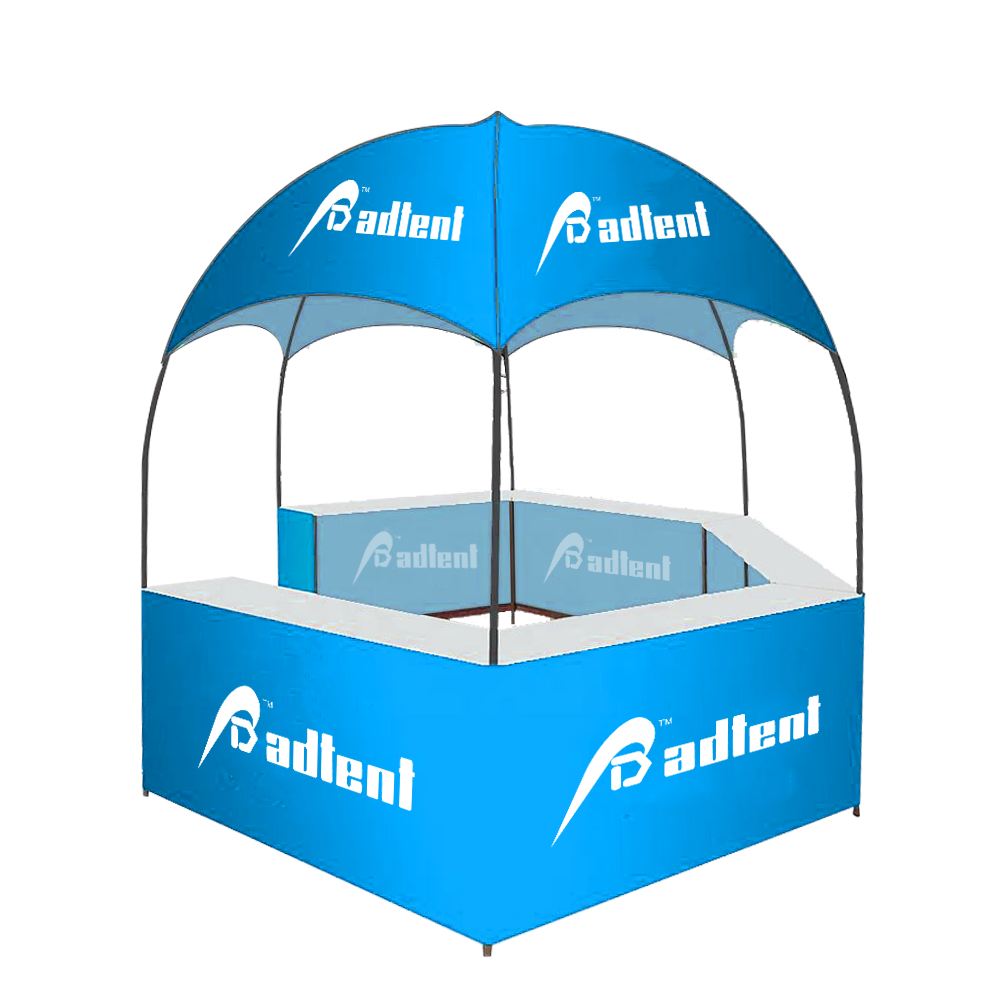
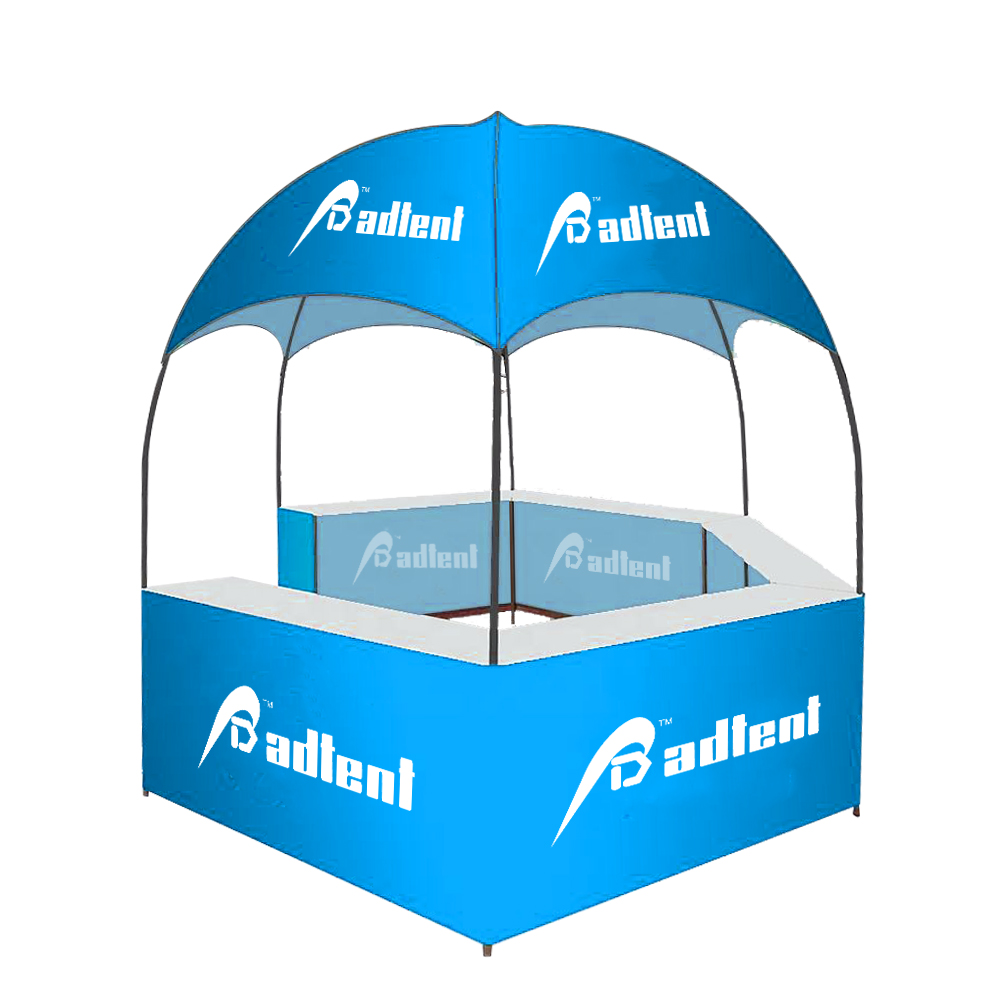
A studio render of the hexagon promotion tent: the event gazebo canopy ties onto a lightweight steel dome frame, while the hexagonal display counter forms the working perimeter of the pop-up kiosk.
The design-district pop-ups are the format's natural habitat. London Design Festival's twelve districts — from Brompton to Shoreditch — are loose clusters of showrooms, courtyards and street installations, and most of them have no permanent welcome infrastructure. The districts that do look organised this week are the ones that put a branded pop-up kiosk at the gate: a dome kiosk printed with the district mark, a crew member inside the sampling booth handing out the printed programme, and the hexagonal display counter doubling as an information desk. A single promotional kiosk tent turns an anonymous courtyard into an entry point with a queue, and the same street promotion tent does it again the following weekend in a different district.
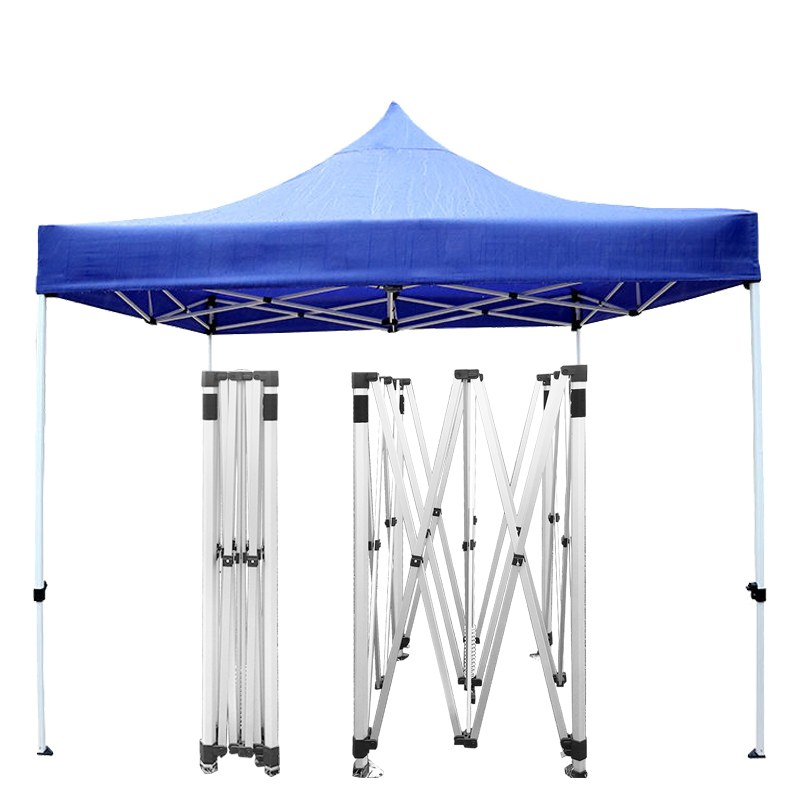
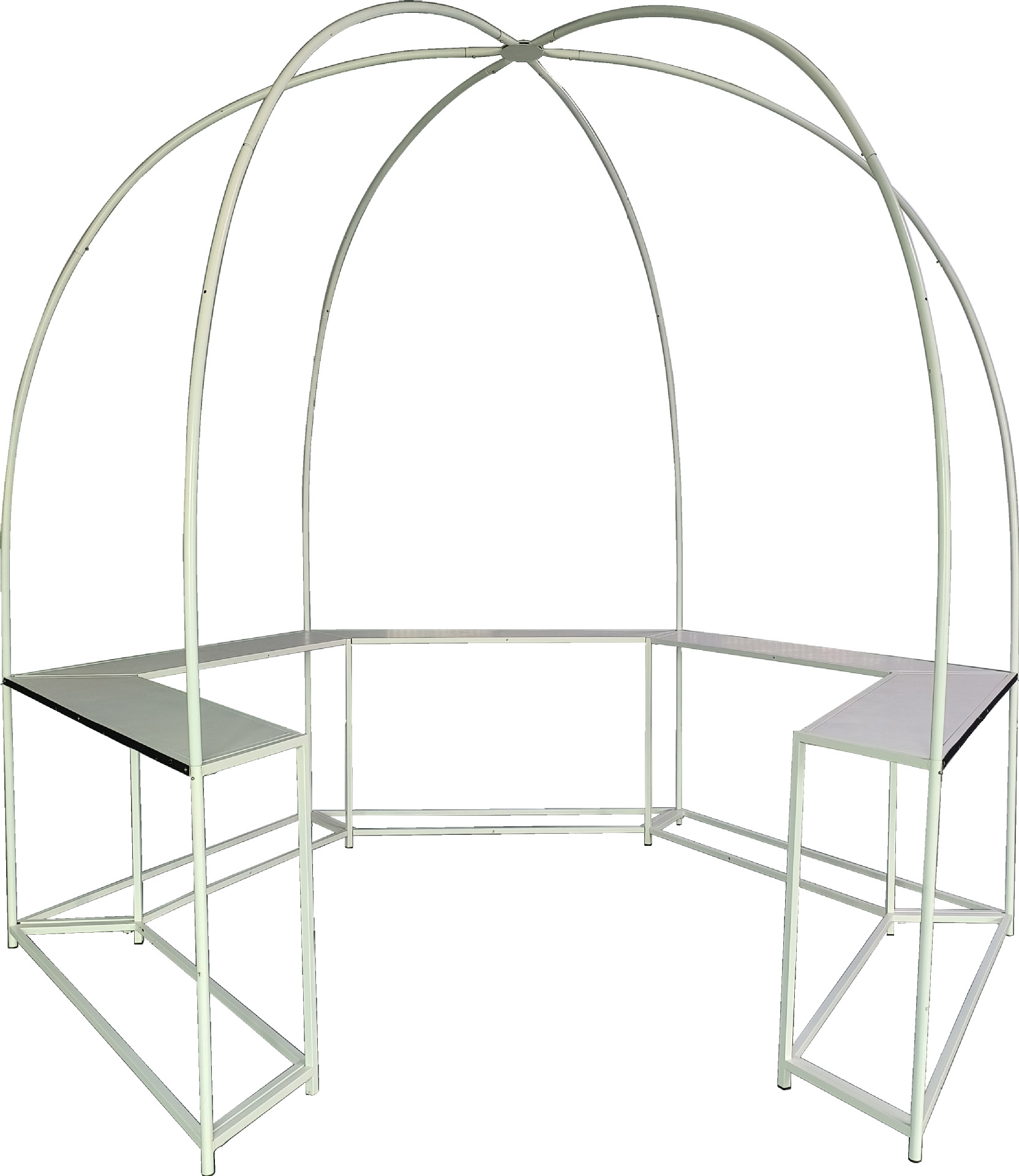
Buyers coming to the format for the first time usually start with the structure of the promotional kiosk tent, and it is worth understanding before ordering. A hexagon promotion tent is not a hexagonal marquee: the roof is a sprung dome of five curved steel ribs that meet at a single top coupler, and the canopy is a one-piece oxford-cloth cover tensioned onto the ribs with fixed hooks. There are no legs at the corners, no cross-ropes and no ground-frame, which is what lets the event gazebo sit on flagged plaza surfaces where a traditional marquee cannot be pegged — and what makes the hexagon promotion tent a pop-up kiosk rather than a marquee in the first place.
The bare dome frame of a promotional kiosk tent — five curved ribs meeting at a single coupler, with the hexagonal display counter frames clipped on underneath. One person can assemble this pop-up kiosk in under fifteen minutes.
Assembly is the second thing buyers check, and it is the reason the format keeps winning festival tenders. The dome ribs lock into the coupler by hand, the counter frames clip to the same base rails, and the printed canopy and counter covers go on last — a two-person crew has the full street promotion tent up in about fifteen minutes, with no tools and no ladder above shoulder height. For a sampling booth crew that moves site every day of a nine-day festival, that fifteen minutes per promotional kiosk tent is the difference between two activations a day and one.
The hardware underneath the fabric is where cheap versions of the promotional kiosk tent fall apart, so buyers should read the spec sheet rather than the render. On a properly built dome kiosk the canopy is heat-transfer printed oxford cloth with taped seams, the hexagonal display counter panels are PVC board rather than cardboard-core composite, the retaining nuts on the counter hinges are captive, and the fixed hooks that hold the canopy are stitched through reinforcement patches rather than the plain cloth. Those five details decide whether a hexagon promotion tent survives one season of weekend markets or four — a question every sampling booth buyer eventually asks.
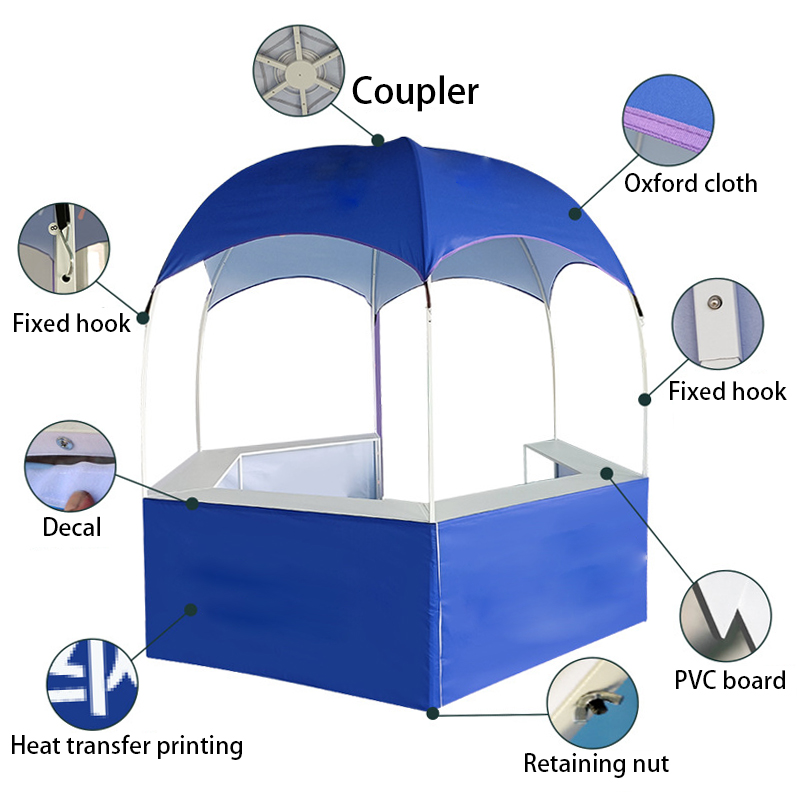
Construction details of the dome kiosk: a single top coupler, oxford-cloth canopy with heat transfer printing, PVC-board counter panels, fixed hooks and retaining nuts — the hardware spec a sampling booth buyer actually checks before ordering.
Footprint is the third number a buyer should ask for, and it is the reason the format fits the spaces Britain's September actually provides. The standard dome kiosk is three metres across and 2.6 metres to the peak of the canopy, with the hexagonal display counter set at 78 centimetres — standard worktop height — and a working depth of around 1.5 metres. That geometry drops a complete sampling booth into a standard parking-bay plot, a shopping-centre atrium or a pedestrianised high street without a licensing headache, which is exactly the kind of site a street promotion tent ends up on. Buyers comparing an event gazebo with walls against this open hexagonal display counter layout should note the queue: an open pop-up kiosk serves three customers where a walled gazebo serves one.
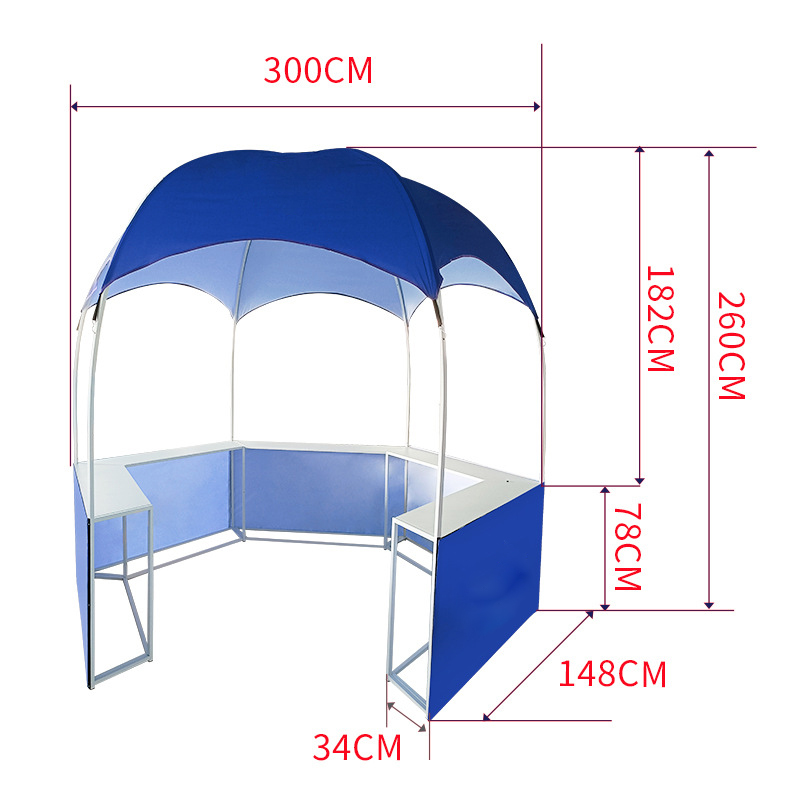
Key dimensions of the hexagon promotion tent: 3 m across, 2.6 m to the canopy peak, a 78 cm counter height on the hexagonal display counter, and a 148 cm deep footprint — the working geometry of a street promotion tent.
Not every pop-up kiosk sells anything, and the format's second life is as a services point. Guest-services versions of the dome kiosk — printed for stadium and venue partners — turn the counter inward and use the promotional kiosk tent as an information booth: two staff inside, wayfinding graphics on the canopy, and a queue that forms around the hexagonal display counter instead of across a walkway — the street promotion tent doing crowd control. For the Fashion Week sites springing up around Soho and Mayfair from tonight, a guest-services event gazebo is the cheapest way to put a branded, staffed pop-up kiosk at a door that has none — a dome kiosk dressed as a concierge desk rather than a sales counter.
Buyers weighing a guest-services order against a custom build should note that the two share ninety per cent of their hardware. The same hexagon promotion tent frame, the same canopy cut and the same counter frames serve a sampling booth, an information point and a ticket-check kiosk; only the print changes. That is why venue operators tend to order the event gazebo frame once and treat the printed covers as a consumable, re-printing canopy and counter wraps for each season or each campaign.
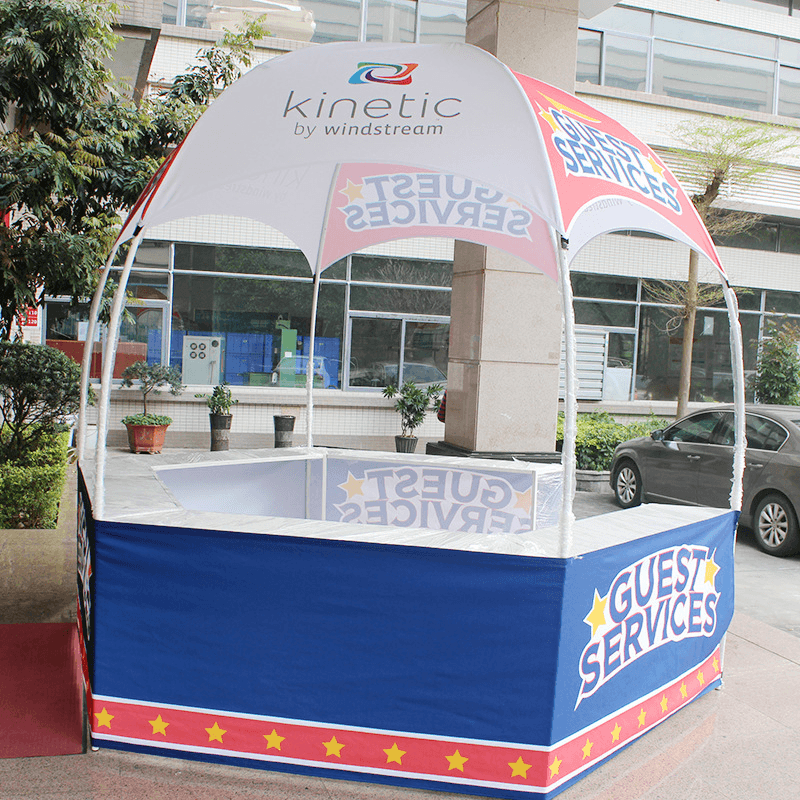
A guest-services dome kiosk branded for a stadium retail partner: the promotional kiosk tent doubles as an information point, with the hexagonal display counter turned inward so two staff can serve visitors from inside the event gazebo.
The all-over print version is the format's fashion-week face. Because the canopy is printed edge to edge in panels and the counter covers are printed on all six faces, a full-bleed hexagon promotion tent reads like a piece of installation design rather than a market stall — which is precisely why street-culture and lifestyle brands keep choosing the dome kiosk for launches. For a buyer planning an activation around the Shoreditch design district this week or a York festival bar next week, the promotional kiosk tent is the only structure on the shortlist that photographs like a set piece and still folds into a car boot — and the hexagonal display counter is the six-sided reason it photographs that well. An event gazebo in print this bold stops traffic; a plain pop-up kiosk does not — and on Monday the same sampling booth resets for the next activation.
Cost logic is the part buyers do the maths on last and care about most. A sampling booth on this frame works roughly thirty outdoor event days a season; a printed canopy and counter wrap set is a fraction of the cost of the frame, so the second campaign on the same dome kiosk runs at perhaps a third of the per-event cost of the first — for a street promotion tent working thirty weekends, the frame pays for itself inside the first quarter. Agencies that run the numbers converge on the same playbook: buy the hexagon promotion tent frames, store them, and re-print the pop-up kiosk graphics per client — the hexagonal display counter and the ribs never change, only the skin.
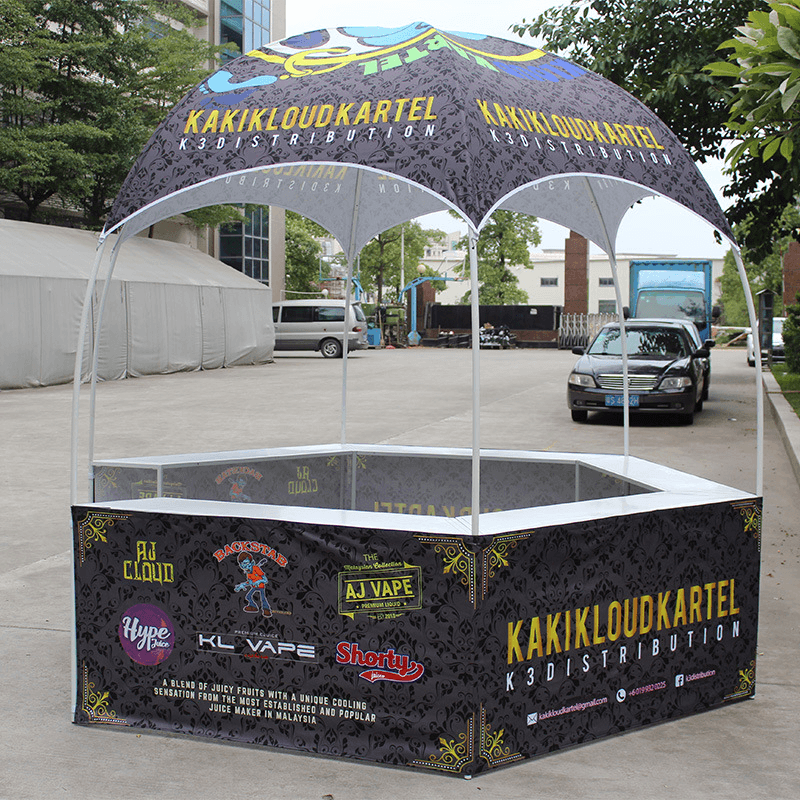
An all-over print hexagon promotion tent built for a street-culture campaign: every canopy panel and every counter face of the pop-up kiosk carries campaign artwork, the kind of full-bleed branding sampling booth buyers order for fashion-week activations.
There is also a working-side reason the hexagon promotion tent has quietly replaced the gazebo-and-folding-table combo that used to dominate street activation. With the crew inside the promotional kiosk tent, stock sits on the hexagonal display counter behind a solid perimeter, the canopy shades both staff and queue, and the customer-facing side of the street promotion tent stays clear for conversation. A dome kiosk also gives the sampling booth a defined footprint, and event organisers notice the difference: a pop-up kiosk with a defined edge keeps its queue tidy, and a tidy queue is the first thing a site manager looks for when deciding who gets the good pitch next year.
The hexagon promotion tent from the working side: staff stand inside the pop-up kiosk, product sits on the hexagonal display counter, and the event gazebo canopy shades both the crew and the queue — the full street promotion tent workflow in one shot.
The fortnight ahead will put the format through its full range. London Design Festival district pop-ups run to Sunday, Fashion Week sites operate through September 21, and from Friday the streets of York fill with tasting stands for nine days — most of them dome kiosks with a hexagonal display counter and a printed canopy, exactly as the same frames will appear again at Christmas markets in November. The hexagon promotion tent does not headline any of these events, and it is on site for all of them. Order the promotional kiosk tent once, and the street promotion tent becomes a sampling booth, a concierge desk or a ticket point as the calendar demands. For buyers planning an autumn activation, the practical summary is short: one frame, one tool-free fifteen-minute build, one six-sided counter that does the selling — and a print cycle that turns the same event gazebo into a different campaign every weekend.