


From NFL tailgates to Oktoberfest tents: how advertising flags quietly take over September's outdoor stage
As kickoff weekend in the United States and Wiesn opening in Munich fall within ten days of each other, the same feather-flag kit shows up in every parking lot, beer hall and marathon route on the calendar.
MUNICH / GREEN BAY — September 8, 2026
By the second Tuesday of September the autumn outdoor calendar has stopped planning and started building. In Green Bay, Kansas City and Philadelphia, crews are unloading pallets of blade flags into NFL stadium parking lots for kickoff weekend. Eleven days later and an ocean away, the same feather-flag kit will be lining the pathways of the Theresienwiese in Munich as Oktoberfest opens its tents. In between, the Berlin Marathon, the Tour of Britain and a dozen county fairs will lean on the same advertising flag system to turn a patch of grass into a recognisable brand stage. Along the coast, a beach flag marks every surf club regatta and seaside festival that runs through the last warm weekends of the European and American summer. By October the same blade flag will have done duty at two of those events and a feather flag will have done duty at three.
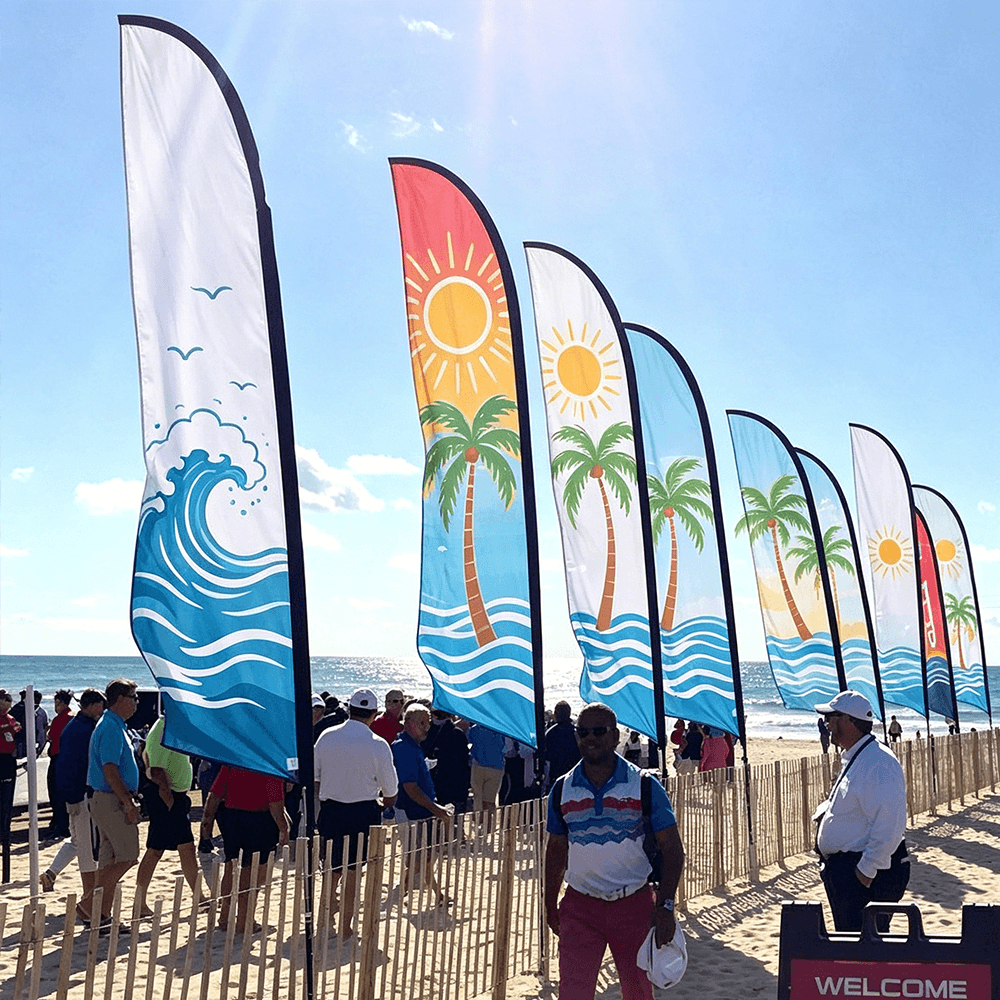
A row of beach flags lines the surf-side welcome arch at a coastal event — the same format that now anchors September's outdoor stages.
It is easy to miss the product, because every feather flag is doing the same job at every event: it rises between three and five metres into the sky, catches the wind, and turns a piece of polyester knit into a moving billboard. The kit is small enough to fit in a duffel bag, light enough for one person to carry, and graphic enough that a single feather flag can identify a sponsor, a sponsor village, or an entire stadium approach from two hundred metres away. Across the autumn calendar, no advertising flag system gets more use per weekend than this one, and no other outdoor display product ships in the same volumes in September. A single feather flag order in September can do duty at three different advertising flag deployments by the end of October.
The September 10 NFL kickoff weekend is the single largest feather-flag deployment in North America. Tailgating culture turns every stadium car park into a temporary branded village, and the blade flag has become the standard wayfinding tool. A pair of blade flags at the gate tells fans where to enter; a row of blade flags along the fanzone edge marks a sponsor activation; a tall blade flag on the broadcast platform makes sure the on-camera view carries the team's colours.
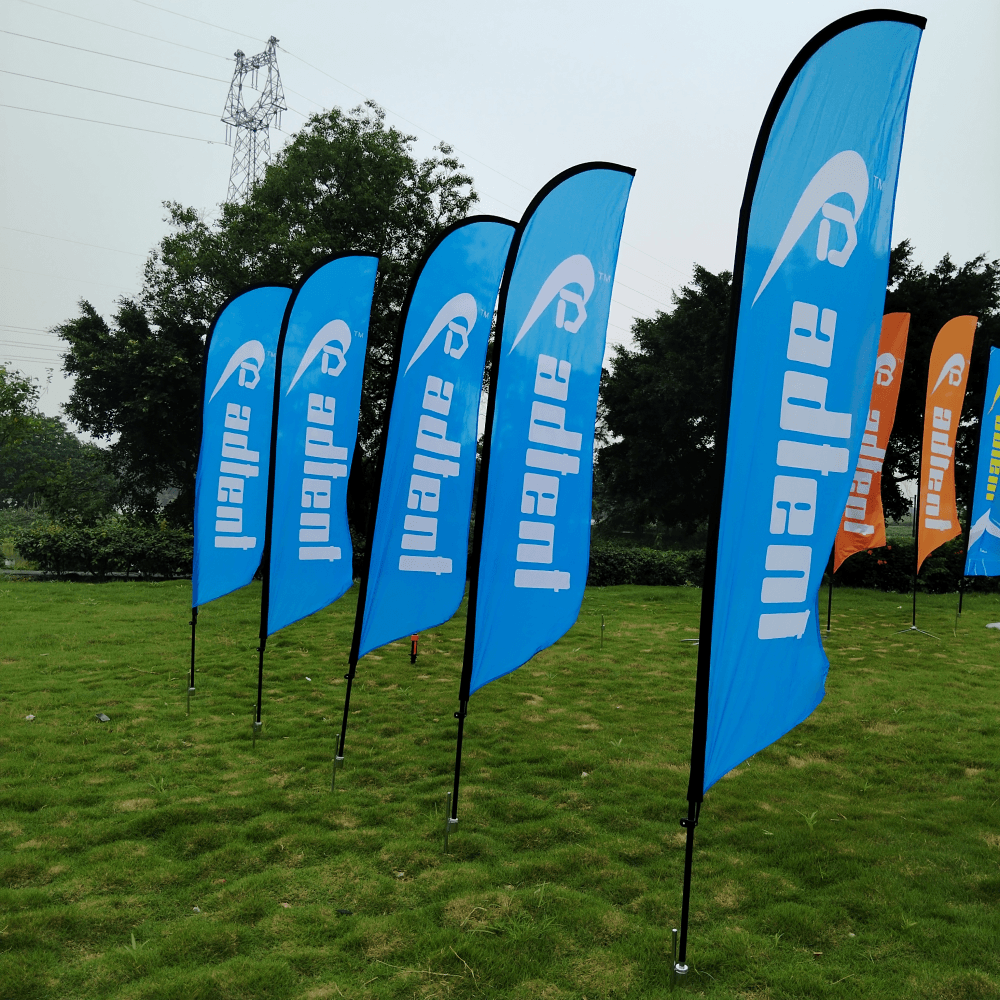
Blade flags in sponsor colours rise above the crowd at a stadium approach.
The blade flag is the workhorse of the family. Its curved top and tapered sail move in the lightest breeze, which keeps the print graphic animated rather than limp, and its single-piece pole telescopes from a 2-metre small to a 5-metre grand in two minutes. Most stadiums order three blade flags for every gate and a dozen blade flags for the main sponsor village, which is why kickoff weekend alone can move thousands of blade flags in a single shipment. A blade flag also anchors the camera positions at the broadcast platform, where the same blade flag stays in shot for the whole pre-game show. Across a single NFL stadium, more than two hundred advertising flags will be on the ground by kickoff Sunday, and almost every one of them is a blade flag. By the end of the weekend, the same blade flag will be folded into its duffel bag and ready to move on to the next advertising flag deployment.
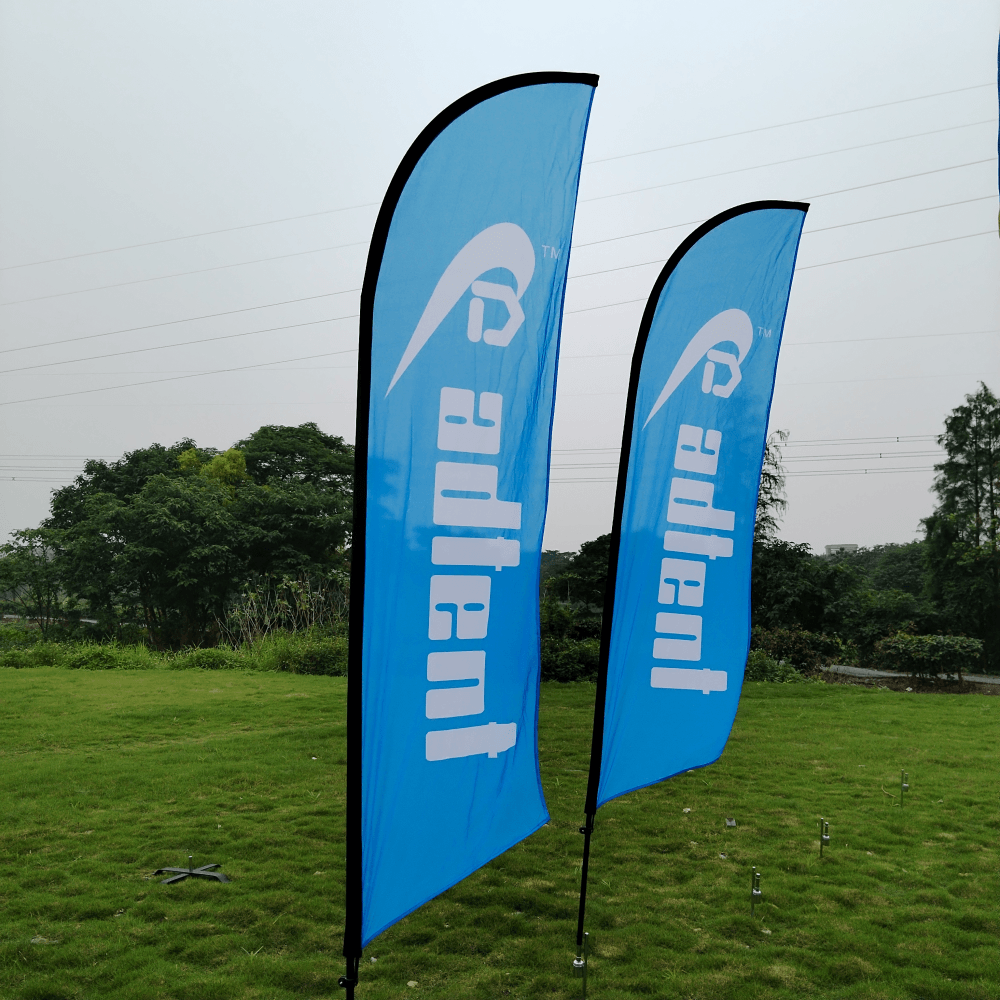
A trio of blade flags at three heights shows how a single feather-flag system scales from a 3-metre small to a 5-metre grand.
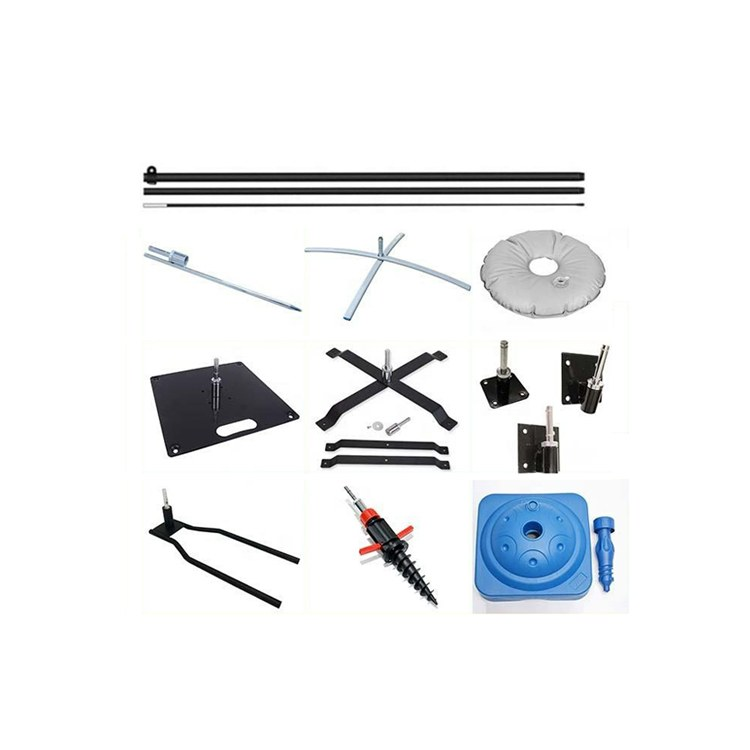
Outside the stadium gates the deployment gets smaller but no less deliberate. A single blade flag on a ground stake marks the corner of a tailgate tent. A second blade flag on the same ground stake marks the entry to a sponsor activation. The ground stake is a short spiral anchor that screws into grass or asphalt in under a minute, which is why it is the most-shipped accessory in the entire feather-flag kit. The same ground stake will plant a rectangle flag outside a county fair, a beach flag on a seaside boardwalk, and a teardrop flag outside a brewery tasting room.
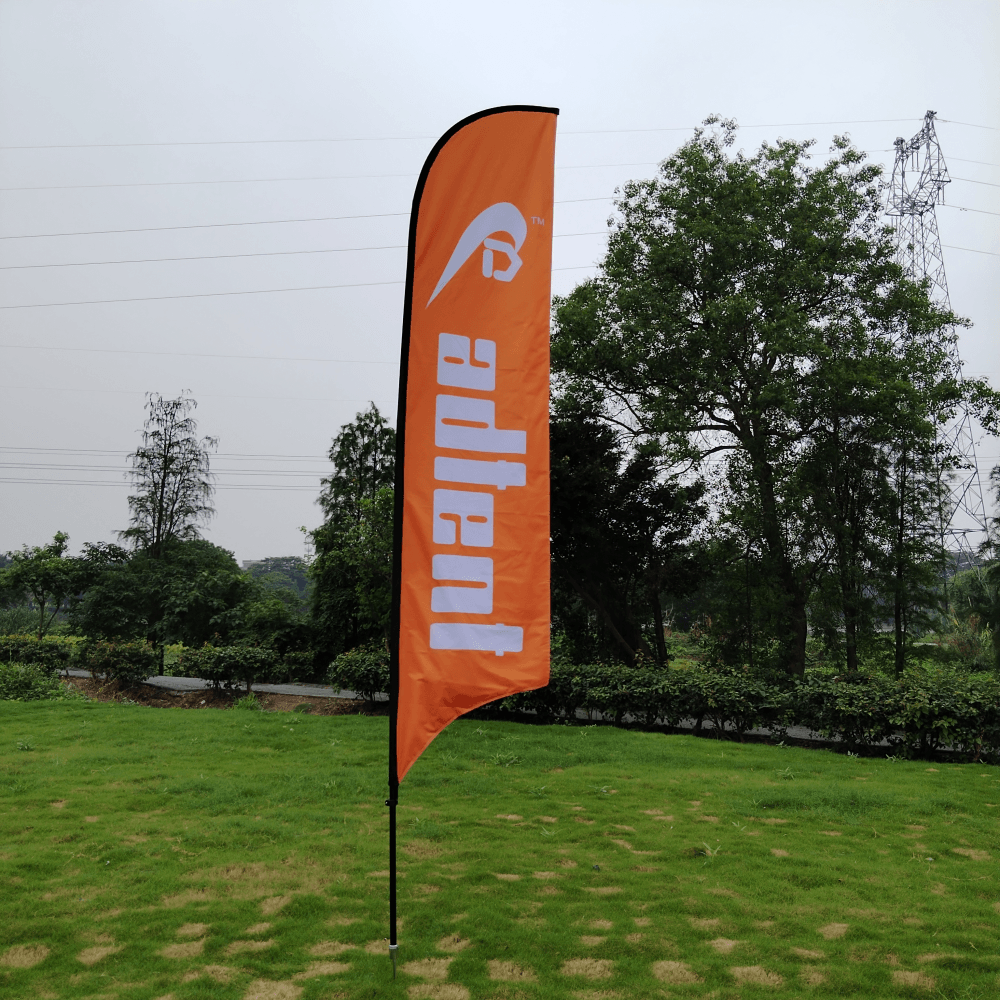
A single blade flag planted on a ground stake marks a tailgate corner.
On the other side of the Atlantic, Oktoberfest opens on September 19 and the Wiesn turns into one of the largest outdoor branding environments on earth. Fourteen big tents, dozens of small stalls, a 30,000-capacity Hofbrau-Festhalle and a footfall that crosses six million over sixteen days. The beer halls have been the same for a century, but the wayfinding changes every year, and the teardrop flag is the format that German brands keep coming back to. The same teardrop flag works on a roadside approach, on a beach flag line at a seaside festival, and on a sponsor row at a Berlin marathon finish-line gantry. By the family weekend, every beer garden in Bavaria will be flying a teardrop flag outside the entrance.
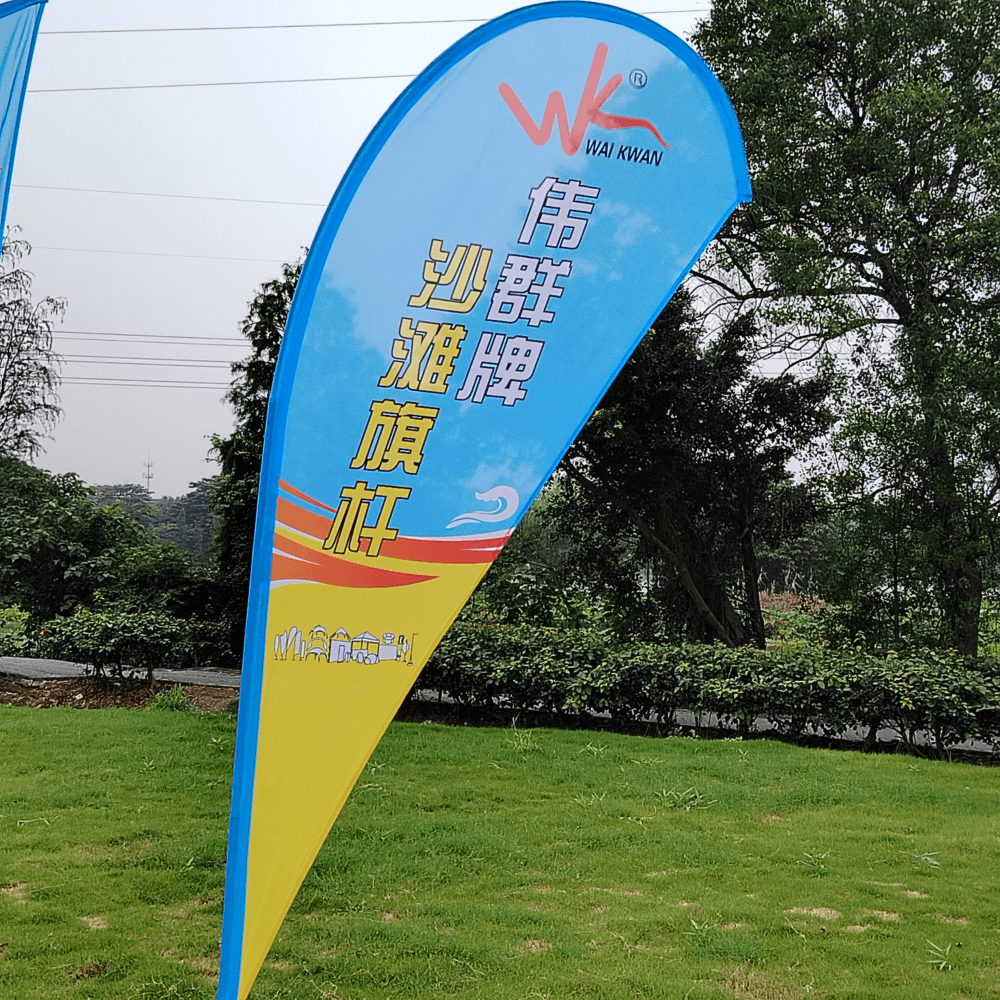
A teardrop flag holds a fully printed graphic on its closed sail — ideal for sponsor logos and Oktoberfest beer-hall branding.
The teardrop flag is the closed-sail member of the family. Its rounded top and taut sail hold a fully printed graphic from pole to pole, which makes it the right shape for a beer-hall logo or a sponsor crest that has to read clearly in a crowded marketplace. Where a blade flag flutters, a teardrop flag holds still, and where a blade flag shows a wordmark, a teardrop flag shows a brand.
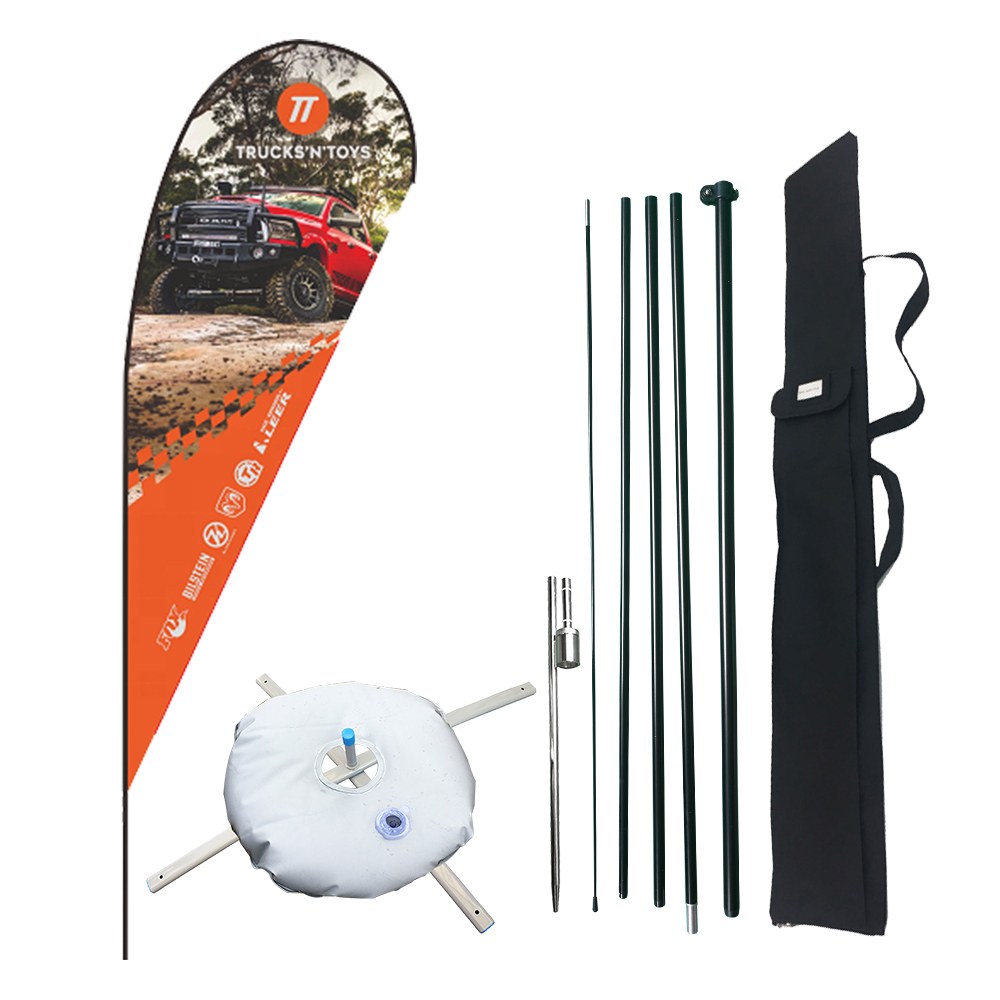
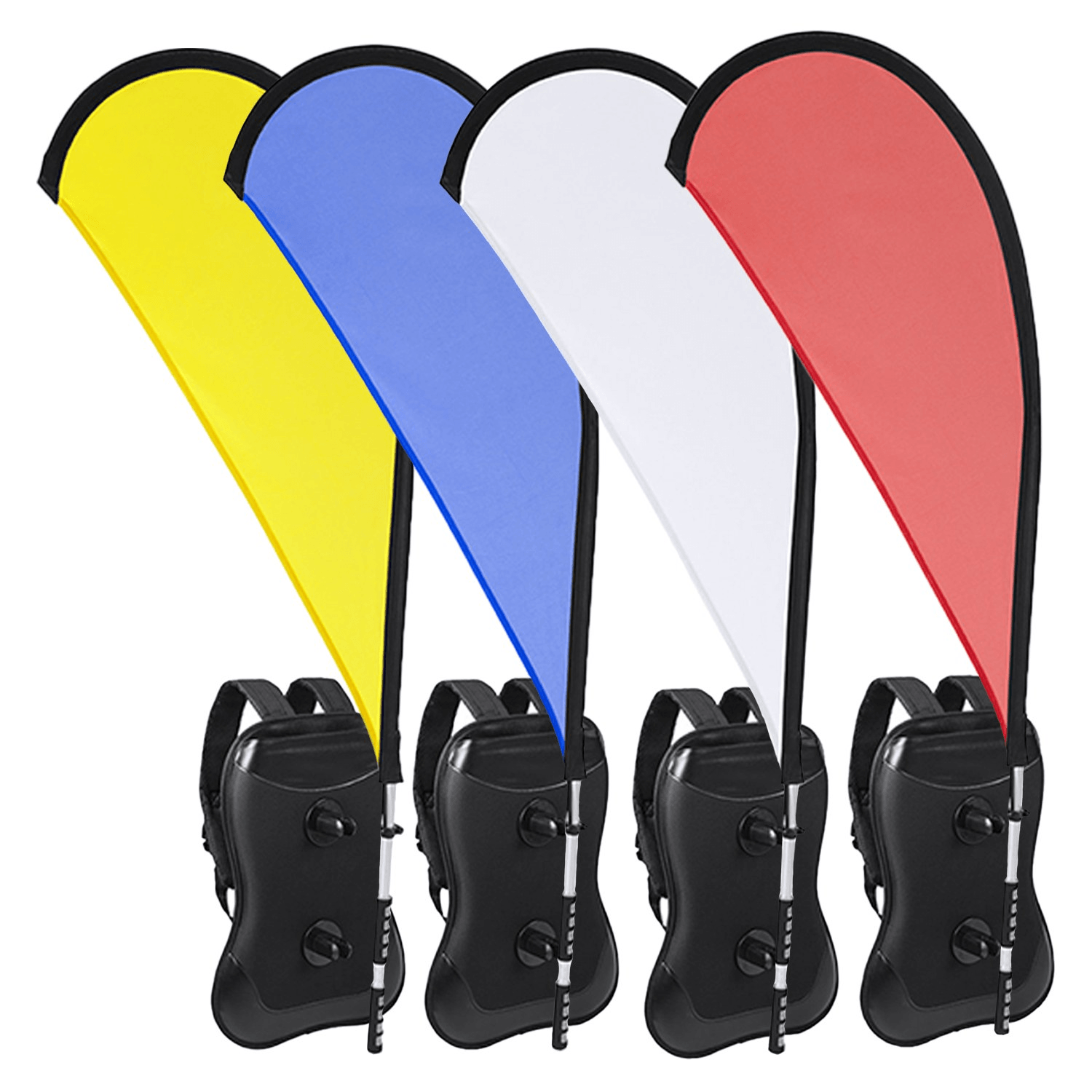
Oktoberfest logistics are unforgiving. The festival grounds are closed to vehicles for the final week of build, every teardrop flag has to be carried in by hand, and every base has to clear a safety inspection. The water-fillable base solves both problems. It ships empty in a duffel bag, fills from any tap in three minutes, and weighs twenty kilograms once filled, which is enough ballast to hold a 4-metre teardrop flag steady through a Bavarian evening. The same water-fillable base keeps a beach flag upright along a windy seaside festival and keeps a rectangle flag planted on a marathon route where ground stakes are not an option.
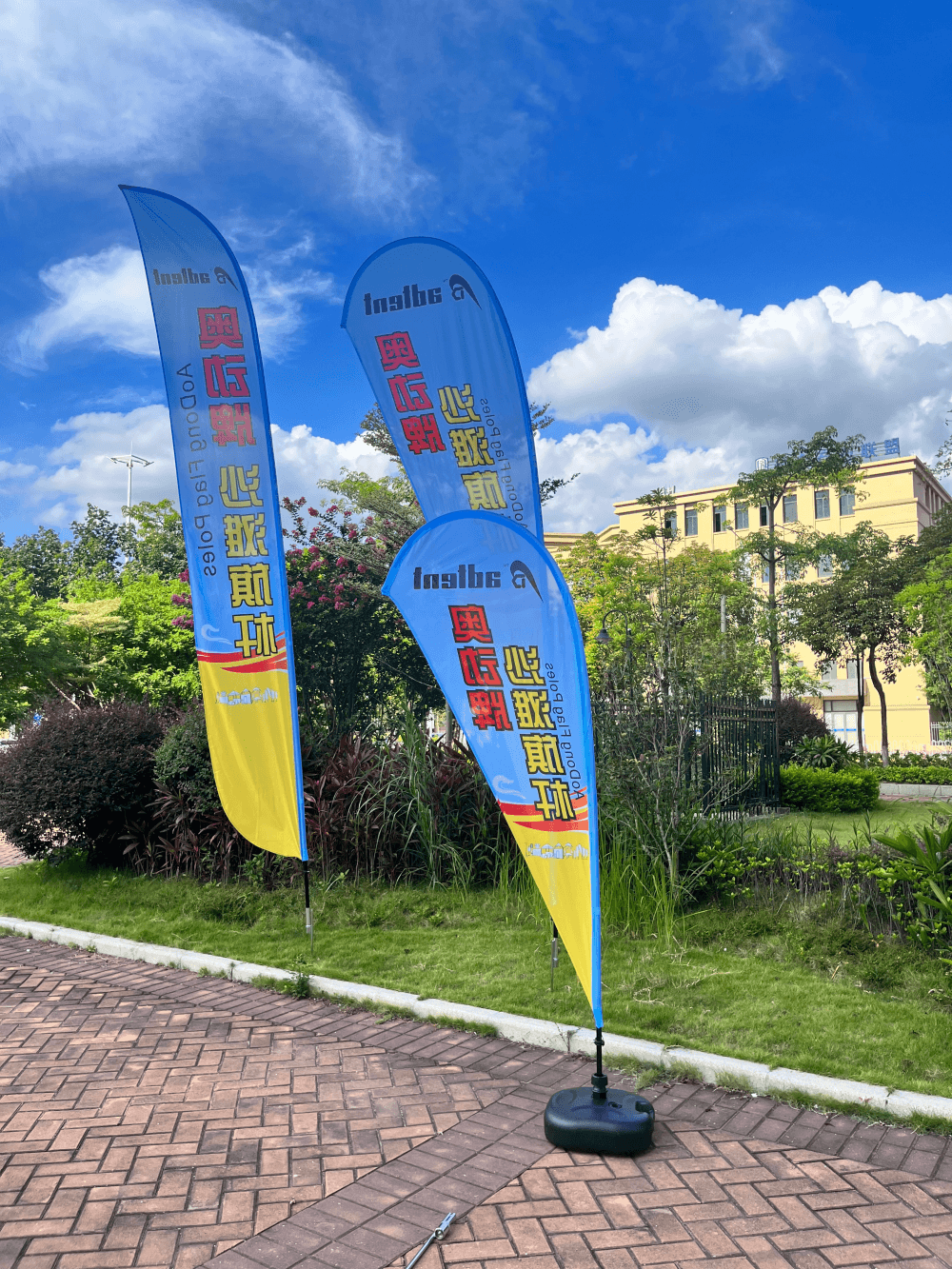
A teardrop flag stands on a water-fillable base that travels in a duffel bag and sets up in minutes.
Outside the beer halls the format that dominates is the rectangle flag. Where the blade flag is a wayfinding tool and the teardrop flag is a brand statement, the rectangle flag is the print-real-estate workhorse. Its straight edges and full printable height keep a graphic readable from every angle, and its aluminium cross base lets a row of rectangle flags stand shoulder to shoulder as a sponsor wall. The rectangle flag also travels flat in the same duffel bag, so a sponsor can ship a row of rectangle flags to a finish-line gantry, a sponsor village, or a beachside festival without breaking the autumn logistics schedule. A single rectangle flag can also stand alone on a roadside approach, where its straight-edged silhouette carries the advertising flag print above passing traffic.
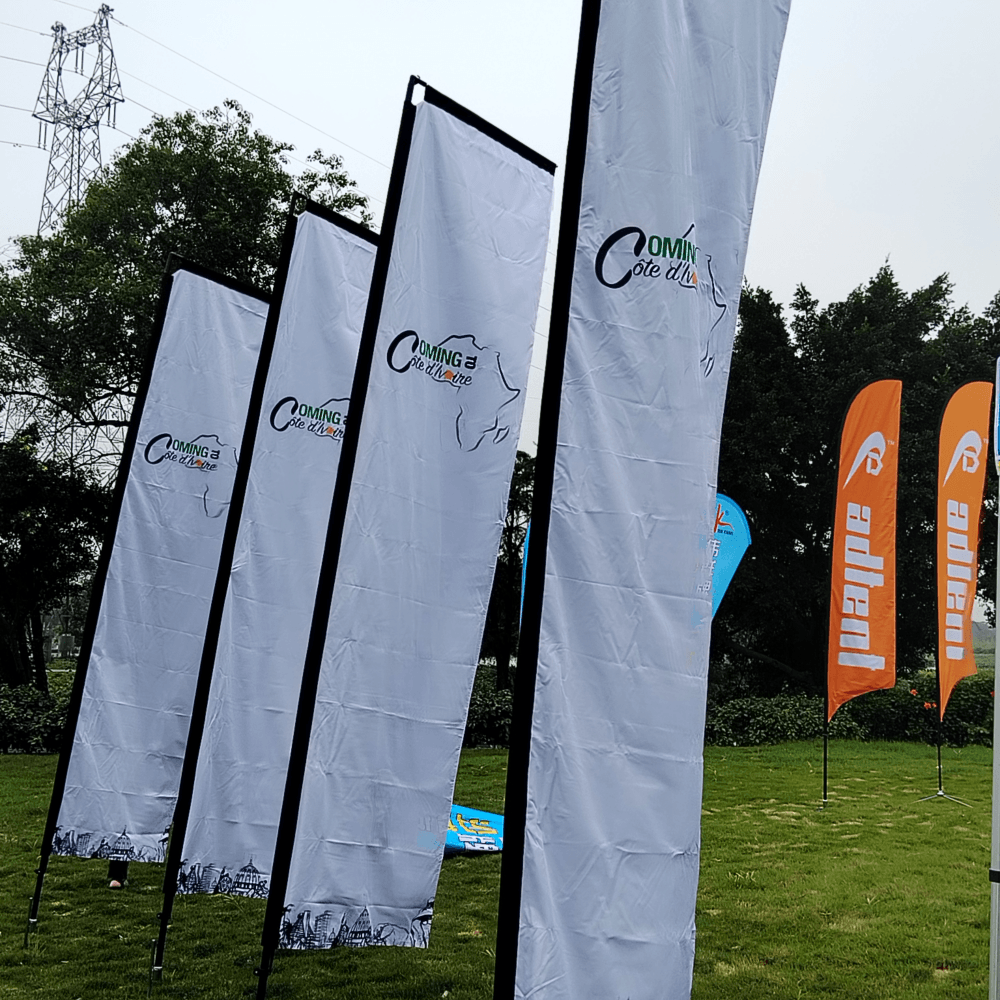
A row of rectangle flags doubles as a sponsor wall at the finish line of an autumn marathon.
The rectangle flag is the format of autumn marathons. Berlin, Cologne and Copenhagen will all run their city marathons in the next four weeks, and every finish-line gantry is dressed with a row of rectangle flags that mark the sponsor village. The Chicago Marathon in October will deploy more rectangle flags than any other U.S. road race, and the New York City Marathon in November will do the same in Central Park. Across those four races, a single rectangle flag can expect to fly at three of them before the season closes.
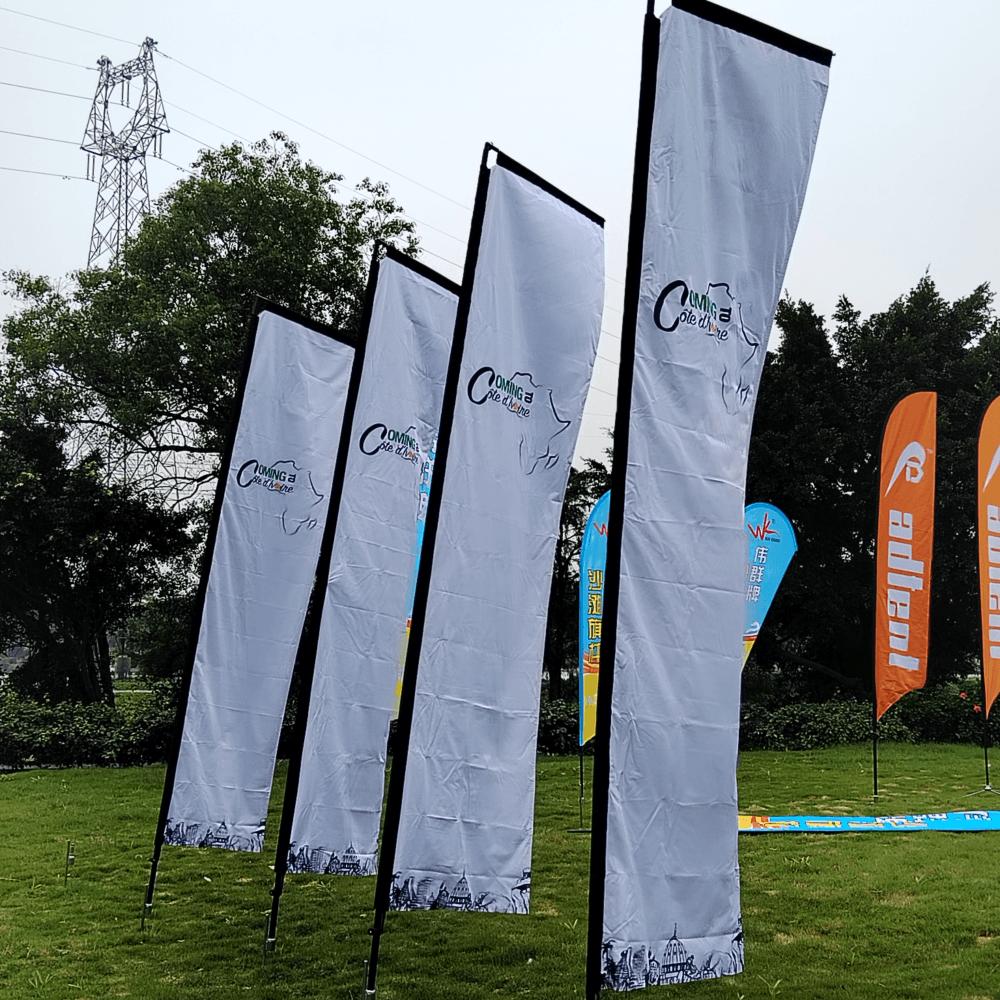
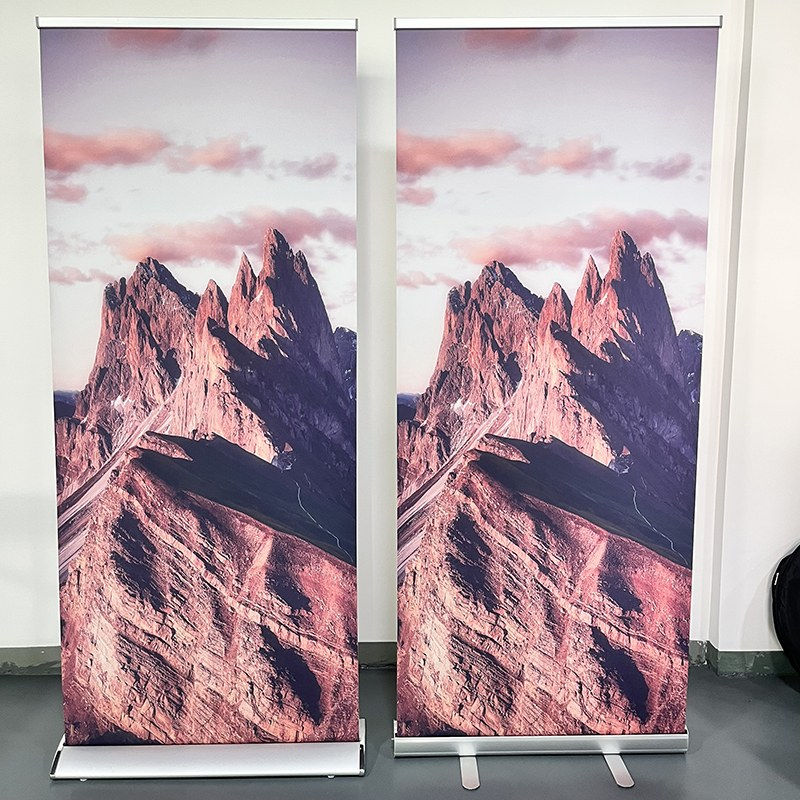
A close-up of a rectangle flag shows how its straight edges keep the print graphic readable from every angle.
A close-up of the rectangle flag makes the case for itself. The straight edges keep the print graphic readable from any angle, which is why a row of rectangle flags works as a sponsor wall on a marathon route. The same rectangle flag can also work as a single sponsor sign on a roadside approach, where the tall rectangular sail catches the eye of every runner, driver and spectator. A rectangle flag is the most photographed advertising flag in the kit, because its tall flat sail carries the print graphic straight into every camera shot.
Behind all three formats sits the same advertising flag system: a fibreglass or aluminium pole, a printed polyester knit sail, a ground stake or a water-fillable base, and a duffel bag that holds the entire kit. A small event can deploy a single feather flag in five minutes; a stadium can deploy two hundred blade flags in an afternoon. The kit is small enough for a one-person marketing team and large enough for a national sponsor rollout, which is why it has become the default outdoor-format of the autumn season. The same advertising flag system works as a blade flag at a stadium, a teardrop flag at a beer hall, a rectangle flag on a marathon route and a beach flag on a coastal festival. Order a feather flag in September and the same advertising flag will be on a ground stake outside a Munich beer hall next weekend, on a water-fillable base outside a Berlin marathon finish line the weekend after, and on a beach flag line at a coastal festival by the end of the month.
By the time the Berlin Marathon crosses the Brandenburg Gate on September 27, every feather flag from kickoff weekend will already be packed away and on its way to the next event. Some will head to Oktoberfest for the family weekend. Others will head to Chicago for the marathon. The advertising flag does not get to rest in September, and neither does the autumn outdoor season. By the time the autumn is over, the same blade flag will have flown over three tailgate lots, the same teardrop flag will have stood outside two beer halls, and the same rectangle flag will have marked three marathon finish lines.
What changes every year is the print. The blade flag, teardrop flag, rectangle flag and beach flag all use the same aluminium and fibreglass hardware, the same polyester knit sail and the same ground stake or water-fillable base. What changes is the artwork, and September is the month when the artwork turns over faster than any other. A blade flag in a Green Bay parking lot on Sunday will be reprinted by Thursday, packed into a duffel bag on Friday, and standing outside a Munich beer hall by the following Saturday. A teardrop flag that flies over the Wiesn family weekend will be back on a water-fillable base at the Chicago Marathon three weekends later. The advertising flag is the smallest piece of hardware in the autumn outdoor kit, and the most travelled. Every advertising flag in the system, whether it sits on a ground stake in a tailgate lot or on a water-fillable base outside a Hofbrau tent, has done this trip before.