


Four weekends, one pavement: the quiet quarter of the A-frame sidewalk sign
The Bank of America Chicago Marathon sends 55,000 runners past roughly 1.7 million spectators on Sunday 11 October. Halloween lands on Saturday 31 October. Germany's Christmas markets open across a twelve-day spread in November — Cologne first, Nuremberg's Christkindlesmarkt last, on the 27th. Small Business Saturday follows Black Friday on 28 November. Four crowds with almost nothing in common, and one product all four of them put on the pavement: the A-frame sidewalk sign.
CHICAGO / NUREMBERG / FOSHAN, GUANGDONG — 8 October 2026
Between the second week of October and the end of November, the most valuable square metre in a lot of Western retail is not inside the shop but on the pavement in front of an A-frame sign. It is the half-metre of pavement between the door and the kerb, and the sandwich board is its tenant. Four events will put more feet in front of an A-frame sign this quarter than at any other time of the year. On Sunday 11 October the Bank of America Chicago Marathon closes 29 neighbourhoods of one American city and walks around 1.7 million spectators past every bar, pharmacy and coffee shop that an A-board can speak for on the route. On Saturday 31 October Halloween falls on a weekend for the first time in four years, and the trick-or-treat economy arrives at the shopfront and its sidewalk signs rather than the school gate. From 16 November Germany's Christmas markets open one after another — Cologne, Munich, Frankfurt, Leipzig, Dresden and finally Nuremberg — filling medieval pedestrian zones with stall signage and A-boards until 24 December. And on Saturday 28 November Small Business Saturday hands the independent retailer the one weekend of the year when the whole marketing argument is a pavement sign. The buyers behind those four moments order different posters on the same A-frame sidewalk sign, but they keep ordering the same A-frame sign to hold them: a double-sided sidewalk sign that folds flat, carries by a handle, fills with water for ballast, and takes a fresh poster in thirty seconds. Every one of the four is buying the same plastic A-frame sign. The plastic A-frame sign is the cheapest advertising medium that still has to be walked outside and stood up by hand, and that is exactly why the sidewalk sign keeps selling, quarter after quarter.
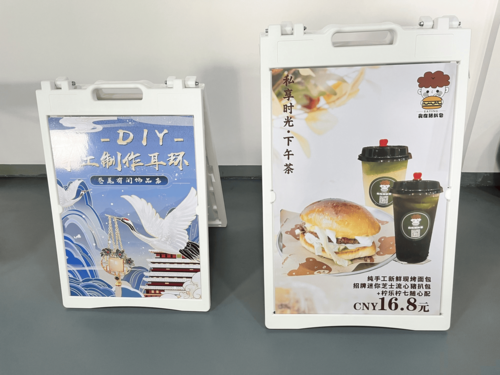
The product doing the work: a pair of white plastic A-frame signs, each holding a full-colour drinks menu on both faces. One unit, four advertising surfaces, zero tools. The double-sided sidewalk sign is the reason a cafe does not need a poster wall — it needs two posters and a pavement.
The pattern repeats across all four events because it is a behaviour, not a season: the pavement sign is infrastructure. A shop on a marathon route cannot put a poster on a closed road, but a sidewalk sign stands on the pavement that stays open. A sweet shop cannot tape a trick-or-treat-hours notice to a door that keeps opening, and an A-board does not need a door. A market stall in Nuremberg has no wall at all — the pitch is three metres of timber bench in an open square, and the only wall is a pavement sign. An independent bookshop cannot outbid a national chain for a search result, but it can put a sandwich board on the pavement where the search actually happens. In each case the requirement is the same: an A-board that stands on hard ground without fixings, shows one message on the two faces of a double-sided sidewalk sign, survives weather and foot traffic, disappears in ten seconds at closing time, and can be re-graphicised, poster swap, same A-frame sign, for next weekend at print-shop money. That is the specification of the A-frame sign, and it has barely changed in fifty years. What has changed in the A-frame sign is the material and the mechanism, and that is where the money is now won or lost in the sidewalk sign category.
Chicago, Sunday 11 October: 29 neighbourhoods and every sidewalk sign on the route
The 48th Bank of America Chicago Marathon starts and finishes in Grant Park, beginning at 7:30 in the morning, with every sandwich board on the route out by seven, and sends 55,000 runners from more than 100 countries past every pavement sign on a 26.2-mile loop through 29 of the city's neighbourhoods. Around 1.7 million spectators line the streets, and the neighbourhood stretches — Pilsen around Mile 19, Chinatown near Mile 21, the block-party miles on the north side — are precisely the districts where a sidewalk sign does a day's work: independent restaurants, taquerias, bars and record shops. Race week for the outdoor sidewalk sign starts earlier still: the Abbott Health & Fitness Expo runs 8 to 10 October at McCormick Place, pulling 55,000 runners and their families through the city for bib collection, and the 27th Mile Post-Race Party runs in Butler Field until 4 in the afternoon. For a shop anywhere on that route, and for every sandwich board it owns, race day is the highest-footfall Sunday of the year, and the only advertising medium that works on it is a folding sidewalk sign standing on the pavement saying 'open, bathrooms at the back, espresso two doors down'. Event organisers, charity cheer zones and venue managers buy the outdoor sidewalk sign in tens for exactly this: wayfinding at the cheer zones, queue management at the beer stations, an outdoor sidewalk sign at every gate, and a street full of folding sidewalk signs that needs to explain itself to 1.7 million guests by nine in the morning.
The buyer detail worth copying from marathon merchandising is the poster schedule on the sidewalk sign. A route-side business re-prints for race weekend, again for Halloween, again for the holidays — five or six poster cycles inside one quarter, all on the same A-frame sign. Nobody re-buys the frame of an A-frame sign each time. That division — frame as asset, print as consumable — is the commercial heart of the pavement sign business, and it is why the window version of an A-frame pavement sign, which takes a new poster without adhesive or tools, has quietly become the default specification for anyone who changes artwork more than twice a season.
Five names, one product: the vocabulary that decides what lands in your search
No other display product in the pavement sign family carries as many names as this one, and the naming is genuinely useful to a buyer of pavement signs because it sorts the market. In the United States the trade says sidewalk sign or sandwich board; in the United Kingdom it is pavement sign or A-board; and the construction is an A-frame sign on both sides of the Atlantic. Around those core terms the specification words of the sidewalk sign trade pile up: a double-sided sidewalk sign means both faces carry artwork; a folding sidewalk sign means the two panels hinge flat for storage; an outdoor sidewalk sign means the body is hollow and takes water or sand as ballast; a plastic A-frame sign means moulded polyethylene rather than steel tube and a printed panel. A buyer who searches only 'A-board' finds one supplier; a buyer who understands the vocabulary finds the whole A-frame sign family. It also explains the price bands of the A-board market. The steel A-board with a printed panel is the furniture-store relic; the moulded plastic A-frame sandwich board with a hollow, fillable body is what a modern cafe, pharmacy, market stall and marathon route actually buy, because it survives the two things that kill a cheaper A-board: wind, and being moved twice a day.
What a buyer actually inspects on an A-frame sign before signing
Across a showroom floor, every A-frame sidewalk sign looks like every other one. The differences that decide whether it lasts two seasons or one are all in the engineering of the A-frame sign, and there are five places on a sidewalk sign worth looking. First, the hinge: on a properly built folding sidewalk sign the two lugs meet at a through bolt with a washer, set into a thickened rib section of the panel — not a self-tapping screw driven straight into thin moulding, which is the first thing to strip on a sidewalk sign that is opened and closed twice a day. Second, the retaining cable: inside the body, a steel cable on a bolted plate connects the two panels of the A-frame sign and limits how far the legs splay, so an outdoor sidewalk sign cannot be over-opened by the wind or flattened by a passing trolley. Third, the wall thickness and rib pattern of the moulding, which is what a cheaper quote for a plastic A-frame sign quietly reduces. Fourth, the grip surfaces: a textured panel and a real handle cut-out in the top rail of the A-frame sign, wide enough for a gloved hand, because a folding sidewalk sign gets carried out every morning and carried back every night. Fifth, the feet: moulded non-slip pads that keep a plastic A-frame sign stable on wet tile, marble and polished stone, not just on the concrete a showroom floor imitates.

The hinge of a folding sidewalk sign, photographed on the black model: two moulded lugs meeting at a through bolt with a washer, set into a thickened rib section of the panel. This is the joint that decides whether an outdoor sidewalk sign survives two seasons of being opened and slammed shut twice a day.
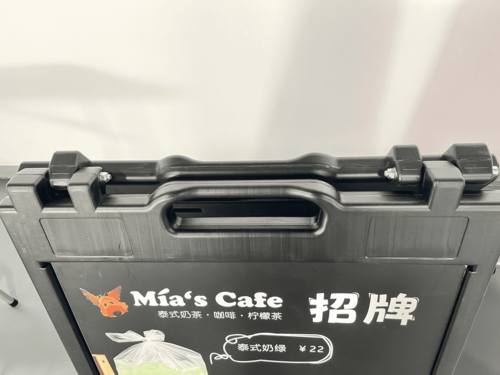
The carry handle moulded into the top rail of a black A-frame sidewalk sign, with the textured grip panel below it. A sandwich board that one member of staff can lift flat-handed and walk out to the kerb gets moved every morning; one that needs two people gets left in the stockroom.
A note on what to ask for rather than look at on a sandwich board. A supplier who can state, in writing, the polyethylene grade, the UV stabilisation package and the recommended ballast fill for an A-frame sign is a different class of supplier from one who can only point at a plastic A-frame sign on the floor. The plastic A-frame sign is a commodity in appearance and an engineered product in fact, and the paperwork is where the quality of a sidewalk sign shows — the same way it shows for any pavement sign that lives outdoors all winter.
The numbers that matter for a sidewalk sign: 61 by 92
The display area of this generation of plastic A-frame sign is 61 by 92 centimetres on each face — within a millimetre of the 24 by 36 inch poster, the most printed large format in the world and the stock size of the sidewalk sign trade. That single fact does more for the economics of a sidewalk sign than any feature on the frame. It means the artwork of a pavement sign or an A-board lays out on a standard sheet, every print shop in the customer's city is a supplier, and replacement posters cost print-shop money rather than display-industry money. The rest of the dimensional sheet of the A-frame sign follows from it: 68 cm across the top rail, a 108 cm panel, 105 cm overall when open, and a 77 cm footprint at the base, which is what keeps a loaded A-frame sandwich board standing on a pavement with people brushing past it all day. Buyers of an A-frame sidewalk sign should check one number against their own premises before anything else: 77 cm of footprint is wider than some shop doorways, which is fine, because the panels of a folding sidewalk sign fold flat and go through sideways — but a folding sidewalk sign that has to be negotiated through a narrow door twice a day is a sandwich board that migrates permanently to the stockroom by December.
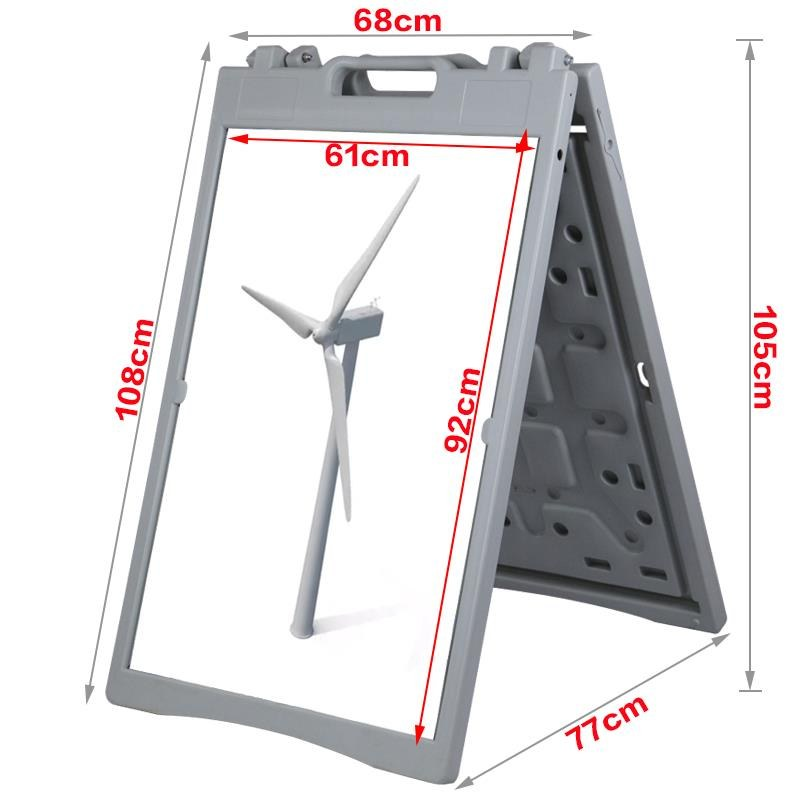
The dimensional sheet a buyer quotes from: 68 cm across the top rail, a 61 x 92 cm display area on each face, a 108 cm panel, 105 cm overall and a 77 cm footprint at the base. The 61 x 92 cm display area is the point — it is the frame size of a standard 24 x 36 inch poster, so artwork prints on the cheapest standard sheet a print shop runs.
Two face versions share the same A-frame sign body, and the choice between them is the first real decision on the order. The window version has four cut-out openings with retaining lips behind which a poster slides in from the side — no adhesive, no tools, a thirty-second change that keeps the A-frame sign current between customers. The flat-panel version takes a rigid board such as 5 mm KT board, fixed to the sidewalk sign with clips or adhesive, for a customer whose pavement sign artwork changes rarely or who wants a single seamless graphic. The rule of thumb that has held across the pavement sign trade: if the artwork changes more than twice a season, buy the window A-frame sign; if it changes once a year, the flat-panel version of the A-frame sign prints cleaner and costs less to re-fit. Either way the A-frame sign is the asset and the print is the consumable, and every other economics question in the sidewalk sign category follows from that line.
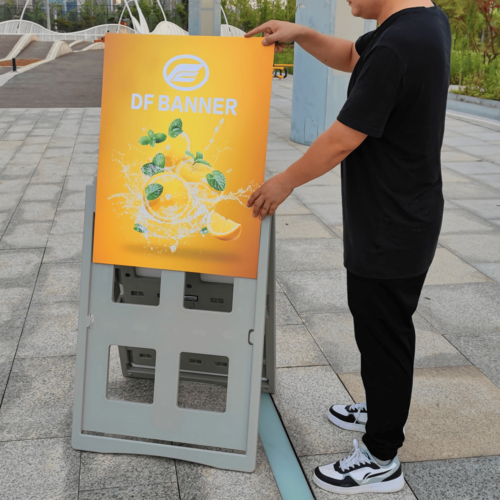
The thirty-second poster change on the window version of the A-frame sign: four cut-out windows with retaining lips, and the poster slides in behind them from the side. No adhesive, no clips, no tools — the reason a folding sidewalk sign gets re-printed for every promotion instead of every season.
Water in the body of the sidewalk sign: the ballast question, and the freight answer
The hollow moulded body of an outdoor sidewalk sign is not a cost-saving; it is the answer the A-frame sign gives to wind. Fill chambers in each panel of the sidewalk sign take water or sand through a screw-cap hole, converting a few kilograms of empty plastic into a plastic A-frame sign that stands its ground on an exposed pavement. The commercial elegance of the outdoor sidewalk sign is in what happens in reverse: drained, the folding sidewalk sign is light enough for one member of staff to carry by the handle, and nested, the A-frame sign folds flat into a carton. Compare that with the pavement sign alternatives a buyer will be quoted. A concrete or cast-iron pavement sign is genuinely heavy — which is stable, but also a two-person move, a storage problem and a freight bill paid on weight all year for a benefit needed a dozen days a year. A water-fillable A-board pays for its ballast only on the days it is needed, with a tap, which is the whole argument for the outdoor sidewalk sign. Freight is the other half of the same argument for an A-frame sidewalk sign: folding sidewalk signs ship nested and flat, a container of A-frame signs fills on volume rather than weight, and the packaging drawing of a folding sidewalk sign — carton quantity, panel protection at the corners, loading direction — is the second document a serious buyer asks for, right after the price list for the A-frame sidewalk sign.
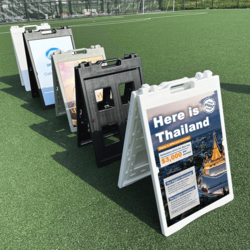
A colour run on turf: the same A-frame pavement sign in white, black and grey, holding different posters. Distributors standardise on one frame colour and let the printed poster carry the brand, because the frame is the asset and the print is the consumable.
Halloween, Saturday 31 October: the doorstep becomes the shopfront
Halloween 2026 falls on a Saturday, and that single scheduling fact rewrites the retail evening and the sidewalk sign print calendar. On a weekday, most of the celebration is a school-gate affair; on a Saturday, the trick-or-treat economy comes to the high street — costume shops at capacity, pharmacies and supermarkets running confectionery promotions, cafes selling the parents something hot while the children work the doors, every one of them standing an A-frame sign out front. US Halloween spending has run above ten billion dollars a year in recent seasons, and almost every one of those transactions is decided on the pavement in front of a shop, at the reading height of an A-frame sign. The seasonal posters that perform on a sandwich board are the practical ones: trick-or-treat hours, confectionery bundles, costume swaps, late openings, every one of them a job for a sidewalk sign. The buyer pattern behind them on the sidewalk sign is the print-cycle pattern again — a seasonal A-frame sandwich board poster is printed for a fortnight, replaced for the next promotion, and the frame of the A-frame sign rolls on to New Year without being re-purchased. For a distributor of the A-frame sign this is the clearest repeat-purchase loop in the sidewalk sign category: the frame sells once, the poster sells forever, and Halloween is the date that starts the winter poster cycle on the A-board.
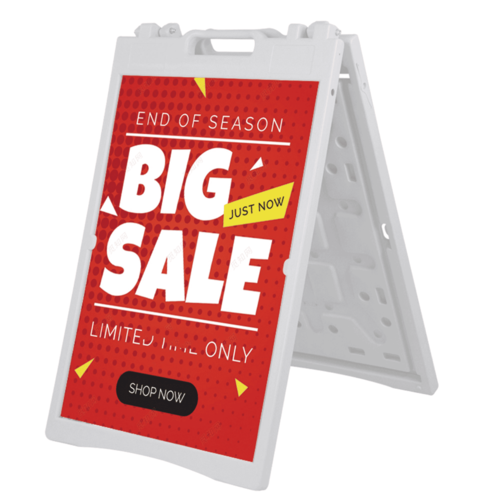
The poster that pays for the frame: an end-of-season sale message on a plastic A-frame sign. Retail uses a sidewalk sign the way digital advertising wishes it could — one graphic, one afternoon, printed locally in the morning and standing on the pavement by lunch.
Nuremberg, 27 November: the strictest pedestrian zone in Europe
Germany's Christmas markets, the densest six weeks of the European pavement sign year, open across a twelve-day spread in 2026 — Cologne from around 16 November, Munich on the 20th, Frankfurt on the 23rd, Leipzig on the 24th, the 592nd Dresdner Striezelmarkt on the 25th, Stuttgart on the 25th, and finally the Christkindlesmarkt in Nuremberg on 27 November, running daily 10:00 to 21:00 until 24 December with the Christkind's prologue from the Frauenkirche balcony at 17:30 on opening night. Two scheduling details matter to anyone supplying pavement signs to this market: several markets close for Totensonntag on Sunday 22 November, and the first Advent Sunday falls on 29 November. A market stall in one of those squares has no wall, no window and no door — the pitch is a timber bench in an open medieval plaza, and every message the trader needs to deliver (what the Glühwein costs, where the mug deposit is refunded, what is in the Lebkuchen, which way to the toilets) is delivered on standing signage, most of it an A-board or a pavement sign. Nuremberg enforces a famously strict aesthetic on its stalls — wood, no plastic cladding, no neon, an aesthetic that shapes every A-board on the Hauptmarkt — which pushes stallholders toward the quieter grey and white plastic A-frame sign holding a printed panel rather than anything illuminated. The buyer note for a pavement sign in this market is material and colour, not capability: a folding sidewalk sign in neutral grey with a matt-laminated poster reads as traditional, survives six weeks of winter weather and vanishes into the stall's own palette at the Christkindlesmarkt. Buyers supplying continental markets with pavement signs should also check the local rules before quoting: city councils and market operators each set their own conditions for what stands where, and the sidewalk sign that passes in one square needs permission in the next.
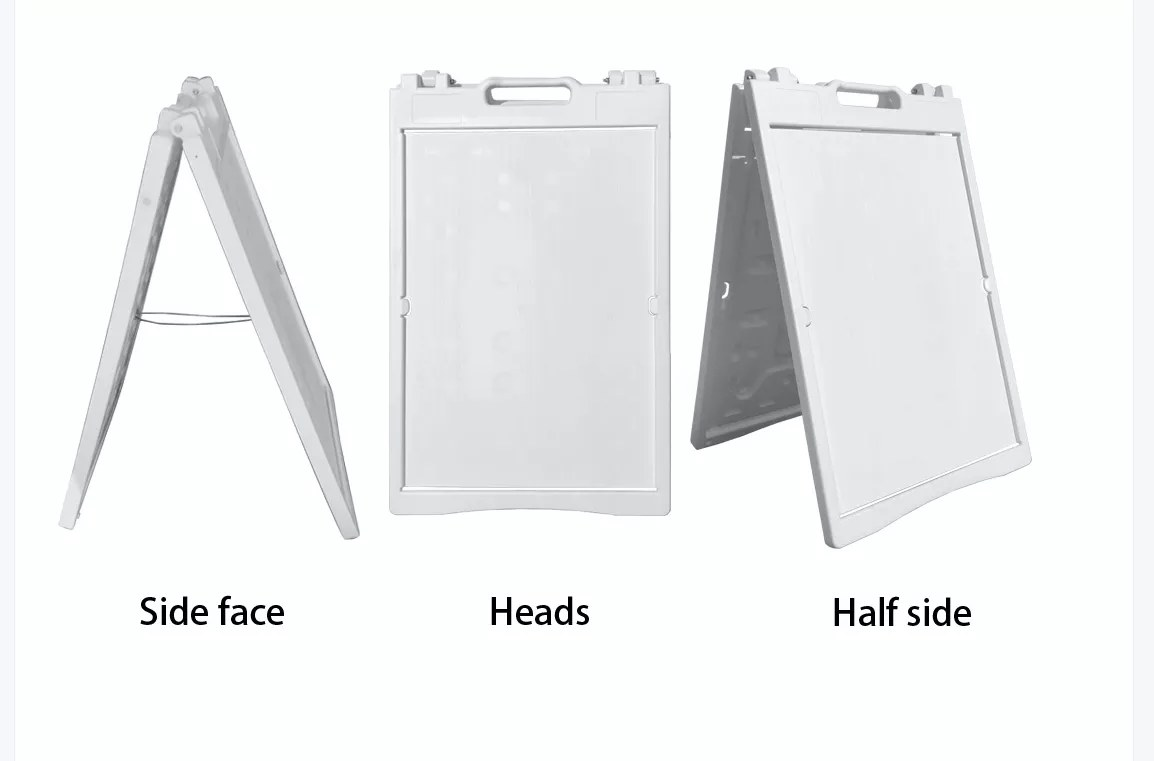
Frame anatomy, from the supplier's drawing: the A-frame side face, the moulded heads at the hinge line and the half-side profile. The hollow body is what makes the water-fillable ballast chamber possible, and the moulded heads are what keep the two panels of a double-sided sidewalk sign moving as one hinge.
Small Business Saturday, 28 November: the weekend the pavement sign is the argument
Thanksgiving falls on Thursday 26 November, Black Friday on the 27th, and then comes the day built for the sidewalk sign: Small Business Saturday on Saturday 28 November, the shop-small weekend founded in 2010 that deliberately turns the spotlight on independent retailers and their pavement signs. The economics of that Saturday are exactly the economics of a sidewalk sign. An independent bookshop, florist, bakery or barbershop cannot outspend a national chain in any paid channel, but on Small Business Saturday the customers are walking toward the independents anyway, on foot, down the high street — and the only billboard they pass is the pavement, where the sandwich board is waiting. Trade surveys of the shop-small weekend have measured spending in the tens of billions of dollars in recent years, spread across exactly the businesses whose entire marketing budget is one A-frame sign and a printed poster. The buyer behaviour that follows is the two-sign pattern seen in the product photography of the plastic A-frame sign: one A-frame sidewalk sign at the kerb carrying the promotion, one at the door carrying hours, social handles and the personal note that no chain can copy. Pair the two A-boards, and a shopfront explains itself to everyone walking past without anyone inside lifting a finger.
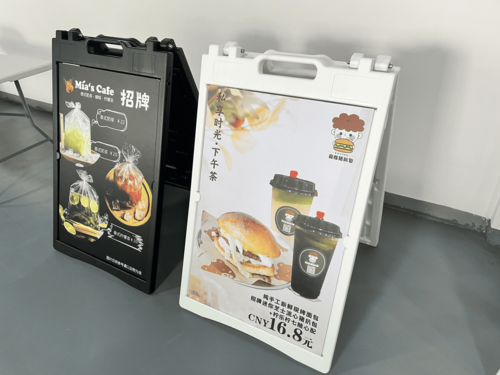
Black and white on the same pavement: two A-frame sidewalk signs working as a pair, one carrying a menu, one carrying a promotion. Buyers ordering a pavement sign for a shopfront nearly always end up specifying two — one at the kerb, one at the door.
Buyer reference: the specification that survives a windy street
Run through any supplier's catalogue for the sidewalk sign category and the same eleven specification points decide whether a plastic A-frame sign order is right or wrong. They are worth reading in full even for a repeat order of sidewalk signs, because almost every field complaint about a plastic A-frame sign traces back to one of them.
- Face construction of the A-frame sign: window version with four retaining lips for poster swaps, or flat panel for rigid boards such as 5 mm KT board. A double-sided sidewalk sign shows artwork on both faces, so double the poster count in the artwork budget of an A-frame sign.
- Display area: 61 x 92 cm, matching the standard 24 x 36 inch poster — confirm before ordering artwork sized to any other format on an A-frame sign.
- Ballast: the fill chambers of the plastic A-frame sign take water or sand through screw-cap holes; confirm the fill volume and the filled weight of an outdoor sidewalk sign against the wind exposure of the actual site.
- Hinge: through bolt with washer set into a thickened rib section, on a folding sidewalk sign opened and closed twice a day; a self-tapping screw in thin moulding is the known failure point of a cheap sandwich board or a cheap plastic A-frame sign.
- Retaining cable: an internal steel cable on a bolted plate limits the splay of the A-frame sign and keeps the panels of an outdoor sidewalk sign from over-opening in wind.
- Handle and ergonomics: an integrated carry handle in the top rail of the sidewalk sign and a textured grip panel, so one member of staff can move the pavement sign without a second pair of hands, and a folding sidewalk sign can go back through the door at closing.
- Footprint and height: 77 cm at the base, 105 cm overall, 108 cm panel — check the A-frame sign against doorways, alcoves and the sightline of passing traffic.
- Colour: white, black and grey A-frame sign frames from stock; hold one colour across repeat orders, because a row of mismatched A-boards on one street reads as chaos.
- Poster consumables for the sidewalk sign: standard-size posters print anywhere at print-shop prices; agree the artwork template once and every future poster change on the A-frame sign is a local print job.
- UV stabilisation: confirm the polyethylene grade and UV package for a plastic A-frame sign that stands outside all season, or expect chalking and colour shift in year two.
- Carton and pallet data for the folding sidewalk sign: nesting quantity per carton, corner protection and loading direction, which decide the landed cost of a folding sidewalk sign as much as the unit price of the A-board does.
- Wind rule: an outdoor sidewalk sign with filled ballast chambers stands where an empty sandwich board cannot; fill with water for daily use and with sand where the pavement stays exposed all winter, and drain the A-frame sign before it goes back in the van.
- Placement: an A-frame sign reads best at the kerb line facing oncoming foot traffic, angled with the flow; a double-sided sidewalk sign carries one message in each direction, so the two faces never have to share an audience.
- Storage: folding sidewalk signs stack flat on a shelf ten or more at a time; a sandwich board that does not fold ends up leaning in a corridor, and a leaning A-board is a trip hazard and a claim waiting to happen.
- Care: wash the plastic A-frame sign with the poster in place, check the hinge bolt and the retaining cable once a season, and re-tighten the hinge of the A-frame sign before the windiest month, because the maintenance schedule of a sidewalk sign is one entry long.
Eight questions before the first sidewalk sign order
Institutions and chains buy sidewalk signs differently from a single cafe, but the process worth copying is the same at any volume: settle eight questions in order, because each answer constrains the next A-frame sign decision. Worked through honestly, the list converts 'we need some sidewalk signs' into a quotable line item for an A-frame sidewalk sign order.
- Where will the A-frame sidewalk sign stand: covered doorway, open pavement, plaza or turf? Wind exposure decides the ballast requirement of an outdoor sidewalk sign and whether the filled weight is adequate.
- How often will the artwork change? More than twice a season points to the window version of the A-frame sign; once a year points to the flat-panel pavement sign.
- Who moves it, how many times a day? If the answer is one assistant and two moves a day, the sandwich board earns its handle, and the empty weight and the carry path through the doorway matter more than any other line in the A-frame sign catalogue.
- How many messages at once? A double-sided sidewalk sign carries two; the two-sign kerb-and-door pairing of A-frame signs carries four and is the common real-world layout.
- What poster standard will you commit to? Fix on 24 x 36 inch artwork once for the A-frame sign, and every future poster for the pavement sign prints at standard-sheet prices forever.
- What does the local authority require? Councils and market operators set their own rules, permits and fees for a pavement sign on public ground — check before quoting, not after delivery.
- Which colour, and can you hold it? White photographs well and disappears into most palettes; black hides scuffs and reads strongest against pale stone; grey reads as neutral on heritage streets and suits a heritage pavement sign.
- What are the carton dimensions and the nesting quantity? This decides the landed cost of a plastic A-frame sign as much as the unit price, and it is the question buyers of a folding sidewalk sign forget until the freight quote arrives.
A procurement team that works through those eight questions usually ends up with a two-line specification: one frame colour in one face version, and one committed poster standard for the A-frame sign. That is not a compromise. It is the only sidewalk sign specification a multi-site operator can actually run across every plastic A-frame sign in the estate.
The three buying mistakes on a pavement sign, and what each one costs
Three mistakes recur in the sidewalk sign category, and all three are visible only after the container has landed — which is what makes them worth naming before the order for a pavement sign instead.
- Buying on the photograph. Every sandwich board looks upright and white in a product image. The difference is in the hinge construction, the rib density and the wall thickness of the sidewalk sign, none of which photograph — which is why a sample, not a picture, is the correct basis for a first order of a plastic A-frame sign.
- Buying on the unit price. A pavement sign quoted ten per cent lower usually carries a thinner moulding or a lighter hinge, and a plastic A-frame sign that cracks at the hinge in month six is not ten per cent cheaper; it is a replacement order plus a gap in the shopfront.
- Buying without the consumables line. Posters, replacement screw caps and spare hinge bolts are the running cost of a sidewalk sign and a poster schedule; a supplier who cannot ship spare parts separately turns a two-euro repair on a plastic A-frame sign into a replacement frame.
There is one more habit worth importing from the experienced end of the sidewalk sign market. Rather than judging a supplier on the first container, serious buyers keep one A-frame sandwich board from each production run as a reference — same frame, same hinge, same weight in the hand. Over three or four orders that comparison says more about the consistency of a folding sidewalk sign supplier than any inspection report, and it costs one A-board.
MOQ, proofs and freight for the A-frame sign
The order mechanics of the A-frame sign are friendlier than most buyers expect. Minimum order quantity is typically one piece, which makes the sidewalk sign unusually easy to trial: a distributor can order a single A-frame sidewalk sign, fill it, load it with a poster and put it on a real pavement for a week before committing to a container of sidewalk signs. Tooling already exists for the standard A-frame sign, so there is no mould cost on a catalogue model. Where customisation is required — a moulded colour, a printed logo on the grip panel, a branded carton, a special poster size for the A-board — sampling is quoted separately and the sample normally ships in one to three days from confirmation, with electronic proofs for the sidewalk sign artwork before that. Goods move on EXW or FOB terms from Guangzhou, Shenzhen or Foshan depending on the routing, the standard ports for a plastic A-frame sign, and by express, air or sea depending on the deadline. The timing rule for the sidewalk sign category is the reverse of most display products: because the product ships flat and nested, a container of folding sidewalk signs fills on volume before weight, and a buyer who books in September holds the October-to-November window when every one of this quarter's four events lands. A buyer who waits for the marathon route map to publish, or for the first cold morning to prove the Christmas season, is buying freight at peak — and freight at peak is a margin a pavement sign order cannot carry, which every A-frame sign buyer learns once.
The quarter in one paragraph
Between 11 October and 28 November 2026, four unrelated audiences will try to talk to more people than their buildings can hold, and each of them will rent a pavement sign to do it. A route-side restaurant in Chicago will stand an outdoor sidewalk sign in front of 1.7 million passing spectators on the marathon route. A high-street retailer will re-print a Halloween poster for a sidewalk sign on a Saturday morning and have the A-board standing by lunch. A stallholder in Nuremberg will hold an A-frame sign with a printed panel in a 592-year-old square against six weeks of winter weather on the Hauptmarkt. An independent bookshop will put a sandwich board on the pavement for the one weekend the whole retail calendar calls the pavement the hero, and the folding sidewalk sign its hero product. None of them will call it an advertising decision, because for all four it is a pavement decision, and the A-frame sign is how the pavement is furnished. That is what a double-sided sidewalk sign is: the cheapest rent on the busiest ground a business will ever get — a plastic A-frame sign that folds flat at closing time, fills with water against the wind, and takes a fresh poster in the time it takes to print one. Season after season, that is the whole argument for the A-frame sidewalk sign, and it is why the A-board and the folding sidewalk sign remain the quiet volume business of every Guangdong display line.
— keyword density report (longest-match, non-overlapping) —
word_count=4866 total_keyword_phrases=243 density=4.99% per-keyword: a-frame sandwich board=4, a-frame sidewalk sign=12, double-sided sidewalk sign=7, plastic a-frame sign=24, folding sidewalk sign=21, outdoor sidewalk sign=13, a-frame sign=51, sandwich board=15, pavement sign=32, sidewalk sign=43, a-board=21
Event dates verified 8 October 2026. Bank of America Chicago Marathon: 48th running, Sunday 11 October 2026, Grant Park start and finish from 7:30 a.m., 26.2 miles through 29 Chicago neighbourhoods, 55,000 participants from more than 100 countries, around 1.7 million spectators; Abbott Health & Fitness Expo at McCormick Place 8-10 October 2026; 27th Mile Post-Race Party in Butler Field until 4:00 p.m. Halloween 2026 falls on Saturday 31 October. German Christmas markets 2026 (dates from city tourist boards): Cologne from around 16 November, Munich 20 November, Frankfurt 23 November, Leipzig 24 November, 592nd Dresdner Striezelmarkt 25 November, Stuttgart 25 November, Nuremberg Christkindlesmarkt 27 November to 24 December (daily 10:00-21:00, Christmas Eve 10:00-14:00; Christkind prologue 27 November 17:30); several markets close Totensonntag 22 November; first Advent Sunday 29 November. US Thanksgiving 2026 falls on Thursday 26 November, Black Friday 27 November, Small Business Saturday 28 November (founded 2010). Product dimensions quoted for the A-frame sign are taken from supplier documentation: 68 cm top rail, 61 x 92 cm display area per face, 108 cm panel, 105 cm overall, 77 cm footprint.