


Four crowds that will not stand still: autumn 2026 and the wearable banner
The TCS New York City Marathon sends nearly 60,000 runners past more than two million spectators on Sunday 1 November — the fiftieth running of the five-borough course. Halloween lands on Saturday 31 October. Diwali follows on Sunday 8 November. Black Friday and Small Business Saturday close the month on 27 and 28 November. Four audiences, four dates, one shared problem: the crowd keeps moving, and a fixed sign only meets it once. The product built for that problem is the one a staff member wears — the backpack banner.
NEW YORK / FOSHAN, GUANGDONG — 13 October 2026
Every advertising medium in the display industry assumes the customer will come to it; the wearable banner assumes the opposite. The billboard waits on the motorway, the shop window waits on the street, the stand in the hall waits for a visitor who already found it, and only the walking billboard refuses to wait at all. A human billboard waits for nobody. Between 31 October and 28 November this year, when the wearable banner earns its keep, four of the largest crowds in the Western calendar refuse to behave that way, and all four are served by the same backpack flag. On Sunday 1 November the TCS New York City Marathon moves roughly two million spectators along 26.2 miles of pavement across five boroughs, in celebration of the fiftieth anniversary of the course first run in 1976, with a cheer station and a backpack flag on every mile. On Saturday 31 October the Halloween economy pours families down high streets after dark, where a human directional sign is the only signage that keeps pace. On Sunday 8 November Diwali fills celebration venues and shopping districts from Leicester to New Jersey, and the walking billboard fills the crowds between them. And on Friday 27 and Saturday 28 November, Black Friday and Small Business Saturday put shoppers on the pavement in front of every independent store that has ever complained about advertising costs, and a backpack banner is the one premium medium those stores can still afford. In all four cases the audience is in motion, on foot, and moving faster than any fixed sign can be repositioned, which is the whole case for the wearable flag. The one advertising medium that keeps pace, worn on a body, is the backpack banner: a padded harness, a telescoping pole, a printed fabric flag riding above head height — a wearable banner by any other name. The trade calls it a backpack banner, a backpack flag, a human billboard or a walking billboard — and this autumn it is the only sign that follows the customer.
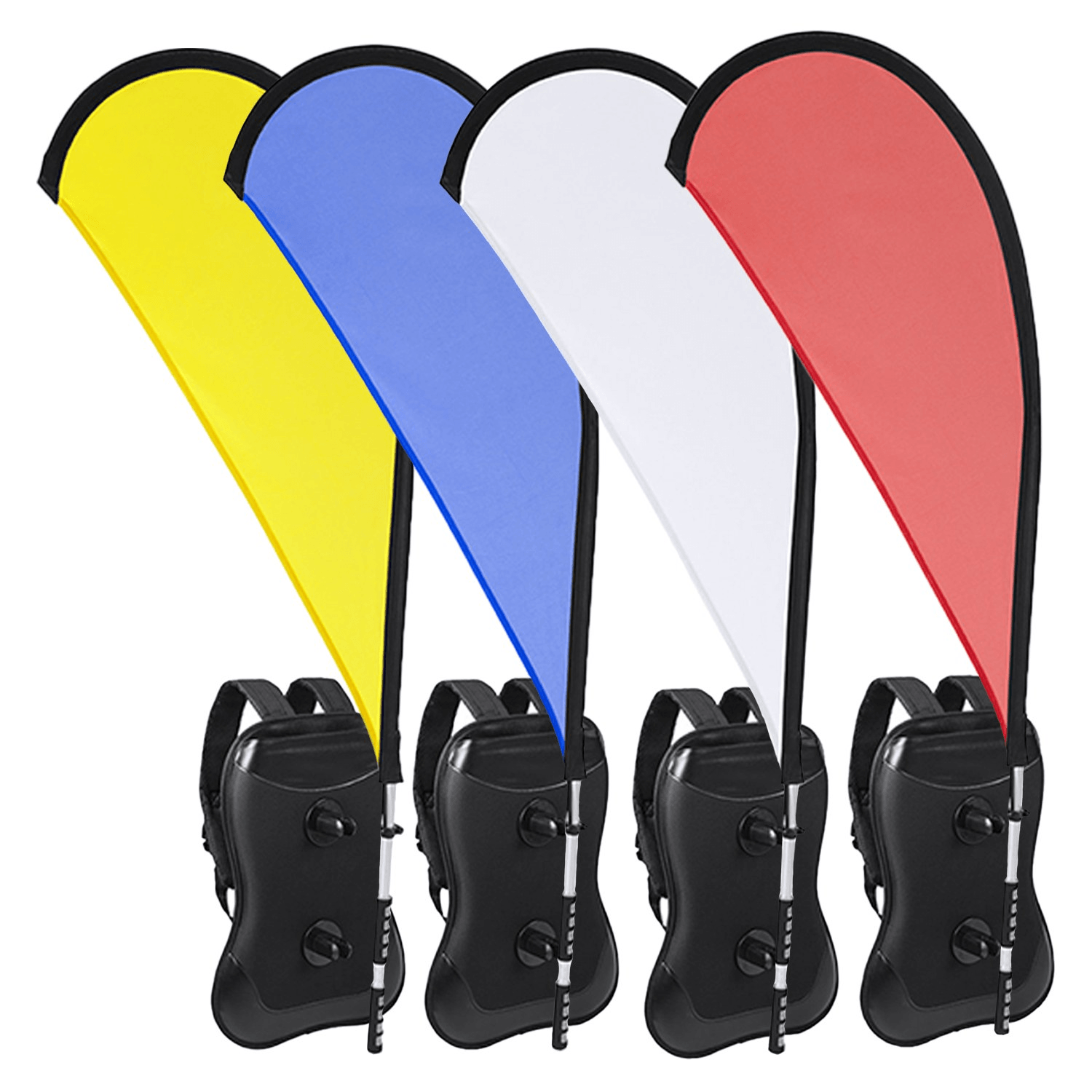
The product line doing the work: four teardrop backpack flags in yellow, blue, white and red, each mounted on the same padded harness and the same telescoping aluminum pole. One kit, four colourways, and every one of them turns the person wearing it into a moving advertising surface that no fixed sign can follow.
The behaviour behind the wearable banner is simple enough to state as a rule of thumb: a static sign meets each member of a moving crowd exactly once, at one point on the route. A walker wearing a human directional sign meets the same crowd continuously, again and again, because the message of a walking billboard travels with the crowd's own speed and direction. Event organisers understood the value of a backpack flag first. A cheer zone on a marathon course cannot bolt a wearable banner to a barrier the city owns, but it can wear one; a festival gate cannot fix a board to ground the landlord does not own, so it issues a backpack banner instead; a promoter outside a venue is working pavement the council owns with a human billboard on every shoulder. What all three can do is put a staff member in a human directional sign — a wearable banner, in the trade's neutral term — and let the sign become as mobile as the permit situation is difficult. That is the commercial logic of the walking billboard, and it explains why orders for the category cluster around the same four weekends every autumn, when walking crowds peak, every fixed surface in town is either full, forbidden or unavailable, and the backpack banner is none of the three.
New York, Sunday 1 November: two million spectators and one moving human billboard
The numbers around the 2026 TCS New York City Marathon, and around every backpack banner sold for it, are worth reading slowly, because each one describes a crowd a human billboard will have to cut through. New York Road Runners received a record 240,000-plus drawing applications from more than 160 countries for a field of nearly 60,000 runners and the wearable banner teams who will greet them — the largest marathon field in the world, chasing the 59,226-finisher world record set by the 2025 edition. More than two million spectators will line a course that starts on Staten Island and that a human billboard can walk, crosses into Brooklyn over the Verrazzano-Narrows Bridge, threads Queens and the Bronx, and finishes in Central Park. This year marks the fiftieth anniversary of the five-borough route, first run in 1976, and New York Road Runners has expanded its Official Charity Partner Program to more than 670 charities — the most ever — with a fundraising goal of 100 million dollars, supported by more than 14,000 charity runners, each of them running toward a cheer station marked by a backpack flag. Every one of those charities wants its name visible on the course, and most of them will buy a backpack flag to do it; the units that deliver that visibility are bought in tens: the cheer-station backpack banner, the wayfinding backpack flag at the water stations, the human billboard walking the approach streets with the charity name riding three metres above the crowd. Charity teams, sponsor activation crews and borough festival organisers all buy the same wearable banner kit for the same reason: the course is 26.2 miles long, the spectators move along all of it, and no fixed sign owns more than three metres of pavement, while a walking billboard owns the lot.
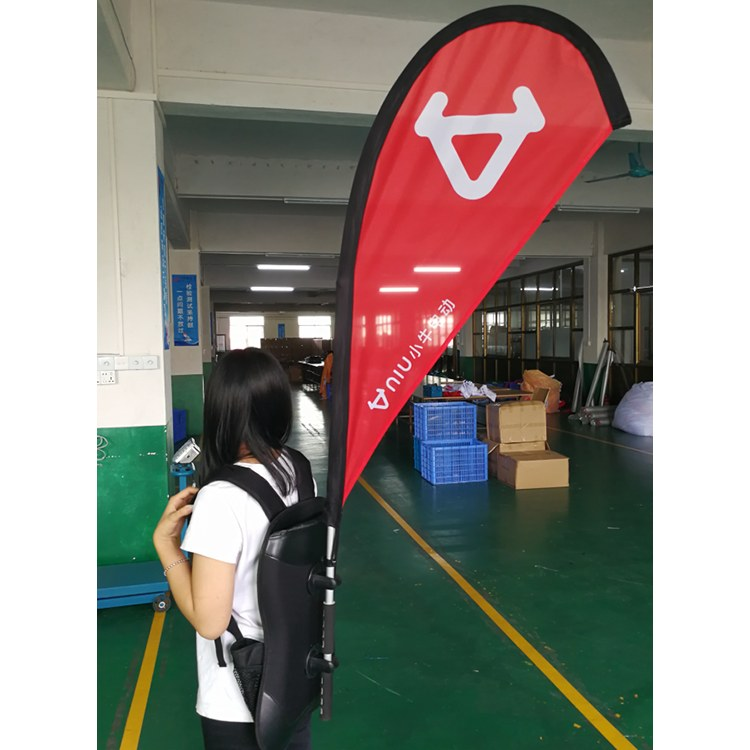
A real shift, photographed on the factory floor: a red teardrop backpack flag worn with the pole in the angled socket, the graphic riding clear above head height. At full height the flag is visible over a crowd from thirty metres away — the working distance of a marathon spectator zone or a festival gate.
The buyer detail worth copying from marathon operations, and the one that sorts the backpack banner market, is the shift-length question. A cheer-station team works four to six hours on its feet wearing a wearable flag, and the whole ergonomics of a human billboard exist for that single fact. The load of a backpack flag rides on a contoured padding panel against the back, the straps distribute weight across the shoulders with a sternum clip, which is what turns a wearable flag into an eight-hour kit, and the flag itself, the printed wearable banner, weighs a few hundred grams of dye-sublimated fabric. The staff member in a body banner or a teardrop backpack banner carries furniture-grade weight and advertising-scale visibility at the same time — and a wearable banner that shifts, chafes or sags after the first hour ends up carried in the hand, which is the failure mode every experienced buyer of a backpack flag designs out before the first order.
Five names for one wearable banner: the vocabulary that decides what a buyer finds
The wearable banner category carries more names than any comparable display product, and the naming is genuinely useful because it sorts by use case. Backpack banner and backpack flag are the trade names for the complete kit — harness, pole and graphic — and they are the terms distributors list a backpack banner under. Human billboard and human directional sign describe the job the wearer does: a walking advertising surface, or a sign that points crowds toward gates, entrances and queues — the two jobs a human directional sign does better than any board on a stand. Walking billboard is the term the activation industry uses when the message on the wearable banner is commercial and the shift is long. Wearable banner and wearable flag are the neutral spec-sheet terms. Body banner names the rectangle variant of the wearable banner, hung full height from the curved spreader rod with corner fixings, that carries a dense layout of prices, sponsors or schedules. A buyer who searches one term for a backpack flag finds one supplier; a buyer who understands the vocabulary of the wearable banner finds the whole category — and, more usefully, finds it sorted into the two real product families: the flag-on-a-pole family for visibility above a crowd, and the body banner family for message density at reading height.
Three shapes, three walkers: a teardrop backpack flag, a blade-cut teardrop and a full rectangle body banner worn on the same harness platform. The frame decision a buyer makes is not the flag — it is which silhouette reads best at the speed of the crowd the staff member will walk in.
What a buyer actually inspects on a backpack flag before signing
Across a supplier's catalogue, every backpack flag looks like every other one: a walker, a pole, a bright flag; the wearable flag that lasts is the one a buyer takes apart on the showroom floor. The differences that decide whether a backpack banner lasts one season or five are all in the details, and there are five places on a backpack flag to look. First, the harness of the flag backpack: a contoured padding panel moulded to the shape of a back, not a flat foam sheet, with a mesh backing panel for airflow and adjustable shoulder straps with a sternum strap and a waist belt — because a wearable banner that loads only the shoulders will be handed back by the second shift. Second, the sockets: the panel of a human billboard should carry two receiving sockets, one vertical and one angled, so the same flag backpack can throw the graphic over a crowd or hold it upright in a corridor. Third, the pole of the backpack banner: telescoping aluminum sections with chamfered ends, a nylon tip where the pole meets the flag sleeve, and a sponge grip at the hand position — the detail that decides whether a wearable banner wobbles at the joint after a month of assembly. Fourth, the rear pocket: a wearable flag needs a stowed home on the harness during breaks, or the pole sections of a human billboard get leaned against walls and left behind. Fifth, the graphic of the backpack flag: dye-sublimated polyester, hemmed with a pole sleeve, printed single-sided with a mirror reverse or true double-sided where the route turns and the crowd sees both faces. Ask a supplier to state those five points on a wearable banner in writing, and the quotes for a backpack flag sort themselves faster than any sample comparison.
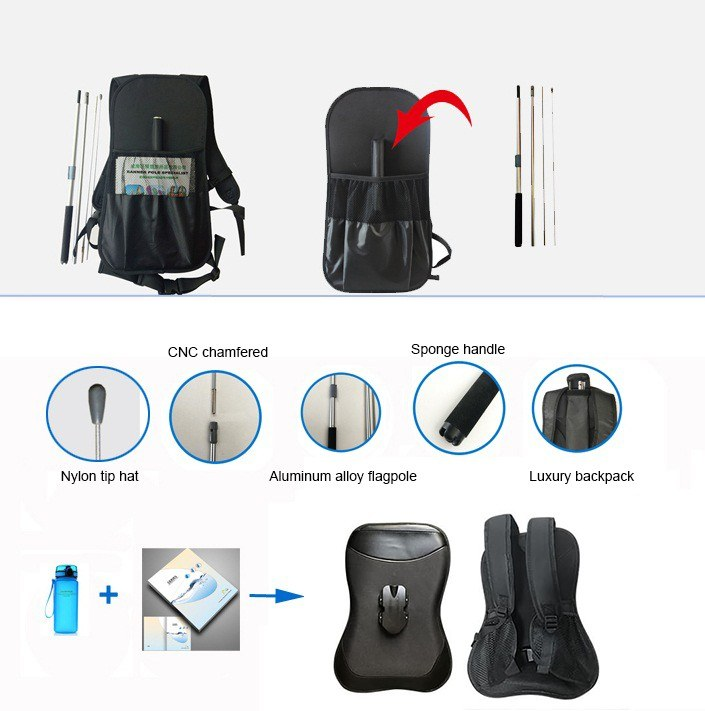
The hardware callouts a serious buyer checks: the pole sections stowed in the rear pocket of the flag backpack, the CNC-chamfered pole ends, the nylon tip, the sponge grip where the hand actually holds, and the padded harness panel. None of these details photograph on a mannequin — all of them decide whether the kit survives a four-hour shift.
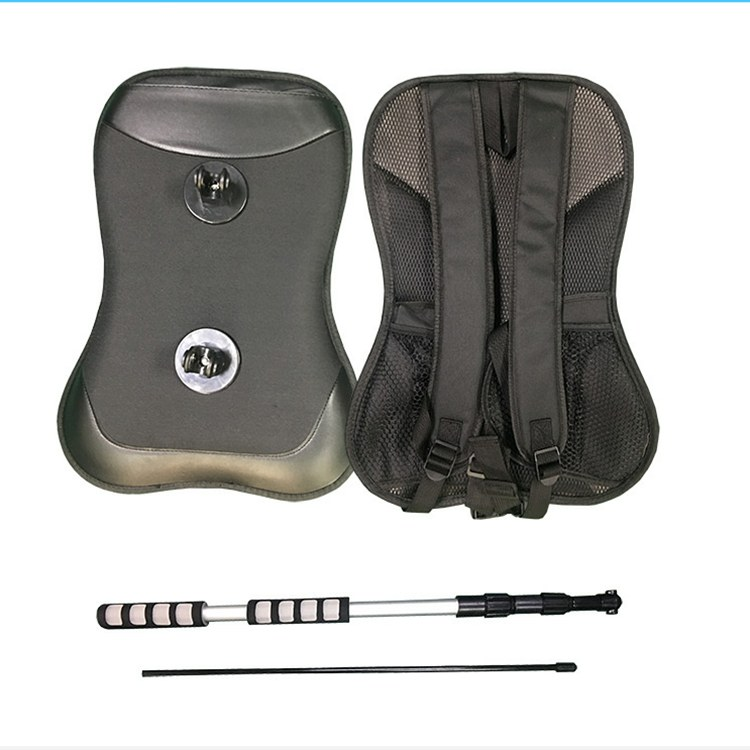
The kit a buyer actually receives: the contoured padding panel with two pole sockets — one vertical, one angled — the mesh back and harness straps, and the aluminum pole sections that sleeve together in under a minute. The two sockets are the whole ergonomics story of a backpack banner: angled throws the graphic over the crowd, vertical keeps it in the sightline of people walking straight at the wearer.
One kit, two silhouettes: the teardrop backpack flag, the rectangle body banner and the crowd-speed rule
The same harness and pole of a backpack banner carry two different graphics, and the choice between them is the first real decision on the order — it is a crowd-speed decision for the wearable flag. The teardrop backpack flag is cut on a curve, tensioned between the pole and its own hem, and stays legible in wind and in motion, which suits fast-moving crowds: marathon spectators, festival queues, street parades — the classic territory of the walking billboard. The rectangle body banner hangs from a curved spreader rod with corner fixings and presents a flat, full-height print face, which suits the slow-moving crowds a rectangle print is cut for: shoppers on a high street, queues outside a venue, night-market strollers who will actually stop and read a price. The rectangle body banner carries more message — headline, offer, sponsors, a map reference — while the teardrop backpack flag carries one brand and one arrow. Experienced distributors quote the pair together: a teardrop wearable flag leads at junctions and gates, the rectangle body banner works the queue where reading happens, and the two-wearer pattern of a human directional sign covers a corner no single fixed sign can see around.
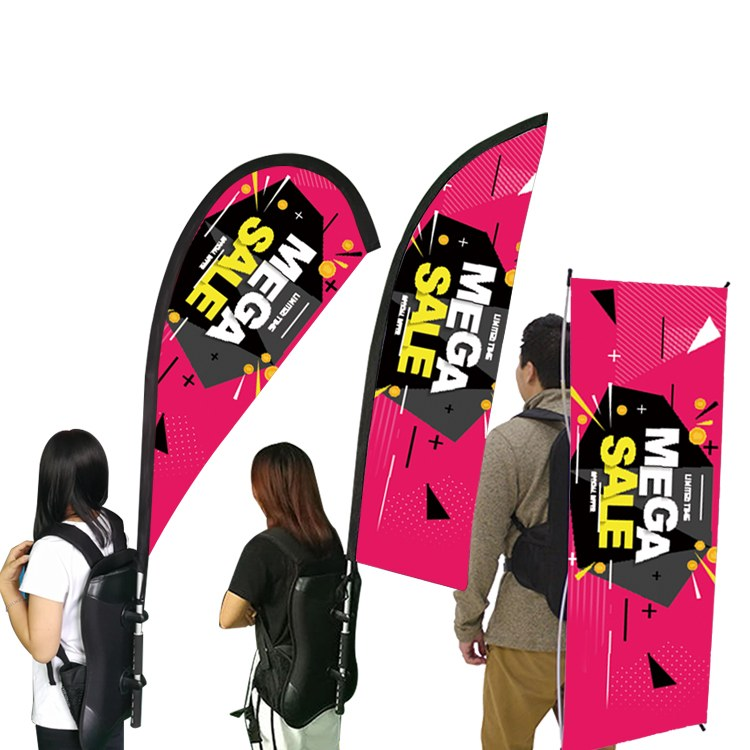
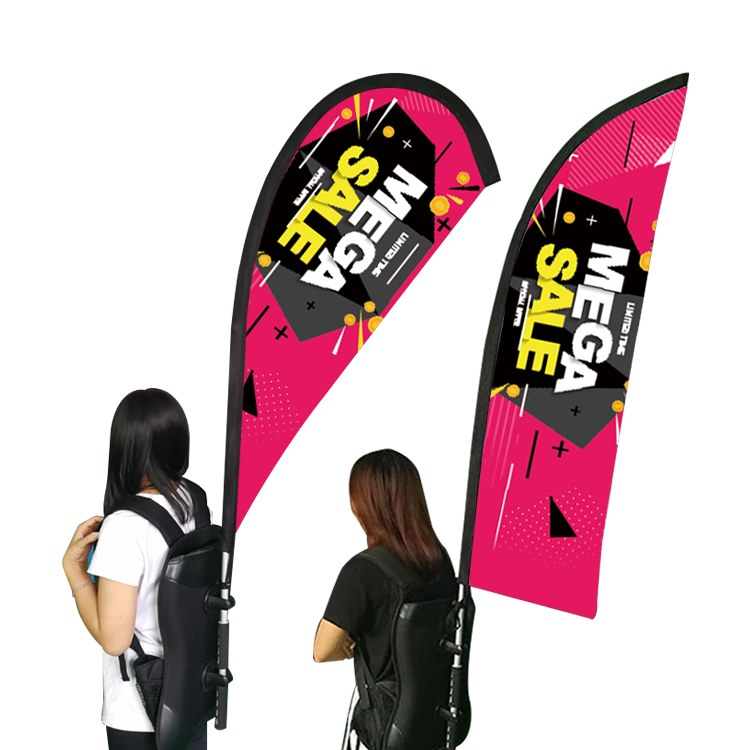
A sale team in motion: a teardrop and a rectangle wearable banner carrying the same campaign artwork on two wearers. This is the two-person pattern that recurs across the category — one walker holds the high ground at a junction while the other works the queue, and the pair covers a corner no fixed sign can see around.
Rectangle and teardrop on the same walking platform: a full-height rectangle backpack banner for a destination brand and a curved teardrop backpack flag for a city campaign. The rectangle carries a dense message layout for slow-moving crowds; the teardrop stays tensioned and legible in wind for fast-moving ones.
Halloween, Saturday 31 October: the night the message has to move
Halloween 2026 falls on a Saturday, and that single scheduling fact rewrites the evening economy and the order book for the backpack flag. On a Saturday night the costume, confectionery and party trade spills out of the shops and onto the pavements: bars run door teams, family attractions run trail-side wayfinding on a human directional sign, city councils run safety messaging that a wearable banner can carry along the routes the children actually walk. Every one of those jobs shares the same constraint that the wearable banner was invented to solve — the audience is walking, in the dark, past crowds dense enough that a sign at ground level disappears behind the first three strollers. A human directional sign worn at pole height clears the crowd, carries a reflective-bright print, and moves with the flow instead of fighting it. Bars and clubs were the earliest adopters of the walking billboard for exactly this night; family attractions and councils have followed, because a staff member in a human billboard is simultaneously a sign, a marshal and a person the public can approach and ask a question — three functions a printed board has never managed, and one reason the wearable flag keeps the Halloween shift.
The walking billboard at work on the street: a full-height printed rectangle carrying a price-and-product message, hung from the curved spreader rod with corner fixings. One member of staff, one printed panel, and a message that walks the exact route the customers walk — past the queue, around the corner, into the square.
Diwali, Sunday 8 November: celebration crowds and the reading-height sale
Diwali 2026 falls on Sunday 8 November, and the festival week around it has become one of the most reliable retail windows in cities with large South Asian communities — Leicester's Golden Mile switch-on, Southall, Tooting, the Diwali mela grounds of New Jersey and Texas — every one of them a human directional sign opportunity, with jewellers and sweet shops running their highest-volume fortnight of the year and a wearable banner at the door. The crowd pattern that faces a human directional sign is different from the marathon's: families arrive, slow down, browse and compare, which is when a walking billboard actually gets read, and which is precisely the reading condition the rectangle body banner is built for. A jeweller promoting an evening offer on a walking billboard, a sweet shop listing its hampers, a community association directing visitors to the parking and the stage — all three need a sign that stands in a crowd that has no walls and no permission to fix anything, and all three reach the same conclusion the trade has reached: a human billboard matched to the day's crowd density beats a fixed frame the crowd never reaches. The buyer note for this window is simple: order the rectangle print face of the backpack banner for message density, keep the teardrop backpack flag for the entrance, and put both wearable flags on staff who are already walking the event all evening, every evening of the fortnight.
Black Friday, 27 November, and Small Business Saturday, 28 November: the sidewalk team
Thanksgiving falls on Thursday 26 November, Black Friday on the 27th, and Small Business Saturday — the shop-small weekend founded in 2010 — on the 28th, the two days a year a wearable banner works hardest. For the independent retailer, the economics of that weekend are exactly the economics of the backpack banner. A shop cannot outbid a national chain on any paid channel, but it can put two staff members in wearable banners and walk the offers up and down the high street, past the queue for the chain store, around the car park, along the route the shoppers are already taking, shoulder to shoulder with a human billboard. Trade surveys have measured Small Business Saturday spending in the tens of billions of dollars in recent years, and a backpack flag is how independents reach it; the businesses earning it have marketing budgets measured in hundreds — which is why the walking billboard keeps winning the assignment: it is the only premium-visibility medium with a one-piece minimum, and a backpack flag is the only sign of that kind that fits in a carry bag. The recurring pattern in the field for a walking billboard is the two-wearer team: one body banner carrying the headline offer at reading height, one teardrop backpack flag pulling attention at junctions, both wearable banners worn by staff who are distributing flyers or managing the queue anyway.
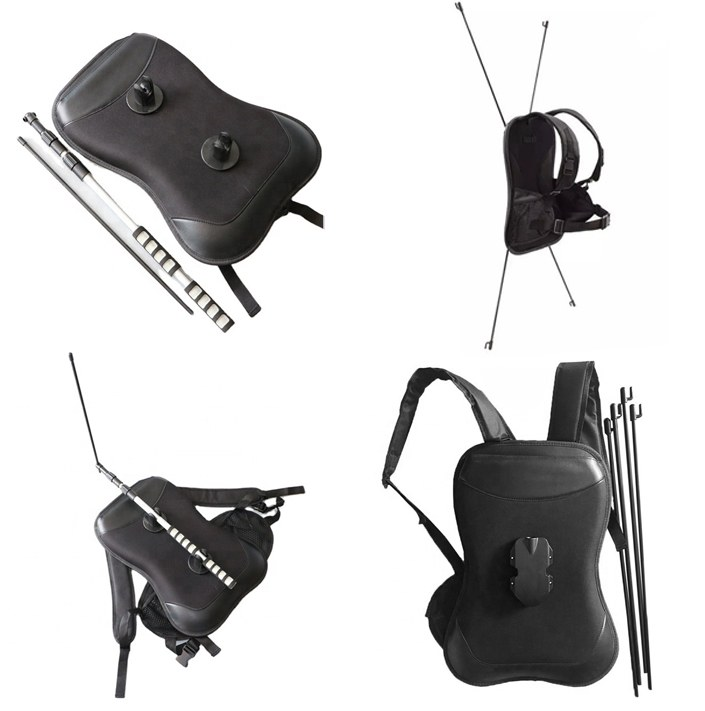
Four views of one wearable banner kit: the padded backboard with its dual sockets, the pole sleeved into the rear pocket, the harness worn loaded, and the pole sections packed alongside. Everything a human billboard needs ships in one carton — which is why the category travels to event sites as cheaply as it does.
Buyer reference for a walking billboard: the specification that survives a full shift
Run through any supplier's catalogue for the wearable banner and the same specification points decide whether a backpack banner order is right or wrong. They are worth reading in full even for a repeat order of wearable flags, because almost every field complaint about a wearable banner traces back to one of them.
- Harness construction of the backpack flag: a contoured padding panel moulded to the back, mesh airflow backing, adjustable shoulder straps with sternum strap and waist belt. A flat-foam harness is the first corner cut in a cheap backpack flag, and the wearer feels it inside two hours.
- Socket configuration on a human billboard: two receiving sockets — one vertical, one angled — so one flag backpack serves corridor duty and crowd-duty on the same shift. Confirm the sockets of the wearable banner are bonded through the panel, not glued.
- Pole specification of the backpack banner: telescoping aluminum sections with CNC-chamfered ends, a nylon tip at the flag interface, and a sponge grip at the hand position. Check the extended height of a wearable flag clears head height with the flag mounted, and that the sections lock positively at full extension.
- Rear stowage on a flag backpack: a pocket on the harness panel that holds the pole sections during breaks, because a human billboard whose pole lives against a wall loses sections by the end of the season.
- Graphic family: teardrop backpack flag for tensioned, wind-stable visibility above a moving crowd; rectangle body banner on the curved spreader rod for message density at reading height. Quote both shapes of the wearable banner; deploy by crowd speed.
- Print method for a wearable flag: dye-sublimated polyester, hemmed, with a pole sleeve or corner fixings as the shape requires. Single-sided with a mirror reverse is standard on a backpack flag; specify true double-sided print on the human directional sign where the route turns and both faces get read.
- Weight discipline: the loaded backpack banner should stay light enough that the wearer forgets it — fabric grams, aluminum sections, one padding panel. Ask for the packed weight of a wearable banner per kit, because it drives both the shift and the freight.
- Spare parts for the flag backpack: replacement pole sections, socket knobs and spare flags are the running cost of a wearable banner; a supplier who ships spares separately turns a two-dollar repair into a non-event.
- Colour consistency: hold one harness colour across the walking billboard fleet and let the printed flags carry the brands, because mismatched harnesses on a human directional sign team photograph badly and wear unevenly.
- Carton and kit data for the backpack banner: kits per carton, packed dimensions and carry-bag inclusion decide the landed cost of a backpack banner order as much as the unit price does.
Eight questions before the first wearable banner order
Institutions and activation agencies buy a backpack flag differently from a single venue, but the process worth copying is the same at any volume: settle eight questions about the wearable banner in order, because each answer constrains the next. Worked through honestly, the list converts 'we need some walking signs' into a quotable line item for a wearable banner order.
- How long is the shift? Four hours or more demands the contoured harness, the sternum strap and the waist belt — the full ergonomic package of a professional backpack flag, and the line that separates a wearable banner from a costume.
- How fast does the crowd move? Fast crowds take the teardrop wearable flag; slow, browsing crowds take the rectangle body banner; mixed routes take one of each.
- What does the print on a human billboard need to say? One brand and an arrow fits a teardrop; headline, offer and sponsors fit the body banner rectangle.
- Will the crowd see both faces of the backpack banner? Straight routes forgive a mirror reverse; turning routes justify true double-sided print on the human billboard.
- Who carries it, and for how many hours? The socket angle, the grip position and the packed weight of the flag backpack all follow from the shift length.
- What does the venue or council permit? Most public-ground permits treat a worn human directional sign differently from a placed one — the core advantage of a human directional sign on public ground — but confirm it in the permit language.
- How many wearers in the team? The two-wearer pattern — body banner in the queue, teardrop at the junction — is the smallest team that covers a corner, and the smallest walking billboard team worth briefing.
- What spares travel in the kit box? One spare pole section and one spare flag per five kits keeps a walking billboard team on the pavement instead of in the van.
The three buying mistakes on a backpack flag, and what each one costs
Three mistakes recur in the wearable banner category, and all three are visible only after the first shift in a backpack flag — which is what makes them worth naming before the order instead.
- Buying on the photograph of a backpack banner. Every harness looks padded and every pole looks straight in a product image. The difference is in the panel contour, the socket bonding and the pole locks, none of which photograph — which is why a sample, worn for a full shift by a real staff member, is the correct basis for a first order of a backpack flag.
- Buying on the unit price of a backpack flag. A wearable banner quoted ten per cent lower usually carries flat foam instead of contoured padding, glued instead of bonded sockets, and a lighter pole — and a human billboard that fails in month two of a season-long activation is not ten per cent cheaper; it is a replacement order plus a staffing gap on the day that mattered.
- Buying without the spare-parts line. Pole sections, socket knobs and replacement flags are the running cost of a human billboard fleet; a supplier who cannot ship a single replacement section turns a two-dollar repair into a grounded team.
MOQ, proofs and freight for the wearable banner
The order mechanics of a wearable banner are friendlier than most buyers expect. Minimum order quantity is typically one piece, which makes the backpack banner unusually easy to trial: a distributor can order a single backpack banner, print one flag, and put a real staff member on a real pavement for an afternoon before committing to volume. Tooling already exists for the standard harness and pole of the wearable flag, so there is no mould cost on a catalogue model. Where customisation is required — a branded harness print, a special flag shape, a double-sided rectangle for a body banner, a non-standard height — sampling is quoted separately and the sample normally ships in one to three days from confirmation, with electronic proofs of the backpack banner artwork before that. Goods, and every wearable flag in the order, move on EXW or FOB terms from Guangzhou, Shenzhen or Foshan depending on the routing, and by express, air or sea depending on the deadline. The timing rule for the wearable banner runs in reverse of most display products: because a wearable banner is light and compact, air freight on a small team's kit is affordable right up to the week before the event, but sea freight on a season's fleet of human directional signs — cheer stations for a marathon, street teams for a holiday quarter — needs booking as soon as the event calendar confirms, and a buyer who waits for the permit to clear is buying freight at peak, while a backpack flag booked in September travels for very little.
The quarter in one paragraph
Between 31 October and 28 November 2026, four unrelated audiences will be in motion on foot, and four orders for the same wearable banner: two million marathon spectators along a fifty-year-old course, greeted by a backpack flag at every cheer station, Halloween families working the high street after dark behind a human directional sign, Diwali crowds browsing the festival fortnight past a walking billboard in every doorway, and the Black Friday and Small Business Saturday shoppers every independent retailer has waited all year for, each of them passed by a body banner. None of those crowds will stand still long enough to meet a fixed sign twice, but all of them will meet a wearable banner many times. A staff member in a backpack banner meets all of them, continuously, for the price of one harness, one pole and one printed wearable flag — a human directional sign that packs into a carton, assembles in a minute, clears the crowd at pole height, and walks the exact route the customer walks, which is the final argument for the human billboard. That is the whole argument of the backpack banner, and it is why the human billboard remains the quiet volume business of every Guangdong display line whenever the calendar promises a crowd in motion, and a wearable flag is the only sign that moves with it.