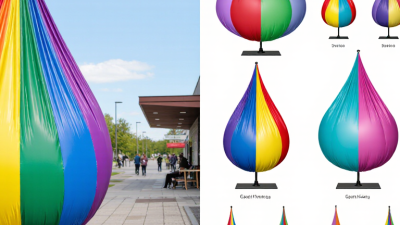
Teardrop banners are pretty popular, and honestly, it’s easy to see why. They don’t take up a ton of space, but they still get your message out there. That curved shape helps them rise above the crowd, so people can spot your booth, storefront, or event entrance from way off. Plus, the whole setup is lightweight—pole and fabric flag—so you can carry it from one location to another without breaking a sweat. And when it’s time to set it down, a ground base or weighted stand keeps it right where you put it. Honestly, setup is usually pretty simple. And that’s a big deal, especially when event teams are juggling a ton of tasks and barely have any time to spare.
Let’s be honest—teardrop banners aren’t for everyone, but they’re pretty handy in the right setting. Outdoor markets, sports events, retail promos? If people are walking by fast, they can work really well. Big logo, a few words you can actually read—that beats a cluttered design any day. The fabric does flutter in the wind, which is kind of nice visually, but it can make small text tough to catch. And the final result? It depends on a bunch of things: weather, the surface, how well it’s printed, even the base you choose. So yeah, the little details count.
In this article, I want to dig into why banners are still such a familiar pick, how their design actually helps them stand out, and what you should think about before ordering one. I'll also touch on some common limitations—like the fact that print space is pretty limited, and you need to choose a base that works for your specific setting. A banner isn't a full marketing plan, obviously. But when you give real thought to its size, message, and placement, it can be a clear visual marker without taking over the whole space. Okay, real talk: you can dress something up so it looks amazing, but if the actual message is muddled? That pretty exterior isn't going to save you.
What Defines a Teardrop Banner?
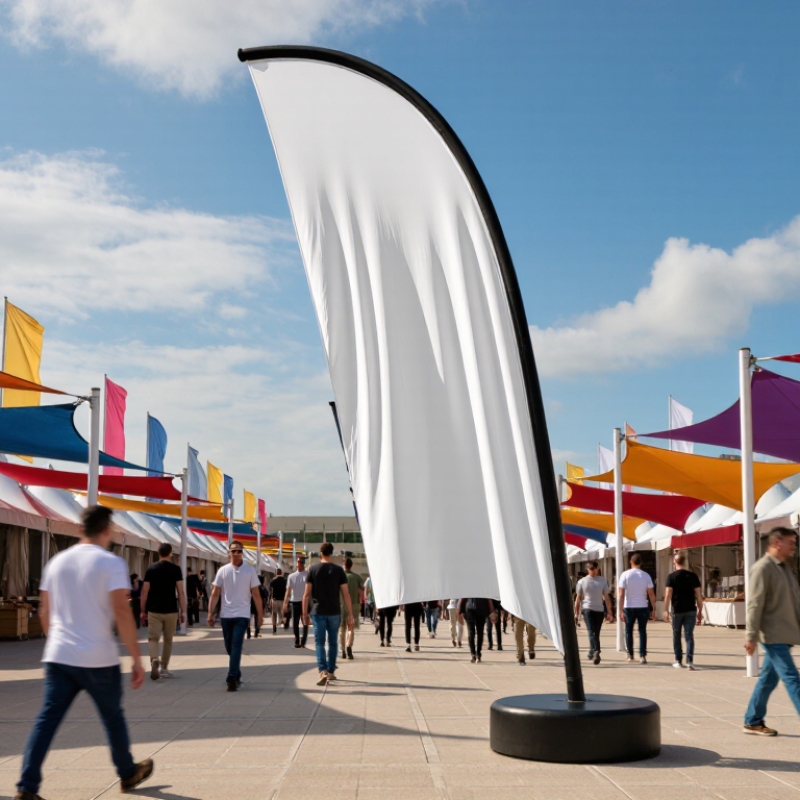
A teardrop banner is a tall, fabric display with a curved top and a tapered lower end. Its outline resembles a water droplet, giving it a distinctive profile beside entrances, walkways, and event spaces. A flexible pole runs through a sewn fabric sleeve, holding the material in shape. The bottom attaches to a base, which may be chosen for indoor floors or outdoor ground.
The curved form is more than decoration. Fabric tension helps the printed panel stay open, while the narrow lower section gives the banner its characteristic silhouette. Exact shapes vary by construction, so the finished outline may look fuller or slimmer than expected. Check the product dimensions and setup instructions before choosing a location. Small details matter.
Teardrop banners are popular partly because they are lightweight and relatively quick to assemble. Their vertical shape can stand out without taking up much ground space. Still, they are not equally readable from every angle. Text near the curved edge may distort, and gusts can shift a lightweight base. That trade-off is easy to overlook. Clear, large lettering and a suitable base usually make the display more practical.
How Its Shape and Structure Work
Why Are Teardrop Banners So Popular?
A teardrop banner gets its recognizable outline from a curved pole and fabric pulled tight around it. The rounded top gives the flag a broad area for large lettering. Its tapered end helps maintain tension instead of flapping loosely like a rectangle. From a few steps away, that clean silhouette is easy to spot. Small details matter.
The shape also affects wind loading. The American Society of Civil Engineers’ ASCE 7 standard gives a basic velocity-pressure equation of q = 0.00256V² pounds per square foot, with wind speed measured in miles per hour. At 20 mph, that equals about 1.0 psf before exposure and other design factors. This is not a banner safety rating; fabric area, pole stiffness, base weight, and gusts still matter. A lightweight base on a smooth floor can shift. Not a magic shield.
Industry demand helps explain their visibility, but does not prove one banner shape is best. The Out of Home Advertising Association of America reported U.S. outdoor advertising revenue of $9.1 billion in 2023, up 11.5% year over year. That growth reflects a broad market, not teardrop banners alone. Their practical appeal is simpler: a compact footprint, a tall display surface, and a shape that stays recognizable when fabric moves. Even so, the shape can twist or crease if its pole and sleeve do not match. A useful reminder: construction matters as much as the outline.
What Makes Teardrop Banners Easy to Use
Teardrop banners are popular partly because setup is straightforward. A flexible pole slides into a fabric sleeve, then attaches to a ground spike or weighted base. The curved frame holds the fabric open, keeping the design readable without constant adjustment. No complicated hardware. For a small event team, that can mean less time unpacking and more time helping visitors.
Their portability is useful, too. Pole sections usually separate for storage, while the fabric folds into a carry bag. One person can often move the kit between an entrance, sidewalk, or indoor booth. Teardrop Flags And Banners also take up less floor space than many rigid display boards. Check the setup area first: a spike needs suitable ground, while hard surfaces call for a stable base. Wind still matters. A banner can shift or tip if its base is too light.
Easy setup does not mean no maintenance. Before an event, check that the pole joints fit securely and the sleeve has no tears. Fabric can twist if it is threaded unevenly, which is a small but frustrating mistake. The shape also limits how much text fits, so a short message is usually clearer than a crowded design.
How Their Design Attracts Attention
A Teardrop Flag draws attention with a tall, tapered silhouette that stands apart from rectangular signs. Its curved edge creates movement, even when the fabric is still. The narrow top and broad lower section also give designers a clear space for a short message. In a crowded entrance, contrast matters. Use large lettering, strong color separation, and one main idea. Small details matter.
A 2017 Nielsen report commissioned by the Outdoor Advertising Association of America found that 46% of U.S. adults had used a search engine after seeing an out-of-home advertisement. That figure is not specific to flags, but it shows how visible outdoor messages can prompt follow-up. The same association reported U.S. out-of-home advertising revenue of $9.1 billion in 2023, up 2.1% from 2022. This industry-wide growth reflects continued investment, not proof that any single display will succeed. At eye level, a clean logo-free message and a few readable words are often more useful than dense copy. Keep it simple. Still, wind, viewing distance, and background clutter can weaken the effect; placement deserves as much thought as the flag’s shape.
Why Are Teardrop Banners So Popular? – How Their Design Attracts Attention
| Design Dimension |
Typical Feature |
How It Attracts Attention |
Best Use |
| Distinctive silhouette |
A tall, curved flag shape narrows toward the bottom and is held in form by a supporting pole. |
The unusual outline stands apart from rectangular signs and helps people spot the display from a distance. |
Entrances, sidewalks, and event areas |
| Vertical format |
The long, upright layout provides a narrow area for a short headline, logo-free graphic, or directional message. |
Its height places the message above many objects at ground level, while the compact width makes it easy to notice in a row of displays. |
Queues, storefronts, and exhibition spaces |
| Fabric movement |
Lightweight flag fabric can move when there is a breeze; the amount of movement depends on the fabric, pole, and conditions. |
Motion can draw the eye toward the banner, especially in otherwise static surroundings. |
Outdoor events and open pedestrian areas |
| Print visibility |
Designs commonly use large lettering, simple graphics, and strong contrast. Printing and visibility on the reverse side depend on the banner construction. |
Clear, high-contrast artwork is easier to recognize quickly than small text or crowded layouts. |
Short promotional messages and wayfinding |
| Flexible placement |
Many systems use a pole with a ground stake for soft ground or a separate base for hard surfaces; available fittings vary. |
The banner can be positioned close to a pathway or entrance where passing visitors are likely to see it. |
Trade shows, retail entrances, and outdoor gatherings |
| Portable construction |
Many models separate into pole sections and pack with the fabric, though packed size and setup method vary by product. |
Convenient transport makes it practical to reuse the display at different locations and events. |
Mobile promotions and recurring events |
| Outdoor suitability |
Outdoor use depends on the banner material, base, setup, and weather. Strong wind can make a flag difficult or unsafe to use. |
A moving flag can be conspicuous in suitable conditions, but stable placement and weather awareness are essential. |
Use only in conditions supported by the product instructions |
Where Teardrop Banners Are Commonly Used
Teardrop Banner Flags are commonly placed where people need a quick visual cue: outside retail entrances, at exhibition booths, beside event registration desks, and along sports-field walkways. Their curved shape stays readable from a distance, while a narrow base can fit near a doorway or curb. At a busy market, one flag can mark the check-in point without taking up a table. Small detail, real help. They also appear at campuses, open houses, and community events, where visitors may be unfamiliar with the site. Keep them clear of door swings, accessible routes, and vehicle sightlines.
Outdoor visibility is a substantial advertising category. The Outdoor Advertising Association of America reported $9.1 billion in U.S. out-of-home advertising revenue for 2023. That figure covers many formats, not teardrop flags specifically, so it should not be treated as proof that one flag drives attendance. It does show why physical signage remains part of public-facing promotion. In practice, wind, crowd flow, and viewing distance matter as much as artwork. A flag hidden behind a queue is wasted space. And placement is not always perfect; organizers sometimes choose a spot for convenience, then discover people approach from the opposite direction. Check the site from a visitor’s eye level before setting it up.
Why Businesses Choose Teardrop Banners
Businesses choose teardrop banners because they make a message visible without taking up much floor space. Their tall, curved shape stands out beside a shop entrance, at a weekend market, or near a registration table. A single banner can show a short offer or help visitors find the right doorway. Setup is usually straightforward, and the fabric can be packed away between events. That matters outdoors. Still, no banner is effortless: strong gusts can make it twist or become difficult to read.
Tips: Keep the headline brief and use strong contrast. Check that the text remains readable from several steps away. With Teardrop Banner Design, place key information away from tight curves and fabric edges, where it may distort.
Businesses also value the format because it is easy to move between locations. A lightweight frame can suit a small storefront one day and a community event the next. Before ordering, measure the display area and check the base options for the surface. A banner that looks impressive in a product photo may feel oversized in a narrow hallway. It’s worth testing the layout at full scale; small text often looks fine on a screen, then disappoints in person.
What to Consider When Selecting One
A teardrop banner earns attention through its curved silhouette and tall, uninterrupted graphic area. That shape can stay recognizable beside busy entrances, market stalls, or race routes. A 2012 U.S. retail-signage survey reported that 76% of respondents had entered a store they had not visited before because its sign caught their attention. The finding concerns signage generally, not teardrop banners specifically, but it highlights why visibility matters.
Start with placement, not color. Measure the viewing distance, doorway width, and available floor space; a banner that blocks a path is a poor choice. Check the assembled height and printed area, then use large lettering and strong contrast. Keep essential wording away from the narrow tip, where it may be harder to read. Simple wins.
Next, match the base and fabric to the setting. A cross base suits many indoor floors, while soft ground may need a stake. Outdoors, ask the supplier for wind guidance; no lightweight banner is immune to gusts. Confirm whether the pole, base, and carry bag are included, and whether the fabric can be replaced separately. I’d also check the print from several steps away before approving it. Small text often looks fine on a screen and disappoints in the real world.
Conclusion
Teardrop Banners are lightweight display signs named for their distinctive curved, droplet-like shape. A flexible pole supports the fabric, keeping it stretched into a clear, recognizable form. Their structure is designed for straightforward setup and takedown, and many versions can be packed into a carrying case for transport. Depending on the base and materials, they can be used in different settings, including indoor venues and outdoor events.
Their tall profile and broad printed surface help attract attention from a distance, making Teardrop Banners useful for pointing out entrances, sharing event information, or highlighting a business or service. They are commonly seen at exhibitions, markets, sporting events, and storefronts. When choosing one, consider its size, print area, fabric and pole durability, base type, portability, and intended location. Matching these practical details to the display environment can help ensure the banner is easy to use, visible, and suitable for repeated use.